
油气藏评价与开发 ›› 2026, Vol. 16 ›› Issue (1): 141-152.doi: 10.13809/j.cnki.cn32-1825/te.2025357
李经纬1,2( ), 彭勃1,2(), 王泽滕1,2, 陈晓倩1,2, 张正昊1,2, 刘金栋1,2, 刘双星3, 李晓枫4
收稿日期:2025-07-29
发布日期:2026-01-06
出版日期:2026-01-26
通讯作者:
彭勃(1969—),男,博士,教授,主要从事碳捕集、利用与封存和油气田化学与工程研究。地址:北京市昌平区府学路18号,邮政编码:102249。E-mail:cbopeng@cup.edu.cn作者简介:李经纬(1994—),男,在读博士研究生,主要从事分子模拟及CO2封存潜力评估研究。地址:北京市昌平区府学路18号,邮政编码:102249。E-mail:long-lat-itude@outlook.com
基金资助:
LI Jingwei1,2(), PENG Bo1,2(), WANG Zeteng1,2, CHEN Xiaoqian1,2, ZHANG Zhenghao1,2, LIU Jindong1,2, LIU Shuangxing3, LI Xiaofeng4
Received:2025-07-29
Online:2026-01-06
Published:2026-01-26
摘要:
CO2地质封存潜力的定量计算是前期封存选址适宜性评估和后期量化核查的重要组成部分。油气藏作为封存的优选地质体,兼具提高采收率经济效益与CO2封存环境效益。其中,具有良好圈闭结构的常规(枯竭)油气藏是经典碳封存潜力评估模型发展和应用的基础。而针对不同油藏条件、项目不同阶段场景以及充分考虑各种封存机制贡献的潜力评估模型仍需进一步更新。系统综述了油气藏CO2封存机制及封存潜力的评估方法,并对模型的发展历程与应用实践进行分析总结。在封存机制方面,油藏以构造封存、残余封存、溶解封存和矿化封存为主;气藏则依赖压力补充、竞争吸附和重力分异协同作用。该研究梳理了20种主流潜力评估模型,根据模型基本原理将其划分为考虑地质储量与采收率、考虑封存可用储层孔隙空间、原始模型改进与拓展、新角度与新方法4个阶段。目前,模型仍以构造和残余封存为出发点,仅少数量化溶解与矿化贡献;输入参数精细化与不确定性量化成发展趋势;混相压力预测、溶解度计算、矿化反应动力学和气体竞争吸附的时空间演化机制仍需进一步探究。未来需耦合地质监测数据与人工智能技术并开发轻量化评估工具,支撑场地级工程决策,推动封存潜力评估从“理论可行”迈向“工程落地”。
中图分类号:
LI Jingwei,PENG Bo,WANG Zeteng, et al. CO2 storage potential assessment models and their practical progress in oil and gas reservoirs[J]. Petroleum Reservoir Evaluation and Development, 2026, 16(1): 141-152.
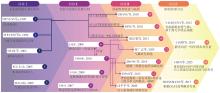
图1
油气藏封存潜力评估方法发展历程示意图[6,14,18-38]注:ECL Tech.为英国能源承包商科技公司;IEAGHG为国际能源署温室气体研究与开发计划机构;USDOE为美国能源部;CGSS为CO2地质封存解决方案;USGS为美国地质调查局。"
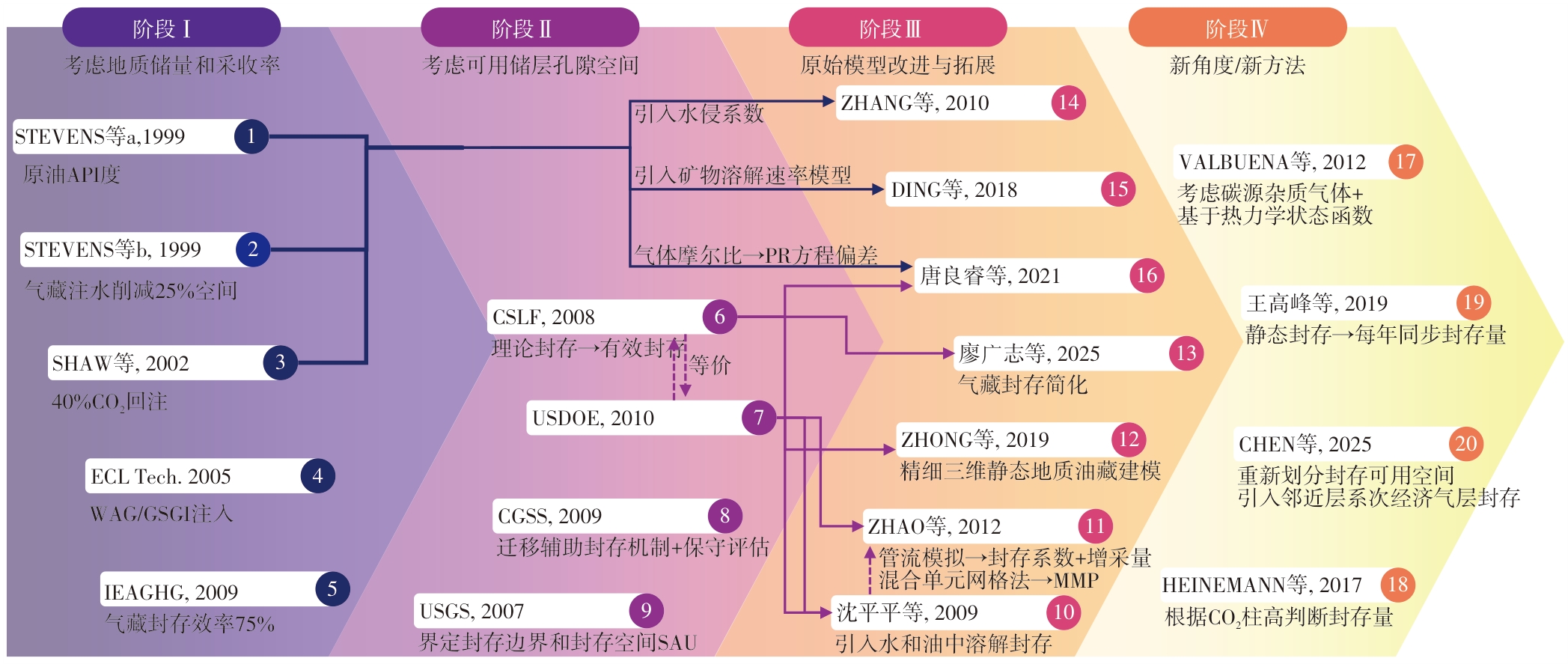

表1
基于物质平衡法的封存潜力评估模型汇总[18-22]"
| 模型编号 | 计算原理 | 参数含义 |
|---|---|---|
| 1 | 驱油情景: 废弃情景: | |
| 2 | ||
| 3 | CO2突破: 注入HCPV: | |
| 4 | WAG: GSGI: | |
| 5 |
表2
基于有效容积法的封存潜力评估模型汇总[6, 23-26]"
| 模型编号 | 计算原理 | 参数含义 |
|---|---|---|
| 6 | 气藏: 油藏: | |
| 7 | ||
| 8 | ||
| 9 |
表3
基于有效容积理论和物质平衡理论的改进和拓展模型汇总[14, 27-34]"
| 模型编号 | 计算原理 | 参数含义 |
|---|---|---|
| 10 | $\begin{array}{c} M_{\mathrm{t}}=\frac{\rho_{\mathrm{res}, \mathrm{CO}_{2}}}{10^{9}}\left[E_{\mathrm{Rb}} A h \varphi\left(1-S_{\mathrm{wi}}\right)-V_{\mathrm{iw}}+V_{\mathrm{pw}}+\right. \\ \left.S_{\mathrm{W}, \mathrm{CO}_{2}}\left(A h \varphi S_{\mathrm{wi}}+V_{\mathrm{iw}}-V_{\mathrm{pw}}\right)+S_{\mathrm{O}, \mathrm{CO}_{2}}\left(1-E_{\mathrm{Rb}}\right) A h \varphi\left(1-S_{\mathrm{wi}}\right)\right] \\ M_{\mathrm{t}}=\frac{\rho_{\mathrm{res}, \mathrm{CO}_{2}}}{10^{9}}\left[\left(0.4 E_{\mathrm{Rb}}+0.6 E_{\mathrm{Rh}}\right) A h \varphi\left(1-\mathrm{S}_{\mathrm{wi}}\right)-V_{\mathrm{iw}}+V_{\mathrm{pw}}+\right. \\ \left.S_{\mathrm{W}, \mathrm{CO}_{2}}\left(A h \varphi S_{\mathrm{wi}}+V_{\mathrm{iw}}-V_{\mathrm{pw}}\right)+S_{\mathrm{O}, \mathrm{CO}_{2}}\left(1-0.4 E_{\mathrm{Rb}}-0.6 E_{\mathrm{Rh}}\right) A h \varphi\left(1-S_{\mathrm{wi}}\right)\right] \end{array}$ | |
| 11 | ||
| 12 | $M_{\mathrm{CO}_{2}}=\left(\sum_{i=1}^{n} A_{i} h_{i} \varphi_{i}\right)\left(1-S_{\mathrm{w}}\right) B_{\mathrm{f}} \rho_{\mathrm{res}, \mathrm{CO}_{2}} E_{\mathrm{S}}$ | |
| 13 | ||
| 14 | ||
| 15 | $\begin{array}{c} M_{\mathrm{co}_{2}, \mathrm{oil}}=\left(V_{\mathrm{OOIP}} / \rho_{\mathrm{res}, \mathrm{CO}_{2}}\right) B_{\mathrm{f}}\left(1-R_{\mathrm{f}}\right) C_{\mathrm{co}_{2}, \mathrm{oil}} m_{\mathrm{co}_{2}} \\ M_{\mathrm{co}_{2}, \mathrm{w}}=\left(V_{\mathrm{OOIP}} / \rho_{\mathrm{res}, \mathrm{CO}_{2}}\right) B_{\mathrm{f}} / S_{\mathrm{oi}} S_{\mathrm{w}} \rho_{\mathrm{w}} w_{\mathrm{f}, \mathrm{co}_{2}} / 10^{7} \\ M_{\mathrm{co}_{2}, \mathrm{~m}}=\sum_{j=1}^{n}\left(3.1536 r_{j} m_{\mathrm{co}_{2}} \times 10^{-5}\right) t \end{array}$ | |
| 16 |
表4
考虑新分类和新计算原理的封存潜力评估模型汇总[35-38]"
| 模型 | 计算原理 | 参数含义 |
|---|---|---|
| 17 | $\begin{array}{c} M_{\mathrm{HCPV}}=V_{n_{\mathrm{dep}}}+\int_{n_{\mathrm{dep}}}^{n_{\mathrm{dep}}+\Delta n_{\mathrm{Gi}}} \bar{V}_{\mathrm{x}} \mathrm{~d} n_{\mathrm{dep}} \end{array}$ | |
| 18 | $\begin{array}{c} p_{\mathrm{c}}=\Delta \rho g H \\ p_{\mathrm{t}}=\gamma \cos \theta / R \\ p_{\mathrm{chc}}=\Delta \rho_{\mathrm{hc}} g H_{\mathrm{hc}} \\ H_{\mathrm{CO}_{2}}=\frac{p_{\mathrm{chc}} M}{\Delta \rho_{\mathrm{CO}_{2}} g} \end{array}$ | |
| 19 | $\begin{array}{c} M_{\mathrm{tb}, \mathrm{CO}_{2}}=\sum_{k=1}^{n} Q_{\mathrm{og}, k}\left[S_{\mathrm{c}, \mathrm{o}}-\frac{\rho_{\mathrm{g}, \mathrm{surf}}}{1000}\left(G_{\mathrm{OR}}-R_{\mathrm{si}}\right)\right] \end{array}$ | |
| 20 |
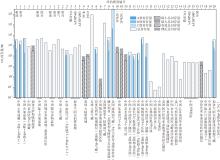
图2
油气藏CO2封存潜力评估实例汇总[20,22,25-33,35-59]"

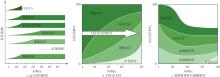
图3
封存机制贡献的时间依赖性"

图4
CO2封存潜力评估模型特征分类平行坐标[6,14,18-38]"
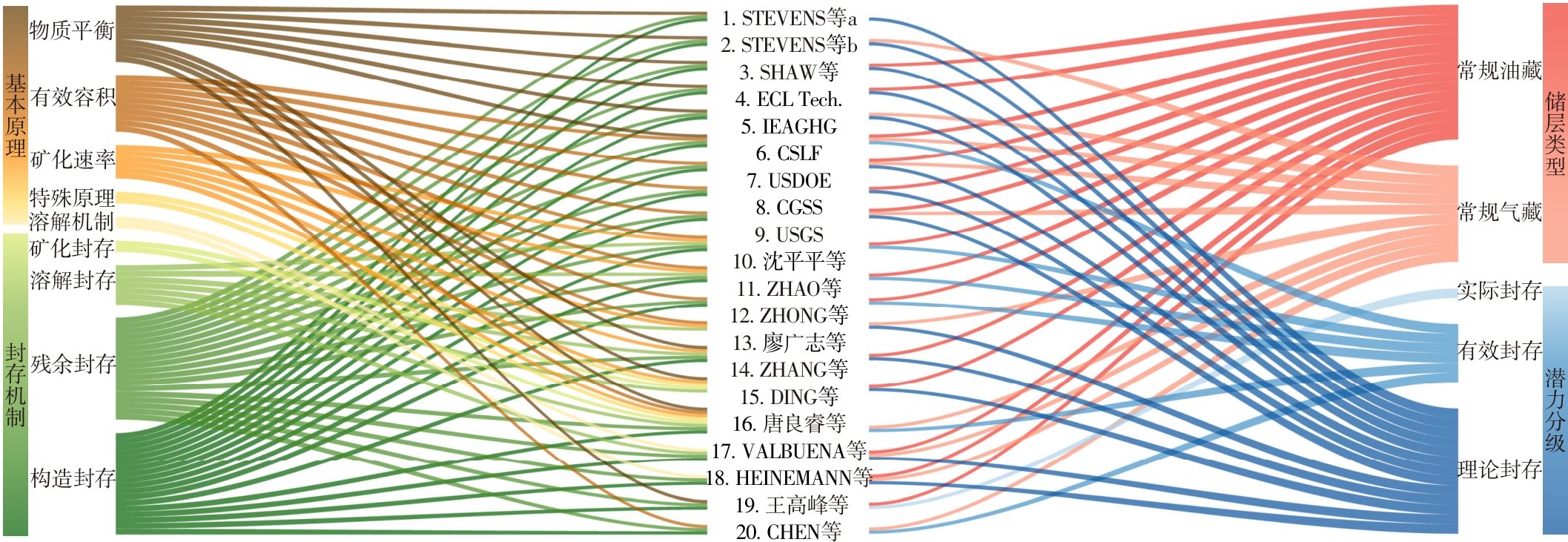
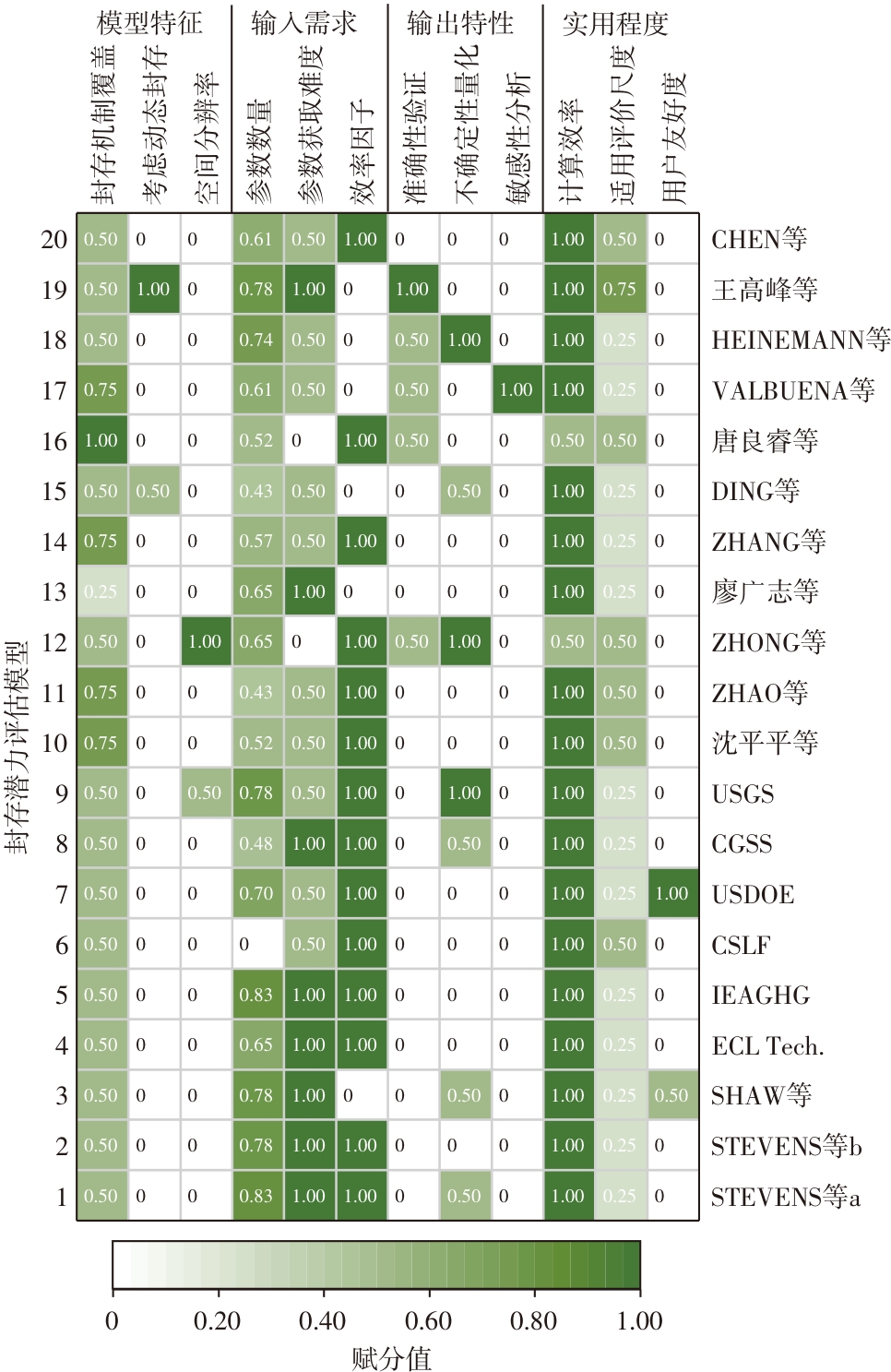
图5
封存潜力评估模型赋分网格"
| [1] | LEE H, CALVIN K, DASGUPTA D, et al. Climate change 2023: Synthesis report, summary for policymakers. Contribution of working groups Ⅰ, Ⅱ and Ⅲ to the sixth assessment report of the intergovernmental panel on climate change[R]. Geneva: IPCC, 2023. |
| [2] | IEA. World Energy Outlook 2024[R/OL]. Paris: IEA, 2024. . |
| [3] | 张贤, 杨晓亮, 鲁玺, 等. 中国二氧化碳捕集利用与封存(CCUS)年度报告(2023)[R]. 北京: 中国21世纪议程管理中心,全球碳捕集与封存研究院,清华大学, 2023. |
| ZHANG Xian, YANG Xiaoliang, LU Xi, et al. China Carbon dioxide capture, utilization and storage (CCUS) Annual report (2023)[R]. Beijing: China Agenda 21 Management Center, Global Carbon Capture and Storage Research Institute, Tsinghua University, 2023. | |
| [4] | 中国人民银行金融监管总局中国证监会关于印发《绿色金融支持项目目录(2025年版)》的通知[EB/OL]. (2025-07-14)[2025-07-22]. . |
| Notice of the People’s Bank of China, the State Administration of Financial Regulation, and the China Securities Regulatory Commission on Issuing the “Catalogue of Green Finance Supported Projects (2025 Edition)”[EB/OL].(2025-07-14)[2025-07-22]. . | |
| [5] | 包琦, 叶航, 刘琦, 等. 不同地质体中CO2封存研究进展[J]. 低碳化学与化工, 2024, 49(3): 87-96. |
| BAO Qi, YE Hang, LIU Qi, et al. Research progress on CO2 storage in different geological formations[J]. Low-Carbon Chemistry and Chemical Engineering, 2024, 49(3): 87-96. | |
| [6] | BACHU S. Comparison between Methodologies Recommended for Estimation of CO2 Storage Capacity in Geological Media by the CSLF Task Force on CO2 Storage Capacity Estimation and the USDOE Capacity and Fairways Subgroup of the Regional Carbon Sequestration Partnerships Program[R]. Cape Town: CSLF, 2008. |
| [7] | 刘廷, 马鑫, 刁玉杰, 等. 国内外CO2地质封存潜力评价方法研究现状[J]. 中国地质调查, 2021, 8(4): 101-108. |
| LIU Ting, MA Xin, DIAO Yujie, et al. Research status of CO2 geological storage potential evaluation methods at home and abroad[J]. Geological Survey of China, 2021, 8(4): 101-108. | |
| [8] | 滕莹, 李佳洁, 刘颖, 等. 离岸CO2地质封存适宜性评价与源汇匹配研究进展[J]. 华南师范大学学报(自然科学版), 2025, 57(1): 100-112. |
| TENG Ying, LI Jiajie, LIU Ying, et al. Research progress in offshore CO2 geological sequestration: Suitability evaluation and source-sink matching[J]. Journal of South China Normal University (Natural Science Edition), 2025, 57(1): 100-112. | |
| [9] | 曹成, 陈星宇, 张烈辉, 等. 气藏注CO2提高采收率及封存评价方法研究进展[J]. 科学技术与工程, 2024, 24(18): 7463-7475. |
| CAO Cheng, CHEN Xingyu, ZHANG Liehui, et al. Review of gas reservoir CO2 injection for enhanced recovery and sequest ration evaluation methods[J]. Science Technology and Engineering, 2024, 24(18): 7463-7475. | |
| [10] | 姚红生, 邱伟生, 周德华, 等. 苏北盆地复杂断块油藏CCUS-EOR关键技术与实践[J]. 天然气工业, 2025, 45(9): 212-222. |
| YAO Hongsheng, QIU Weisheng, ZHOU Dehua, et al. Key technologies and practices of CCUS-EOR in complex fault-block reservoirs in the Subei Basin[J]. Natural Gas Industry, 2025, 45(9): 212-222. | |
| [11] | 李文平, 曹丹平, 乔伟, 等. 深部碳储空间探测与地质评价关键技术[J]. 煤炭学报, 2025, 50(5): 2333-2354. |
| LI Wenping, CAO Danping, QIAO Wei, et al. Key technologies for exploration and geological evaluation of deep carbon storage spaces[J]. Journal of China Coal Society, 2025, 50(5): 2333-2354. | |
| [12] | 孙腾民, 刘世奇, 汪涛. 中国二氧化碳地质封存潜力评价研究进展[J]. 煤炭科学技术, 2021, 49(11): 10-20. |
| SUN Tengmin, LIU Shiqi, WANG Tao. Research advances on evaluation of CO2 geological storage potential in China[J]. Coal Science and Technology, 2021, 49(11): 10-20. | |
| [13] | 叶航, 刘琦, 彭勃. 基于二氧化碳驱油技术的碳封存潜力评估研究进展[J]. 洁净煤技术, 2021, 27(2): 107-116. |
| YE Hang, LIU Qi, PENG Bo. Research progress in evaluation of carbon storage potential based on CO2 flooding technology[J]. Clean Coal Technology, 2021, 27( 2) : 107-116. | |
| [14] | 廖广志, 何新兴, 位云生, 等. 探索CCUS-EGR进攻性提高采收率新技术拓展天然气藏储碳新领域[J]. 石油科技论坛, 2025, 44(1): 9-16. |
| LIAO Guangzhi, HE Xinxing, WEI Yunsheng, et al. Exploring CCUS-EGR new technology to aggressively improve natural gas recovery and expand the new field of underground carbon storage in gas reservoirs[J]. Petroleum Science and Technology Forum, 2025, 44(1): 9-16. | |
| [15] | HAMZA A, HUSSEIN I A, AL-MARRI M J, et al. CO2 enhanced gas recovery and sequestration in depleted gas reservoirs: A review[J]. Journal of Petroleum Science and Engineering, 2021, 196: 107685. |
| [16] | ZHONG Z Q, CHEN Y Q, FU M Y, et al. Role of CO2 geological storage in China's pledge to carbon peak by 2030 and carbon neutrality by 2060[J]. Energy, 2023, 272: 127165. |
| [17] | RUI Z H, LIU T T, WEN X, et al. Investigating the Synergistic Impact of CCUS-EOR[J]. Engineering, 2025, 48(5): 16-40. |
| [18] | STEVENS S H, KUUSKRAA V A, TABER J. Sequestration of CO2 in depleted oil and gas fields: Barriers to overcome in implementation of CO2 capture and storage (disused oil and gas fields)[R]. Report for the IEA Greenhouse Gas Research and Development Programme (PH3/22), 1999. |
| [19] | CHRISTENSEN N P, HOLLOWAY S. Geological storage of CO2 from combustion of fossil fuel[R]. GESTCO, 2004. |
| [20] | SHAW J C, BACHU S. Screening, Evaluation, and ranking of oil reservoirs suitable for CO2-flood EOR and carbon dioxide sequestration[J]. Journal of Canadian Petroleum Technology, 2002, 41(9): 51-61. |
| [21] | GOZALPOUR F, REN S R, TOHIDI B. CO2 EOR and storage in oil reservoirs[J] Oil & Gas Science and Technology-Revue. 2005, 60(3): 537-546. |
| [22] | IEAGHG. CO2 storage in depleted gas fields[R]. IEAGHG, 2009. |
| [23] | GOODMAN A, HAKALA A, BROMHAL G, et al. U.S. DOE methodology for the development of geologic storage potential for carbon dioxide at the national and regional scale[J]. International Journal of Greenhouse Gas Control, 2011, 5(4): 952-965. |
| [24] | BRADSHAW J, ALLINSON G, BRADSHAW B E, et al. Australia's CO2 geological storage potential and matching of emission sources to potential sinks[J]. Energy, 2004, 29: 1623-1631. |
| [25] | POPOVA O H, SMALL M J, MCCOY S T, et al. Comparative analysis of carbon dioxide storage resource assessment methodologies[J]. Environmental Geosciences, 2012, 19(3): 105-124. |
| [26] | JEWELL S, KIMBALL S. National Assessment of Geologic Carbon Dioxide Storage Resources-Results[R]. Reston: USGS, 2013. |
| [27] | 沈平平, 廖新维, 刘庆杰. 二氧化碳在油藏中埋存量计算方法[J]. 石油勘探与开发, 2009, 36(2): 216-220. |
| SHEN Pingping, LIAO Xinwei, LIU Qingjie. Methodology for estimation of CO2 storage capacity in reservoirs[J]. Petroleum Exploration and Development, 2009, 36(2): 216-220. | |
| [28] | ZHAO X L, LIAO X W. Evaluation method of CO2 sequestration and enhanced oil recovery in an oil reservoir, as applied to the Changqing oilfields, China[J]. Energy & Fuels, 2012, 26(8): 5350-5354. |
| [29] | ZHAO X L, YAO Y D, YE H. The CO2 storage and EOR evaluation in Daqing Oilfield[J]. Greenhouse Gases: Science and Technology, 2016, 6(2): 251-259. |
| [30] | ZHONG Z, CARR T. Geostatistical 3D geological model construction to estimate the capacity of commercial scale injection and storage of CO2 in Jacksonburg-Stringtown oil field, West Virginia, USA[J]. International Journal of Greenhouse Gas Control, 2019, 80: 61-75. |
| [31] | THANH H, SUGAI Y, NGUELE R, et al. Integrated workflow in 3D geological model construction for evaluation of CO2 storage capacity of a fractured basement reservoir in Cuu Long Basin, Vietnam[J]. International Journal of Greenhouse Gas Control, 2019, 90: 102826. |
| [32] | ZHANG Y, ZHANG L, NIU B, et al. Integrated assessment of CO2-enhanced oil recovery and storage capacity[C]//SPE Canadian Unconventional Resources & International Petroleum Conference. Calgary, 2010. |
| [33] | DING S W, XI Y, JIANG H Q, et al. CO2 storage capacity estimation in oil reservoirs by solubility and mineral trapping[J]. Applied Geochemistry, 2018, 89: 121-128. |
| [34] | 唐良睿, 贾英, 严谨, 等. 枯竭气藏CO2埋存潜力计算方法研究[J]. 油气藏评价与开发, 2021, 11(6): 858-863. |
| TANG Liangrui, JIA Ying, YAN Jin, et al. Study on calculation method of CO2 storage potential in depleted gas reservoir[J]. Petroleum Reservoir Evaluation and Development, 2021, 11(6): 858-863. | |
| [35] | VALBUENA E, BARRUFET M, FALCONE G. Analytical estimation of CO2 storage capacity in depleted oil and gas reservoirs based on thermodynamic state functions[C]//SPE Latin American and Caribbean Petroleum Engineering Conference. Mexico City: 2012. |
| [36] | HEINEMANN N, HASZELDINE R S, SHU Y, et al. CO2 storage as dispersed trapping in proximal areas of the Pearl River Mouth Basin offshore Guangdong, China[J]. Energy Procedia, 2017(114): 4436-4443. |
| [37] | 王高峰, 秦积舜, 黄春霞, 等. 低渗透油藏二氧化碳驱同步埋存量计算[J]. 科学技术与工程, 2019, 19(27): 148-154. |
| WANG Gaofeng, QIN Jishun, HUANG Chunxia, et al. Calculation of carbon dioxide simultaneous sequestration potential in low-permeable reservoirs [J]. Science Technology and Engineering, 2019, 19(27): 148-154. | |
| [38] | CHEN Z. Challenges and opportunities of CO2 storage in depleted shallow gas reservoirs in Alberta Oils ands area, Western Canada Sedimentary Basin, Canada[J]. Fuel, 2025, 381: 133384. |
| [39] | HENDRIKS C, GRAUS W, VAN BERGEN F. Global carbon dioxide storage potential and costs[R]. Ecofys, 2004. |
| [40] | LI X, WEI N, LIU Y, et al. CO2 point emission and geological storage capacity in China[J]. Energy Procedia, 2009, 1: 2793-2800. |
| [41] | 丁帅伟, 李治平. 油藏CO2地质埋存潜力的计算方法[J]. 特种油气藏, 2010, 17(6): 57-59. |
| DING Shuaiwei, LI Zhiping. An estimation method of CO2 storage potential in a reservoir[J]. Special Oil & Gas Reservoirs, 2010, 17(6): 57-59. | |
| [42] | DERAKHSHANFAR M, NASEHI M, AHMADI F, et al. Potential sinks for geological storage of CO2 in Saskatchewan[C]//SPE Canadian Unconventional Resources Conference. Calgary, Canada: SPE, 2011. |
| [43] | 孙亮, 陈文颖. 中国陆上油藏CO2封存潜力评估[J]. 中国人口·资源与环境, 2012, 22(6): 76-81. |
| SUN Liang, CHEN Wenying. Assessment of CO2 geo-storage potential in onshore oil reservoirs, China[J]. China Population, Resources and Environment, 2012, 22(6): 76-81. | |
| [44] | 杨红, 赵习森, 康宇龙, 等. 鄂尔多斯盆地CO2地质封存适宜性与潜力评价[J]. 气候变化研究进展, 2019, 15(1): 95-102. |
| YANG Hong, ZHAO Xisen, KANG Yulong, et al. Evaluation on geological sequestration suitability and potential of CO2 in Ordos Basin[J]. Climate Change Research, 2019, 15(1): 95-102. | |
| [45] | ZHOU Y L, CHEN J G, LIU J H, et al. Evaluation of CO2 storage potential of oil reservoirs in Ordos Basin[C]//IOP Conference Series: Earth and Environmental Science, 2020. |
| [46] | 刘延锋, 李小春, 方志明, 等. 中国天然气田CO2储存容量初步评估[J]. 岩土力学, 2006, 27(12): 2277-2281. |
| LIU Yanfeng, LI Xiaochun, FANG Zhiming, et al. Preliminary estimation of CO2 storage capacity in gas fields in China[J]. Rock and Soil Mechanics, 2006, 27(12): 2277-2281. | |
| [47] | 黄前峰, 丁蓉, 李清平. 中国南海北部枯竭气田CO2封存潜力展望:以崖城13-1气田和东方1-1气田为例[J]. 中国矿业, 2023, 32(10): 62-70. |
| HUANG Qianfeng, DING Rong, LI Qingping. A review of CO2 storage potential of depleted gas reservoirs in Northern South China Sea: taking YC13-1 and DF1-1 gas fields as examples[J]. China Mining Magazine, 2023, 32(10): 62-70. | |
| [48] | DANIELS S, HARDIMAN L, HARTGILL D, et al. Deep geological storage of CO2 on the UK continental shelf: Containment certainty[R]. London: Department for Energy Security and Net Zero, 2023. |
| [49] | ISKANDAR U, KAV J, LAMA K. CO2 storage capacity estimation of depleted oil and gas reservoirs in Indonesia[J]. Scientific Contributions Oil and Gas, 2011, 34(1): 53-59. |
| [50] | 吕苗. 鄂尔多斯盆地吴起地区某区块长4+5二氧化碳封存层特征及潜力评估[D]. 西安: 西北大学, 2014. |
| Miao LYU. Characteristics and potential assessment of CO2 storage reservoirs in Chang 4+5 of a block in Wuqi area, Ordos Basin[D]. Xi’an: Northwest University, 2014. | |
| [51] | GRAY K. Carbon sequestration atlas of the United States and Canada (third edition)[R/OL]. Southern States Energy Board, CornersPeachtree, (States)GAUnited, 2010[2025-08-21]. . |
| [52] | 陈艳芳, 廖新维, 赵宏军, 等. 计算CO2在油藏的埋存量时两个关键系数的确定[J]. 科技导报, 2010, 28(1): 98-101. |
| CHEN Yanfang, LIAO Xinwei, ZHAO Hongjun, et al. Determination two key dissolution coefficients in calculation of CO2 storage capacity[J]. Science & Technology Review, 2010, 28(1): 98-101. | |
| [53] | 汪传胜, 田蓉, 季峻峰, 等. 苏北盆地油田封存二氧化碳潜力初探[J]. 高校地质学报, 2012, 18(2): 225-231. |
| WANG Chuansheng, TIAN Rong, JI Junfeng, et al. Preliminary estimation of carbon dioxide storage capacity in the oil reservoirs in Subei Basin[J]. Geological Journal of China Universities, 2012, 18(2): 225-231. | |
| [54] | ZHAO D F, LIAO X W, YIN D D. Evaluation of CO2 enhanced oil recovery and sequestration potential in low-permeability reservoirs, Yanchang Oilfield, China[J]. Journal of the Energy Institute, 2014, 87(4): 306-313. |
| [55] | ZHAO X L, LIAO X W, WANG W F, et al. The CO2 storage capacity evaluation: Methodology and determination of key factors[J]. Journal of the Energy Institute, 2014, 87(4): 297-305. |
| [56] | HE L P, SHEN P P, LIAO X W, et al. Potential evaluation of CO2 flooding for EOR and sequestration in YL oilfield of China[J]. International Journal of Global Warming, 2015, 8(3): 436-451. |
| [57] | ZHAO X L, RUI Z H, LIAO X W. Case studies on the CO2 storage and EOR in heterogeneous, highly water-saturated, and extra-low permeability Chinese reservoirs[J]. Journal of Natural Gas Science and Engineering, 2016, 29: 275-283. |
| [58] | ALRASSAS A M, REN S, SUN R, et al. CO2 storage capacity estimation under geological uncertainty using 3-D geological modeling of unconventional reservoir rocks in Shahejie Formation, block Nv32, China[J]. Journal of Petroleum Exploration and Production Technology, 2021, 11(6): 2327-2345. |
| [59] | ALRASSAS A M, THANH H V, REN S, et al. Integrated static modeling and dynamic simulation framework for CO2 storage capacity in Upper Qishn Clastics, S1A reservoir, Yemen[J]. Geomechanics and Geophysics for Geo-Energy and Geo-Resources, 2021, 8(1): 2. |
| [60] | 桑树勋, 刘世奇, 朱前林, 等. CO2地质封存潜力与能源资源协同的技术基础研究进展[J]. 煤炭学报, 2023, 48(7): 2700-2716. |
| SANG Shuxun, LIU Shiqi, ZHU Qianlin, et al. Research progress on technical basis of synergy between CO2 geological storage potential and energy resources[J]. Journal of China Coal Society, 2023, 48(7): 2700-2716. | |
| [61] | 郭建强, 文冬光, 张森琦, 等. 中国二氧化碳地质储存潜力评价与示范工程[J]. 中国地质调查, 2015, 2(4): 36-46. |
| GUO Jianqiang, WEN Dongguang, ZHANG Senqi, et al. Potential evaluation and demonstration project of CO2 geological storage in China[J]. Geological Survey of China, 2015, 2(4): 36-46. | |
| [62] | 董利飞, 董文卓, 张旗, 等. 咸水层中CO2溶解性能预测方法优选[J]. 油气藏评价与开发, 2024, 14(1): 35-41. |
| DONG Lifei, DONG Wenzhuo, ZHANG Qi, et al. Optimal prediction method for CO2 solubility in saline aquifers[J]. Petroleum Reservoir Evaluation and Development, 2024, 14(1): 35-41. | |
| [63] | 王琛, 高辉, 罗开庆, 等. 致密砂岩油藏CO2驱原油动态运移可视化研究[J]. 中国海上油气, 2025, 37(3): 132-141. |
| WANG Chen, GAO Hui, LUO Kaiqing, et al. Visualization study of dynamic crude oil migration in CO2 flooding of tight sandstone reservoirs[J]. China Offshore Oil and Gas, 2025, 37(3): 132-141. | |
| [64] | 李阳, 王锐, 赵清民, 等. 含油气盆地咸水层二氧化碳封存潜力评价方法[J]. 石油勘探与开发, 2023, 50(2): 424-430. |
| LI Yang, WANG Rui, ZHAO Qingmin, et al. A CO2 storage potential evaluation method for saline aquifers in a petroliferous basin[J]. Petroleum Exploration and Development, 2023, 50(2): 424-430. | |
| [65] | METZ B, DAVIDSON O, DE CONINCK H C, et al. IPCC special report on carbon dioxide capture and storage[R]. Cambridge: Cambridge University Press, 2005. |
| [66] | 王香增, 杨红, 刘芳娜, 等. 延长石油CO2捕集与封存技术及实践[J]. 煤炭科学技术, 2024, 52(9): 248-262. |
| WANG Xiangzeng, YANG Hong, LIU Fangna, et al. Technology and practice of CO2 capture and storage from Yanchang Petroleum[J]. Coal Science and Technology, 2024, 52(9): 248-262. | |
| [67] | 甯波, 李俊键, 郭建林, 等. 火山岩气藏注CO2提高采收率与地质封存协同优化算法[J].中国海上油气, 2025, 37(06): 90-100. |
| NING Bo, LI Junjian, GUO Jianlin, et al. Co-optimization algorithm of CO2-enhanced gas recovery and geological storage in volcanic gas reservoirs[J]. China Offshore Oil and Gas, 2025, 37(6): 90-100. | |
| [68] | 吴公益, 孙宇新, 孙晓飞, 等. 基于改进饥饿游戏搜索算法的CO2水气交替驱注入参数优化[J]. 油气藏评价与开发, 2025, 15(3): 500-507. |
| WU Gongyi, SUN Yuxin, SUN Xiaofei, et al. Optimization of CO2 water-alternating-gas injection parameters based on an improved hunger game search algorithm[J]. Petroleum Reservoir Evaluation and Development, 2025, 15(3): 500-507. | |
| [69] | 吴华, 王小琼, 葛洪魁, 等. 超临界CO2对页岩断裂裂缝形态的影响[J]. 石油机械, 2025, 53(6): 130-140. |
| WU Hua, WANG Xiaoqiong, GE Hongkui, et al. Experimental study on the influence of supercritical CO2 on shale fracture morphology[J]. China Petroleum Machinery, 2025, 53(6): 130-140. | |
| [70] | SANGUINITO S, GOODMAN A L, SAMS J I. CO2-screen tool: Application to the oriskany sandstone to estimate prospective CO2 storage resource[J]. International Journal of Greenhouse Gas Control, 2018, 75: 180-188. |
| [1] | 林千果, 王冀星. CO2地质封存泄漏迁移转化模拟研究综述与展望 [J]. 油气藏评价与开发, 2026, 16(1): 11-22. |
| [2] | 杨龙, 许寻, 郭立强, 张艺钟, 王坤, 郑晶晶. 深部咸水层CO2地质封存相平衡参数修正模型 [J]. 油气藏评价与开发, 2026, 16(1): 61-73. |
| [3] | 赵勇, 冯勤, 孙鑫, 王庆. 东海西湖凹陷X区块CO2地质封存诱发地震危险性探讨 [J]. 油气藏评价与开发, 2026, 16(1): 23-33. |
| [4] | 王能昊, 连威, 李军, 李佳琦. CO2深部咸水层封存羽流演变与储盖层完整性影响因素研究——以神华CCS项目为例 [J]. 油气藏评价与开发, 2026, 16(1): 128-140. |
| [5] | 杨术刚, 任金蔓, 蔡明玉, 刘浩童, 刘双星, 薛明, 张坤峰. 气田采出水回注地层CO2封存赋存状态研究 [J]. 油气藏评价与开发, 2025, 15(4): 656-663. |
| [6] | 孙东升, 张顺康, 王智林, 葛政俊, 林波. 苏北断块型圈闭基于安全性CO2地质封存能力计算方法研究 [J]. 油气藏评价与开发, 2025, 15(4): 641-645. |
| [7] | 李士伦,汤勇,段胜才,秦佳正,陈一诺,刘雅昕,郑鹏,赵国庆. CO2地质封存源汇匹配及安全性评价进展 [J]. 油气藏评价与开发, 2023, 13(3): 269-297. |
|
||
