
油气藏评价与开发 ›› 2026, Vol. 16 ›› Issue (1): 11-22.doi: 10.13809/j.cnki.cn32-1825/te.2025491
林千果1,2( ), 王冀星3
收稿日期:2025-10-20
发布日期:2026-01-06
出版日期:2026-01-26
作者简介:林千果(1971—),男,博士,教授,主要从事二氧化碳捕集、利用与封存研究。地址:上海市闵行区东川路800号,邮政编码:201306。E-mail: qianguo.lin@sjtu.edu.cn
基金资助:
LIN Qianguo1,2(), WANG Jixing3
Received:2025-10-20
Online:2026-01-06
Published:2026-01-26
摘要:
CO2地质封存是碳捕集、利用与封存(CCUS)技术实现减排目标的关键环节。随着CO2 注入规模的扩大和注入时间延长,井筒完整性失效、断层活化、盖层裂缝扩展与裂隙发育引发的井筒和盖层泄漏风险逐渐增大。泄漏后的CO2通过纵向上浮和横向运移进入地下水和土壤环境,并在其中广域扩散与多形式转化,进而影响区域生态环境安全。在地层的热-力-流-化学耦合场的作用下,这种多途径、跨空间、大范围、长周期的迁移和扩散转化过程异常复杂,精准识别和量化评估泄漏安全和环境风险,需要依赖各种迁移转化模拟方法。本文系统总结了CO2地质封存的主要泄漏途径(井筒、盖层和断层),阐述了泄漏机制,归纳了温度、压力和地球化学反应等关键影响因素;解析了CO2泄漏后在断层、盖层、地下水和土壤等地下环境中的迁移转化机理,明确了其主导控制因素与环境效应;综述了盖层、断层、地下水和土壤中CO2迁移和迁移转化耦合模拟方法,以及这些模拟在验证泄漏机理、识别迁移转化规律和预测环境风险中的应用。研究表明,当前模型在精确模拟断层气相析出动态分布、跨地层多环境耦合及微生物转化过程方面仍面临挑战。未来应重点开展跨地层多环境耦合的迁移转化模拟研究,构建全空间、全流程的运移泄漏过程分析体系,建立注入-运移-泄漏迁移扩散系统的一体化模拟框架,从而为泄漏监测的全域优化与环境风险精准预测提供理论和支撑。
中图分类号:
LIN Qianguo,WANG Jixing. Review and prospects of simulation studies on leakage, migration, and transformation of geological CO2 storage[J]. Petroleum Reservoir Evaluation and Development, 2026, 16(1): 11-22.
图1
CO2地质封存泄漏路径示意图"
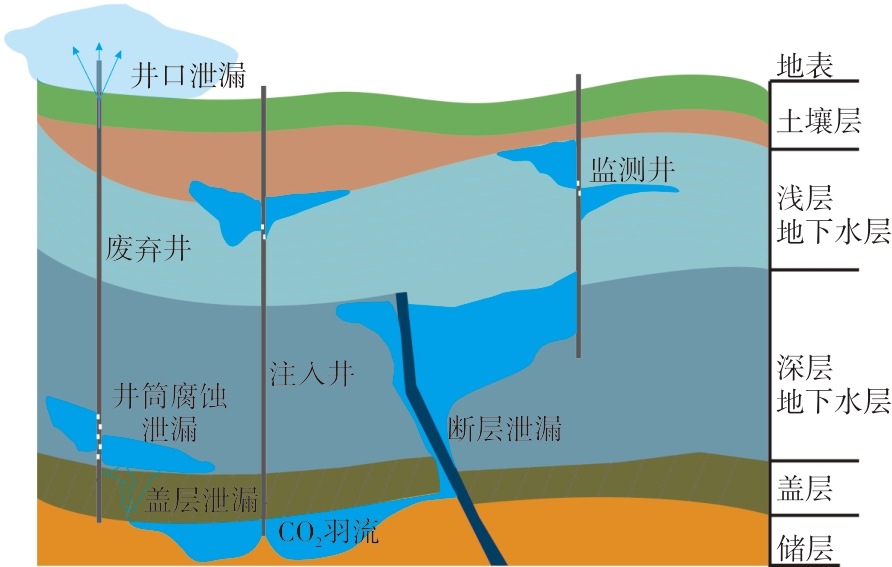
图2
封存CO2泄漏迁移转化机制与环境影响示意图"
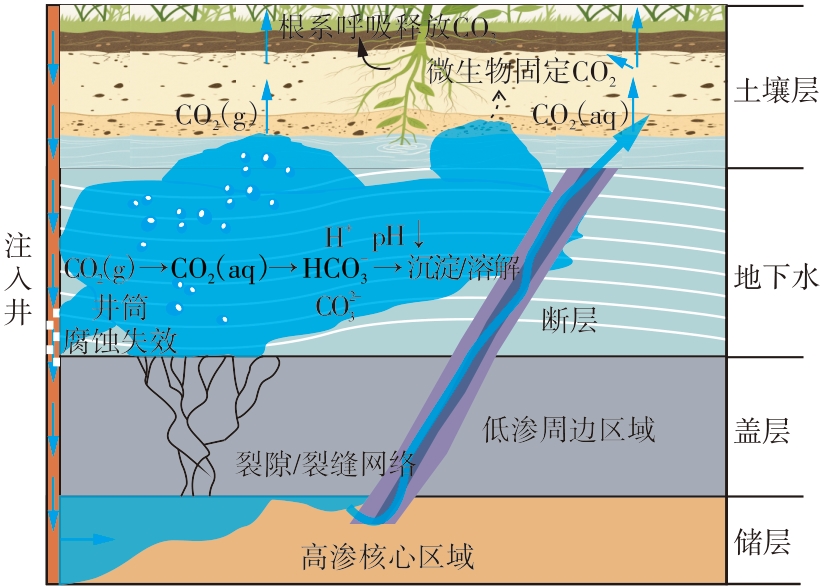
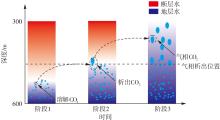
图3
CO2沿断层迁移形成分层流体机制(据参考文献[92]修改)"
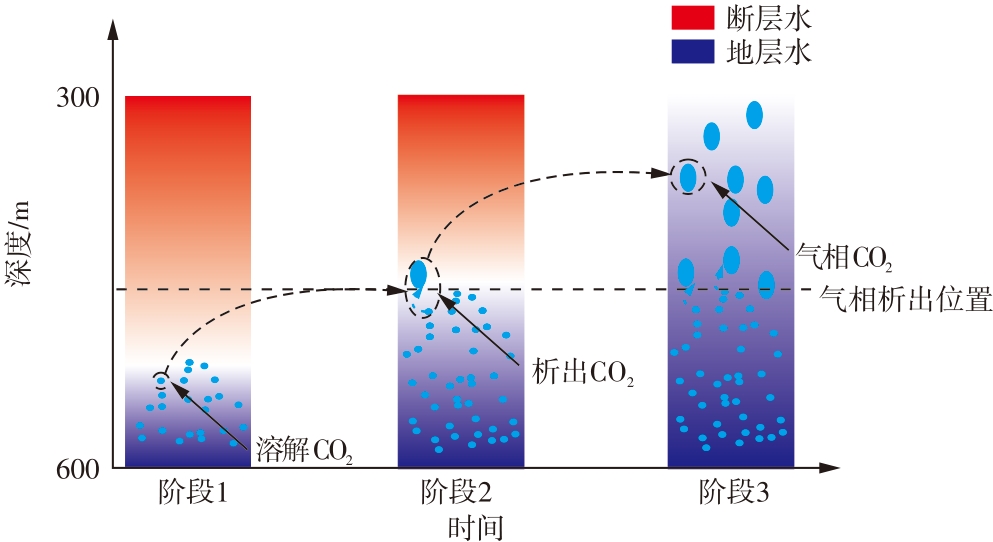
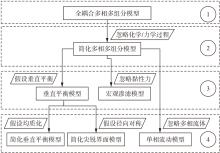
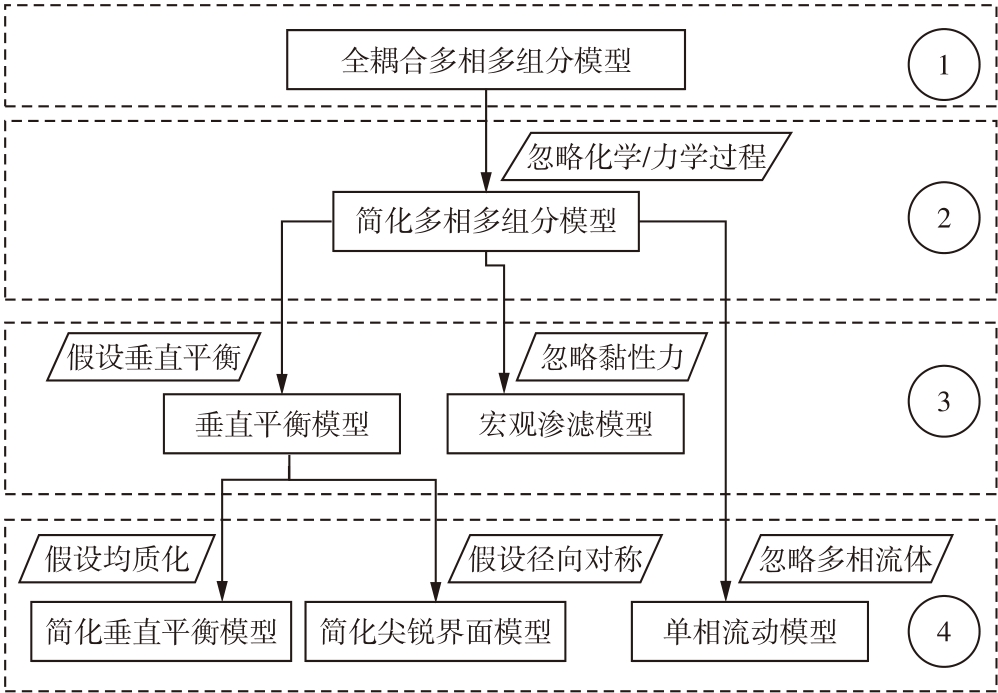
图4
多场全耦合多相模拟模型到单相模拟模型复杂程度分级"
| [1] | 姚红生, 邱伟生, 周德华, 等. 苏北盆地复杂断块油藏CCUS-EOR关键技术与实践[J]. 天然气工业, 2025, 45(9): 212-222. |
| YAO Hongsheng, QIU Weisheng, ZHOU Dehua, et al. Key technologies and practices of CCUS-EOR in complex fault-block reservoirs in the Subei Basin[J]. Natural Gas Industry, 2025, 45(9): 212-222. | |
| [2] | 何志勇, 郭本帅, 汪东, 等. CO2捕集和利用技术的应用与研发进展[J]. 油气藏评价与开发, 2024, 14(1): 70-75. |
| HE Zhiyong, GUO Benshuai, WANG Dong, et al. Application and research progress of CO2 capture and utilization technology[J]. Petroleum Reservoir Evaluation and Development, 2024, 14(1): 70-75. | |
| [3] | VISWANATHAN H S, PAWAR R J, STAUFFER P H, et al. Development of a hybrid process and system model for the assessment of wellbore leakage at a geologic CO2 sequestration site[J]. Environmental Science & Technology, 2008, 42(19): 7280-7286. |
| [4] | CARROLL S, CAREY J W, DZOMBAK D, et al. Review: Role of chemistry, mechanics, and transport on well integrity in CO2 storage environments[J]. International Journal of Greenhouse Gas Control, 2016, 49: 149-160. |
| [5] | 张志升, 吴向阳, 吴倩, 等. CO2驱油封存泄漏风险管理系统及应用研究[J]. 油气藏评价与开发, 2024, 14(1): 91-101. |
| ZHANG Zhisheng, WU Xiangyang, WU Qian, et al. Risk management system and application of CO2 flooding and sequestration leakage[J]. Petroleum Reservoir Evaluation and Development, 2024, 14(1): 91-101. | |
| [6] | JHA B, JUANES R. Coupled multiphase flow and poromechanics: A computational model of pore pressure effects on fault slip and earthquake triggering[J]. Water Resources Research, 2014, 50(5): 3776-3808. |
| [7] | VILARRASA V, RUTQVIST J. Thermal effects on geologic carbon storage[J]. Earth-Science Reviews, 2017, 165: 245-256. |
| [8] | KUANG N J, ZHOU J P, XIAN X F, et al. Geomechanical risk and mechanism analysis of CO2 sequestration in unconventional coal seams and shale gas reservoirs[J]. Rock Mechanics Bulletin, 2023, 2(4): 100079. |
| [9] | CHENG Y, LIU W, XU T, et al. Seismicity induced by geological CO2 storage: A review[J]. Earth-Science Reviews, 2023, 239: 104369. |
| [10] | 禹海涛, 张改, 闫晓. CO2封存诱发近断层活化机制研究进展[J]. 华侨大学学报(自然科学版), 2024, 45(2): 136-149. |
| YU Haitao, ZHANG Gai, YAN Xiao. Research progress on mechanism of near-fault reactivation induced by CO2 geological storage[J]. Journal of Huaqiao University (Natural Science), 2024, 45(2): 136-149. | |
| [11] | 王展鹏, 刘双星, 刘琦, 等. 地质封存过程中CO2注入对地层影响研究进展[J]. 油气藏评价与开发, 2025, 15(4): 632-640. |
| WANG Zhanpeng, LIU Shuangxing, LIU Qi, et al. Research progress on effects of CO2 injection on formations during geological storage[J]. Petroleum Reservoir Evaluation and Development, 2025, 15(4): 632-640. | |
| [12] | PATERSON L, ENNIS-KING J, SHARMA S. Observations of thermal and pressure transients in carbon dioxide wells[C]//Paper SPE-134881-MS presented at the SPE Annual Technical Conference and Exhibition, Florence, Italy, September 2010. |
| [13] | GOR G Y, PRÉVOST J H. Effect of CO2 injection temperature on caprock stability[J]. Energy Procedia, 2013, 37: 3727-3732. |
| [14] | GOR G Y, ELLIOT T R, PRÉVOST J H. Effects of thermal stresses on caprock integrity during CO2 storage[J]. International Journal of Greenhouse Gas Control, 2013, 12: 300-309. |
| [15] | VILARRASA V, RINALDI A P, RUTQVIST J. Long-term thermal effects on injectivity evolution during CO2 storage[J]. International Journal of Greenhouse Gas Control, 2017, 64: 314-322. |
| [16] | SALIMZADEH S, PALUSZNY A, ZIMMERMAN R W. Effect of cold CO2 injection on fracture apertures and growth[J]. International Journal of Greenhouse Gas Control, 2018, 74: 130-141. |
| [17] | LUO Z, BRYANT S, MECKEL T. Application of improved injection well temperature model to cranfield measurements[J]. Energy Procedia, 2013, 37: 4128-4135. |
| [18] | FERRONATO M, GAMBOLATI G, JANNA C, et al. Geomechanical issues of anthropogenic CO2 sequestration in exploited gas fields[J]. Energy Conversion and Management, 2010, 51(10): 1918-1928. |
| [19] | MIOCIC J M, JOHNSON G, BOND C E. Uncertainty in fault seal parameters: Implications for CO2 column height retention and storage capacity in geological CO2 storage projects[J]. Solid Earth, 2019, 10(3): 951-967. |
| [20] | RUTQVIST J. The geomechanics of CO2 storage in deep sedimentary formations[J]. Geotechnical and Geological Engineering, 2012, 30(3): 525-551. |
| [21] | PAN D, GALLI G. The fate of carbon dioxide in water-rich fluids under extreme conditions[J]. Science Advances, 2016, 2(10): e1601278. |
| [22] | RAZA A, GHOLAMI R, SARMADIVALEH M, et al. Integrity analysis of CO2 storage sites concerning geochemical-geomechanical interactions in saline aquifers[J]. Journal of Natural Gas Science and Engineering, 2016, 36: 224-240. |
| [23] | GOODARZI S, SETTARI A, KEITH D. Geomechanical modeling for CO2 storage in wabamun lake area of alberta, canada[J]. Energy Procedia, 2011, 4: 3399-3406. |
| [24] | RUTQVIST J, BIRKHOLZER J T, TSANG C F. Coupled reservoir–geomechanical analysis of the potential for tensile and shear failure associated with CO2 injection in multilayered reservoir–caprock systems[J]. International Journal of Rock Mechanics and Mining Sciences, 2008, 45(2): 132-143. |
| [25] | SHI J Q, DURUCAN S. A coupled reservoir-geomechanical simulation study of CO2 storage in a nearly depleted natural gas reservoir[J]. Energy Procedia, 2009, 1(1): 3039-3046. |
| [26] | TILLNER E, SHI J Q, BACCI G, et al. Coupled dynamic flow and geomechanical simulations for an integrated assessment of CO2 storage impacts in a saline aquifer[J]. Energy Procedia, 2014, 63: 2879-2893. |
| [27] | United States Environmental Protection Agency. Determination of Maximum Injection Pressure[R]. Washington, DC: United States Environmental Protection Agency, 1994. |
| [28] | CHOPRA S, HUFFMAN A R. Velocity determination for pore-pressure prediction[J]. The Leading Edge, 2006, 25(12): 1502-1515. |
| [29] | VILARRASA V, SILVA O, CARRERA J, et al. Liquid CO2 injection for geological storage in deep saline aquifers[J]. International Journal of Greenhouse Gas Control, 2013, 14: 84-96. |
| [30] | RAZA A, GHOLAMI R, SARMADIVALEH M. Feasibility of limestone reservoirs as a carbon dioxide storage site: An experimental study[J]. AAPG Bulletin, 2020, 103(1): 83-96. |
| [31] | GARCIA-RIOS M, LUQUOT L, SOLER J M, et al. Influence of the flow rate on dissolution and precipitation features during percolation of CO2-rich sulfate solutions through fractured limestone samples[J]. Chemical Geology, 2015, 414: 95-108. |
| [32] | HEMME C, VAN BERK W. Change in caprock porosity triggered by pressure and temperature dependent CO2-water-rock interactions in CO2 storage systems[J]. Petroleum, 2017, 3(1): 96-108. |
| [33] | GHARBI O, BIJELJIC B, BOEK E, et al. Changes in pore structure and connectivity induced by co2 injection in carbonates: A combined pore-scale approach[J]. Energy Procedia, 2013, 37: 5367-5378. |
| [34] | EMBERLEY S, HUTCHEON I, SHEVALIER M, et al. Geochemical monitoring of fluid-rock interaction and CO2 storage at the Weyburn CO2-injection enhanced oil recovery site, Saskatchewan, Canada[J]. Energy, 2004, 29(9-10): 1393-1401. |
| [35] | LI D, REN S, RUI H. CO2 leakage behaviors in typical caprock-aquifer system during geological storage process[J]. ACS Omega, 2019, 4(18): 17874-17879. |
| [36] | ESPINOZA D N, KIM S H, SANTAMARINA J C. CO2 geological storage: Geotechnical implications[J]. KSCE Journal of Civil Engineering, 2011, 15(4): 707-719. |
| [37] | SEYYEDI M, MAHMUD H K B, VERRALL M, et al. Pore structure changes occur during co2 injection into carbonate reservoirs[J]. Scientific Reports, 2020, 10: 3624. |
| [38] | ZHANG M, BACHU S. Review of integrity of existing wells in relation to CO2 geological storage: What do we know?[J]. International Journal of Greenhouse Gas Control, 2011, 5(4): 826-840. |
| [39] | SCHWIND B E, PAYNE M L, OTTEN G K, et al. Development of leak resistance in industry standard OCTG connections using finite element analysis and full scale testing[C]//Paper OTC-13050-MS presented at the Offshore Technology Conference, Houston, Texas, April 2001. |
| [40] | CHOI Y S, YOUNG D, NEŠIĆ S, et al. Wellbore integrity and corrosion of carbon steel in CO2 geologic storage environments: A literature review[J]. International Journal of Greenhouse Gas Control, 2013, 16: S70-S77. |
| [41] | ABID K, GHOLAMI R, CHOATE P, et al. A review on cement degradation under CO2-rich environment of sequestration projects[J]. Journal of Natural Gas Science and Engineering, 2015, 27: 1149-1157. |
| [42] | IEA. Long term integrity of CO2 storage-well abandonment[R]. Greenhouse Gas R&D Programme (IEA GHG), 2009. |
| [43] | DANIEL R F, KALDI J G. Evaluating seal capacity of caprocks and intraformational barriers for the geosequestration of co2 [C]//PESA Eastern Australian Basins Symposium III, Sydney, Australia, September 2008. |
| [44] | GHOLAMI R, RAZA A, IGLAUER S. Leakage risk assessment of a CO2 storage site: A review[J]. Earth-Science Reviews, 2021, 223: 103849. |
| [45] | UMAR B A, GHOLAMI R, RAZA A, et al. A study on the surface wettability of clastic rocks with potential application for CO2 storage sites[J]. Natural Resources Research, 2020, 29(3): 2051-2061. |
| [46] | WANG Z, SMALL M J. A Bayesian approach to CO2 leakage detection at saline sequestration sites using pressure measurements[J]. International Journal of Greenhouse Gas Control, 2014, 30: 188-196. |
| [47] | BUSCH A, KAMPMAN N. Geological Carbon Storage: Subsurface Seals and Caprock Integrity[M]. Hoboken: John Wiley & Sons, Inc, 2018. |
| [48] | 张森琦, 刁玉杰, 程旭学, 等. 二氧化碳地质储存逃逸通道及环境监测研究[J]. 冰川冻土, 2010, 32(6): 1251-1261. |
| ZHANG Senqi, DIAO Yujie, CHENG Xuxue, et al. CO2 geological storage leakage routes and environment monitoring[J]. Journal of Glaciology and Geocryology, 2010, 32(6): 1251-1261. | |
| [49] | BIRKHOLZER J T, ZHOU Q, TSANG C F. Large-scale impact of CO2 storage in deep saline aquifers: A sensitivity study on pressure response in stratified systems[J]. International Journal of Greenhouse Gas Control, 2009, 3(2): 181-194. |
| [50] | WANG J G, JU Y, GAO F, et al. A simple approach for the estimation of CO2 penetration depth into a caprock layer[J]. Journal of Rock Mechanics and Geotechnical Engineering, 2016, 8(1): 75-86. |
| [51] | KIVI I R, MAKHNENKO R Y, VILARRASA V. Two-phase flow mechanisms controlling CO2 intrusion into shaly caprock[J]. Transport in Porous Media, 2022, 141(3): 771-798. |
| [52] | CRUZ F, DANG S, CURTIS M, et al. Diffusive leakage of scCO2 in shaly caprocks: Effect of geochemical reactivity and anisotropy[J]. SPE Journal, 2024, 29(9): 5087-5100. |
| [53] | KIM H, MAKHNENKO R Y. Characterization of multiphase flow in shaly caprock for geologic CO2 storage[J]. Advances in Water Resources, 2023, 182: 104570. |
| [54] | DENG H, STAUFFER P H, DAI Z, et al. Simulation of industrial-scale CO2 storage: Multi-scale heterogeneity and its impacts on storage capacity, injectivity and leakage[J]. International Journal of Greenhouse Gas Control, 2012, 10: 397-418. |
| [55] | LIU B, ZHANG Y. CO2 modeling in a deep saline aquifer: A predictive uncertainty analysis using design of experiment[J]. Environmental Science & Technology, 2011, 45(8): 3504-3510. |
| [56] | WANG D, ZHAO M, SONG Y, et al. Influence of capillary pressure and injection rate as well as heterogeneous and anisotropic permeability on CO2 transport and displacement efficiency in water-saturated porous media[J]. Energy Procedia, 2013, 37: 3945-3951. |
| [57] | THOMAS J A, MCGAUGHEY A J H. Reassessing fast water transport through carbon nanotubes[J]. Nano Letters, 2008, 8(9): 2788-2793. |
| [58] | FALK K, COASNE B, PELLENQ R, et al. Subcontinuum mass transport of condensed hydrocarbons in nanoporous media[J]. Nature Communications, 2015, 6: 6949. |
| [59] | 李荣. 碳封存条件下多孔结构内多相流动机理与运移规律研究[D]. 北京: 清华大学, 2017. |
| LI Rong. Investigation on multiphase flow in porous media under carbon geological sequestration conditions[D]. Beijing: Tsinghua University, 2017. | |
| [60] | 高帅, 魏宁, 李小春, 等. 层状非均质性对CO2在盖层中迁移泄漏规律的影响[J]. 岩土力学, 2017, 38(11): 3287-3294. |
| GAO Shuai, WEI Ning, LI Xiaochun, et al. Effect of layered heterogeneity on CO2 migration and leakage mechanism in the caprock[J]. Rock and Soil Mechanics, 2017, 38(11): 3287-3294. | |
| [61] | WEBER U W, RINALDI A P, ROQUES C, et al. In-situ experiment reveals CO2 enriched fluid migration in faulted caprock[J]. Scientific Reports, 2023, 13: 170006. |
| [62] | NOORAIEPOUR M, FAZELI H, MIRI R, et al. Effect of CO2 phase states and flow rate on salt precipitation in shale caprocks: A microfluidic study[J]. Environmental Science & Technology, 2018, 52(10): 6050-6060. |
| [63] | 马瑾. 地质封存条件下超临界二氧化碳运移规律研究[D]. 北京: 清华大学, 2013. |
| MA Jin. Researches on the migration of supercritical CO2 on geological storage conditions[D]. Beijing: Tsinghua University, 2013. | |
| [64] | 孙会珠, 朱玉双, 魏勇, 等. CO2驱酸化溶蚀作用对原油采收率的影响机理[J]. 岩性油气藏, 2020, 32(4): 136-142. |
| SUN Huizhu, ZHU Yushuang, WEI Yong, et al. Influence mechanism of acidification on oil recovery during CO2 flooding[J]. Lithologic Reservoirs, 2020, 32(4): 136-142. | |
| [65] | 郭冀隆. 二氧化碳地质封存过程中CO2—水—岩相互作用实验研究[D]. 北京: 中国地质大学(北京), 2017. |
| GUO Jilong. Experimental studies on CO2-water-rock interactions under geological CO2 storage conditions[D]. Beijing: China University of Geosciences (Beijing), 2017. | |
| [66] | BIRKHOLZER J T, ZHOU Q. Basin-scale hydrogeologic impacts of CO2 storage: Capacity and regulatory implications[J]. International Journal of Greenhouse Gas Control, 2009, 3(6): 745-756. |
| [67] | NICOT J P. Evaluation of large-scale CO2 storage on fresh-water sections of aquifers: An example from the Texas Gulf Coast Basin[J]. International Journal of Greenhouse Gas Control, 2008, 2(4): 582-593. |
| [68] | BRICKER S H, BARKWITH A, MACDONALD A M, et al. Effects of CO2 injection on shallow groundwater resources: A hypothetical case study in the Sherwood Sandstone aquifer, UK[J]. International Journal of Greenhouse Gas Control, 2012, 11: 337-348. |
| [69] | KHARAKA Y K, THORDSEN J J, KAKOUROS E, et al. Changes in the chemistry of shallow groundwater related to the 2008 injection of CO2 at the ZERT field site, Bozeman, Montana[J]. Environmental Earth Sciences, 2010, 60(2): 273-284. |
| [70] | PETER A, LAMERT H, BEYER M, et al. Investigation of the geochemical impact of CO2 on shallow groundwater: Design and implementation of a CO2 injection test in Northeast Germany[J]. Environmental Earth Sciences, 2012, 67(2): 335-349. |
| [71] | KHARAKA Y K, COLE D R, HOVORKA S D, et al. Gas-water-rock interactions in Frio Formation following CO2 injection: Implications for the storage of greenhouse gases in sedimentary basins[J]. Geology, 2006, 34(7): 577-580. |
| [72] | ZHENG L, SPYCHER N. Modeling the potential impacts of CO2 sequestration on shallow groundwater: The fate of trace metals and organic compounds before and after leakage stops[J]. Greenhouse Gases: Science and Technology, 2018, 8(1): 161-184. |
| [73] | OLDENBURG C M, UNGER A J A. On leakage and seepage from geologic carbon sequestration sites: Unsaturated zone attenuation[J]. Vadose Zone Journal, 2003, 2(3): 287-296. |
| [74] | LU J, PARTIN J W, HOVORKA S D, et al. Potential risks to freshwater resources as a result of leakage from CO2 geological storage: a batch-reaction experiment[J]. Environmental Earth Sciences, 2010, 60(2): 335-348. |
| [75] | HARVEY O R, QAFOKU N P, CANTRELL K J, et al. Geochemical implications of gas leakage associated with geologic CO2 storage: A qualitative review[J]. Environmental Science & Technology, 2013, 47(1): 23-36. |
| [76] | MOONIS M, HE W, KIM Y, et al. Effect of potential CO2 leakage from carbon capture and storage sites on soil and leachate chemistry[J]. KSCE Journal of Civil Engineering, 2017, 21(5): 1640-1647. |
| [77] | GUPTA P K, YADAV B. Leakage of CO2 from geological storage and its impacts on fresh soil–water systems: A review[J]. Environmental Science and Pollution Research, 2020, 27(12): 12995-13018. |
| [78] | HE W, YOO G, MOONIS M, et al. Impact assessment of high soil CO2 on plant growth and soil environment: A greenhouse study[J]. PeerJ, 2019, 7: e6311. |
| [79] | SEYEDI D M, VU M N, POUYA A. A two-scale hydromechanical model for fault zones accounting for their heterogeneous structure[J]. Computers and Geotechnics, 2015, 68: 8-16. |
| [80] | AKINNIKAWE O, EHLIG-ECONOMIDES C A. Geologic model and fluid flow simulation of Woodbine aquifer CO2 sequestration[J]. International Journal of Greenhouse Gas Control, 2016, 49: 1-13. |
| [81] | ZHANG L, JIANG M, YANG Q, et al. Evolution of fault-induced salt precipitation due to convection of CO2 and brine along fault during CO2 storage in multilayered saline aquifer-caprock[J]. Energy, 2023, 278: 127758. |
| [82] | ROMANO V, BIGI S, PARK H, et al. A numerical model for gas CO2 migration in a fault zone[J]. Petroleum Geoscience, 2023, 29(3): petgeo2022092. |
| [83] | NAKAJIMA T, XUE Z, CHIYONOBU S, et al. Numerical simulation of CO2 leakage along fault system for the assessment of environmental impacts at CCS site[J]. Energy Procedia, 2014, 63: 3234-3241. |
| [84] | FALTA R W, ZUO L, BENSON S M. Migration of exsolved CO2 following depressurization of saturated brines[J]. Greenhouse Gases: Science and Technology, 2013, 3(6): 503-515. |
| [85] | CURRENTI G, CANTUCCI B, MONTEGROSSI G, et al. CO2 leakage scenarios in shale overburden[J]. Minerals, 2023, 13(8): 1016. |
| [86] | PLAMPIN M R, ILLANGASEKARE T, SAKAKI T, et al. Experimental study of gas evolution in heterogeneous shallow subsurface formations during leakage of stored CO2 [J]. International Journal of Greenhouse Gas Control, 2014, 22: 47-62. |
| [87] | PORTER M L, PLAMPIN M R, PAWAR R, et al. CO2 leakage in shallow aquifers: A benchmark modeling study of CO2 gas evolution in heterogeneous porous media[J]. International Journal of Greenhouse Gas Control, 2015, 39: 51-61. |
| [88] | ZUO L, KREVOR S, FALTA R W, et al. An experimental study of CO2 exsolution and relative permeability measurements during CO2 saturated water depressurization[J]. Transport in Porous Media, 2012, 91(2): 459-478. |
| [89] | ZUO L, ZHANG C, FALTA R W, et al. Micromodel investigations of CO2 exsolution from carbonated water in sedimentary rocks[J]. Advances in Water Resources, 2013, 53: 188-197. |
| [90] | ZUO L, AJO-FRANKLIN J B, VOLTOLINI M, et al. Pore-scale multiphase flow modeling and imaging of CO2 exsolution in sandstone[J]. Journal of Petroleum Science and Engineering, 2017, 155: 63-77. |
| [91] | XU R, LUO S, JIANG P. Pore scale numerical simulation of supercritical CO2 injecting into porous media containing water[J]. Energy Procedia, 2011, 4: 4418-4424. |
| [92] | WANG J X, LI Y, LIN Q G, et al. A two-phase layered model for simulating leakage along faults considering the blocking effect of CO2 exsolution[J/OL]. Greenhouse Gases: Science and Technology, 2025, (2025-10-28)[2025-10-30]. . |
| [93] | PARK J, PARK S S, CHO J, et al. Analysis on caprock and aquifer properties related with leakage during CO2 storage[J]. Geosystem Engineering, 2016, 19(4): 188-196. |
| [94] | HAN G, HAN W S, KIM K Y, et al. Roles of fault structures and regional formations on CO2 migration and distribution in shallow saline aquifer in Green River, Utah[J]. Journal of Hydrology, 2019, 570: 786-801. |
| [95] | GASDA S E, NILSEN H M, DAHLE H K, et al. Effective models for CO2 migration in geological systems with varying topography[J]. Water Resources Research, 2012, 48(10): 2012WR012264. |
| [96] | WIEGERS C E, SCHÄFER D. Numerical simulations of spreading scenarios of highly mineralized water in shallow freshwater aquifers[J]. Grundwasser-Zeitschrift der Fachsektion Hydrogeologie, 2015, 20: 85-95. |
| [97] | MACMINN C W, SZULCZEWSKI M L, JUANES R. CO2 migration in saline aquifers. Part 1. Capillary trapping under slope and groundwater flow[J]. Journal of Fluid Mechanics, 2010, 662: 329-351. |
| [98] | LIU J, YANG F, CHONG S, et al. Modeling CO2 migration in a site-specific shallow subsurface under complex hydrodynamics[J]. International Journal of Greenhouse Gas Control, 2021, 112: 103483. |
| [99] | GASPARINI A, CREDOZ A, GRANDIA F, et al. Experimental and numerical modeling of CO2 leakage in the vadose zone[J]. Greenhouse Gases: Science and Technology, 2015, 5(6): 732-755. |
| [100] | BANDILLA K W, CELIA M A, BIRKHOLZER J T, et al. Multiphase modeling of geologic carbon sequestration in saline aquifers[J]. Groundwater, 2015, 53(3): 362-377. |
| [101] | CELIA M A, NORDBOTTEN J M. How simple can we make models for CO2 injection, migration, and leakage?[J]. Energy Procedia, 2011, 4: 3857-3864. |
| [102] | CHEN X, JIANG M, XU Z. Pore-scale study of heat and mass transfer in different pore throats of porous media with reactive transport[J]. Journal of Porous Media, 2022, 25(10): 47-65. |
| [103] | KHANAL A, KHAN M I, SHAHRIAR M F. Comprehensive parametric study of CO2 sequestration in deep saline aquifers[J]. Chemical Engineering Science, 2024, 287: 119734. |
| [104] | CAI M, SU Y, ELSWORTH D, et al. Hydro-mechanical-chemical modeling of sub-nanopore capillary-confinement on CO2-CCUS-EOR[J]. Energy, 2021, 225: 120203. |
| [105] | OLDENBURG C M, UNGER A J A. Carbon dioxide capture for storage in deep geologic formations[M]. Amsterdam: Elsevier, 2005. |
| [106] | OLDENBURG C M, UNGER A J A. Coupled vadose zone and atmospheric surface-layer transport of carbon dioxide from geologic carbon sequestration sites[J]. Vadose Zone Journal, 2004, 3(3): 848-857. |
| [107] | BASIRAT F, SHARMA P, FAGERLUND F, et al. Experimental and modeling investigation of CO2 flow and transport in a coupled domain of porous media and free flow[J]. International Journal of Greenhouse Gas Control, 2015, 42: 461-470. |
| [108] | ALTEVOGT A S, CELIA M A. Numerical modeling of carbon dioxide in unsaturated soils due to deep subsurface leakage[J]. Water Resources Research, 2004, 40(3): 2003WR002848. |
| [109] | FARAJZADEH R, ZITHA P L J, BRUINING J. Enhanced mass transfer of CO2 into water: Experiment and modeling[J]. Industrial & Engineering Chemistry Research, 2009, 48(13): 6423-6431. |
| [110] | NGHIEM L, SAMMON P, GRABENSTETTER J, et al. Modeling CO2 storage in aquifers with a fully-coupled geochemical EOS compositional simulator[C]// Paper SPE-89474-MS presented at the SPE/DOE Symposium on Improved Oil Recovery, Tulsa, Oklahoma, April 2004. |
| [111] | BACON D H, QAFOKU N P, DAI Z, et al. Modeling the impact of carbon dioxide leakage into an unconfined, oxidizing carbonate aquifer[J]. International Journal of Greenhouse Gas Control, 2016, 44: 290-299. |
| [112] | ZHENG L, SPYCHER N, BIANCHI M, et al. Impacts of elevated dissolved CO2 on a shallow groundwater system: Reactive transport modeling of a controlled-release field test[J]. Chemical Geology, 2016: 447: 117-132. |
| [113] | SZABÓ Z, GÁL N E, KUN É, et al. Geochemical modeling possibilities of CO2 and brine inflow to freshwater aquifers[J]. Central European Geology, 2017, 60(3): 289-298. |
| [114] | XIAO T, DAI Z, MCPHERSON B, et al. Reactive transport modeling of arsenic mobilization in shallow groundwater: Impacts of CO2 and brine leakage[J]. Geomechanics and Geophysics for Geo-Energy and Geo-Resources, 2017, 3(3): 339-350. |
| [115] | SZABÓ Z, GÁL N E, KUN É, et al. Accessing effects and signals of leakage from a CO2 reservoir to a shallow freshwater aquifer by reactive transport modelling[J]. Environmental Earth Sciences, 2018, 77(12): 1-12. |
| [116] | BIE H, YANG C, LIU P. Assessing groundwater monitoring strategy for leakage detection in the Texas Gulf Coast Aquifer (USA) at a hypothetical CO2 storage site: A reactive transport modeling approach[J]. Hydrogeology Journal, 2019, 27(2): 553-566. |
| [117] | ROSSI L, LOISY C, CEREPI A, et al. Impact of a CO2 leak on the release of major and trace elements according to groundwater flow conditions in a shallow freshwater carbonate aquifer: In-situ experiments and modelling[J]. International Journal of Greenhouse Gas Control, 2024, 132: 104042. |
| [118] | 张志升, 吴向阳, 吴倩, 等. CO2 驱油封存泄漏风险管理系统及应用研究[J]. 油气藏评价与开发, 2024, 14(1): 91-101. |
| ZHANG Zhisheng, WU Xiangyang, WU Qian, et al. Risk management system and application of CO2 flooding and sequestration leakage[J]. Petroleum Reservoir Evaluation and Development, 2024, 14(1): 91-101. |
| [1] | 李经纬, 彭勃, 王泽滕, 陈晓倩, 张正昊, 刘金栋, 刘双星, 李晓枫. 油气藏CO2封存潜力评估模型与实践进展 [J]. 油气藏评价与开发, 2026, 16(1): 141-152. |
| [2] | 王能昊, 连威, 李军, 李佳琦. CO2深部咸水层封存羽流演变与储盖层完整性影响因素研究——以神华CCS项目为例 [J]. 油气藏评价与开发, 2026, 16(1): 128-140. |
| [3] | 赵勇, 冯勤, 孙鑫, 王庆. 东海西湖凹陷X区块CO2地质封存诱发地震危险性探讨 [J]. 油气藏评价与开发, 2026, 16(1): 23-33. |
| [4] | 杨龙, 许寻, 郭立强, 张艺钟, 王坤, 郑晶晶. 深部咸水层CO2地质封存相平衡参数修正模型 [J]. 油气藏评价与开发, 2026, 16(1): 61-73. |
| [5] | 石慧, 谢天成, 刘子亮, 蒋志坤, 魏迎春. 碎裂煤中煤粉运移对孔渗影响的数值模拟研究 [J]. 油气藏评价与开发, 2025, 15(6): 1025-1033. |
| [6] | 车阳, 董京楠, 陈春宇, 方明星, 谭茂金, 唐魏泓. 基于声波远探测技术裸眼老井地下定位研究与验证 [J]. 油气藏评价与开发, 2025, 15(6): 1112-1120. |
| [7] | 齐怀彦, 杨国斌, 朱亚娣, 邓茗心, 耿少阳, 田伟超. 基于核磁共振与孔隙尺度模拟的致密油藏渗吸机理研究 [J]. 油气藏评价与开发, 2025, 15(5): 824-833. |
| [8] | 孙秋分, 秦佳正, 冯乔, 乔宇, 刘雅昕, 赵启阳, 徐良, 闫春. 基于机器学习的裂缝水驱气藏采收率预测方法 [J]. 油气藏评价与开发, 2025, 15(5): 834-843. |
| [9] | 王烁石, 纪强, 郭平, 刘煌, 温连辉, 徐锐锋, 汪周华, 张瑞旭. LARSEN & SKAUGE相渗滞后模型在高温高压CO2-水互驱实验中的适应性 [J]. 油气藏评价与开发, 2025, 15(4): 613-624. |
| [10] | 孙东升, 张顺康, 王智林, 葛政俊, 林波. 苏北断块型圈闭基于安全性CO2地质封存能力计算方法研究 [J]. 油气藏评价与开发, 2025, 15(4): 641-645. |
| [11] | 杨术刚, 任金蔓, 蔡明玉, 刘浩童, 刘双星, 薛明, 张坤峰. 气田采出水回注地层CO2封存赋存状态研究 [J]. 油气藏评价与开发, 2025, 15(4): 656-663. |
| [12] | 朱苏阳, 彭真, 邸云婷, 彭小龙, 刘东晨, 官文洁. 页岩气产能评价研究进展:内涵、方法和方向 [J]. 油气藏评价与开发, 2025, 15(3): 488-499. |
| [13] | 陈兴明, 钱洋慧, 陈忠志, 陈子凡. CO2封存泄漏立体监测技术的探索与应用——以苏北盆地张家垛油田为例 [J]. 油气藏评价与开发, 2025, 15(3): 508-514. |
| [14] | 柴妮娜, 李嘉瑞, 张力文, 王俊杰, 刘亚鹏, 朱伦. 夹层型陆相页岩油储层压裂裂缝扩展实验研究 [J]. 油气藏评价与开发, 2025, 15(1): 124-130. |
| [15] | 盖长城, 李洪达, 任路, 曹伟, 郝杰. 地热数值模拟与油藏数值模拟方法对比分析 [J]. 油气藏评价与开发, 2024, 14(6): 849-856. |
|
||
