
油气藏评价与开发 ›› 2026, Vol. 16 ›› Issue (1): 23-33.doi: 10.13809/j.cnki.cn32-1825/te.2025192
赵勇( ), 冯勤, 孙鑫(), 王庆
收稿日期:2025-04-22
发布日期:2026-01-06
出版日期:2026-01-26
通讯作者:
孙鑫(1985—),男,硕士,工程师,从事安全工程工作。地址:上海市浦东新区锦康路50弄2号,邮政编码:200127。E-mail:sunx.shhy@sinopec.com作者简介:赵勇(1966—),男,博士,教授级高工,从事油气田开发工作。地址:上海市浦东新区锦康路50弄2号,邮政编码:200127。E-mail:yangxs.shhy@sinopec.com
基金资助:
ZHAO Yong(), FENG Qin, SUN Xin(), WANG Qing
Received:2025-04-22
Online:2026-01-06
Published:2026-01-26
摘要:
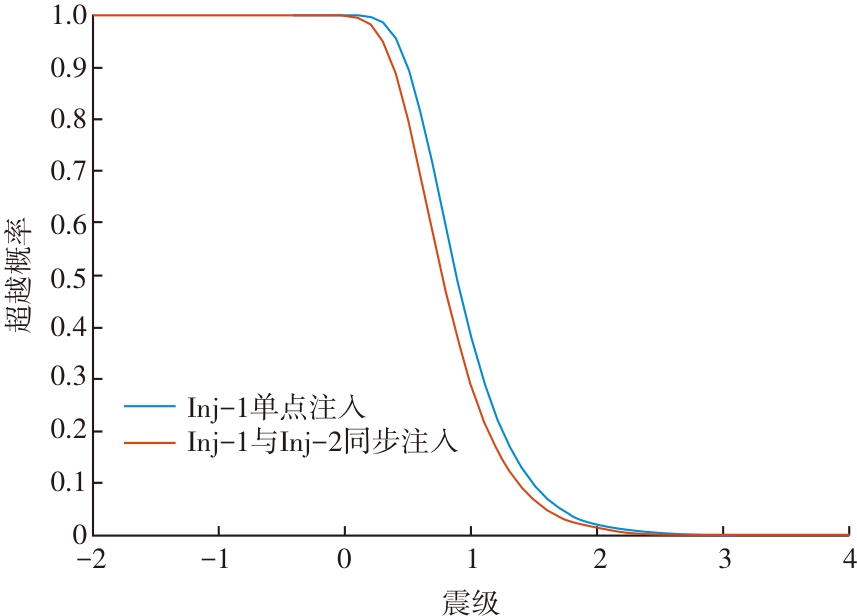
在“双碳”目标背景下,海域CO2地质封存相较于陆上具有显著优势,是未来CO2捕集、利用与封存(CCUS)技术的重要发展方向。但CO2地质封存等深地工业活动存在诱发地震的风险,而东海陆架盆地作为中国海域CO2地质封存的适宜区域,目前缺乏诱发地震危险性评价研究。基于Dieterich速率状态摩擦定律的诱发地震评价方法,从断层稳定性分析入手,将断层面相对地震活动率与库仑破裂应力变化相关联,结合确定性与概率性评价方法,探讨东海西湖凹陷X区块CO2注入诱发地震的危险性。结果表明:①X区块玉泉组中部目标储层呈背斜形态,12条断层将封存圈闭分割为南北两部分,地应力类型为潜在正断型,所有断层初始状态稳定;②南部圈闭按60×10⁴ t/a的规模开展10 a的CO2封存时,孔隙流体压力扩散对周围断层影响较小,诱发高震级地震风险较低,区块诱发地震震级上限预估为1.8级;③CO2注入速率增大将增加诱发地震风险,分区注入可降低风险,但经济性较差。研究提出的评价方法及成果,可作为CO2地质封存诱发地震危险性的评价手段之一,为CCUS项目安全性提供理论支撑。
中图分类号:
ZHAO Yong,FENG Qin,SUN Xin, et al. Investigation on risk of induced earthquakes for CO2 geological storage in X block, Xihu Sag, East China Sea[J]. Petroleum Reservoir Evaluation and Development, 2026, 16(1): 23-33.
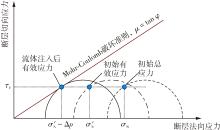
图1
流体注入导致断层破坏诱发地震的机理注:σN'为初始法向有效应力,单位MPa;Δp为孔隙流体压力增量,单位MPa;σN为初始法向应力,单位MPa;τF为切向应力,单位MPa。"
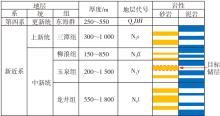
图 2
东海西湖凹陷第四系与新近系地层层序"
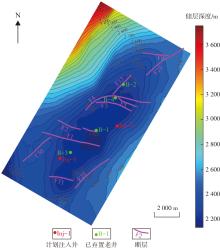
图 3
东海西湖凹陷X区块目标储层地质构造"
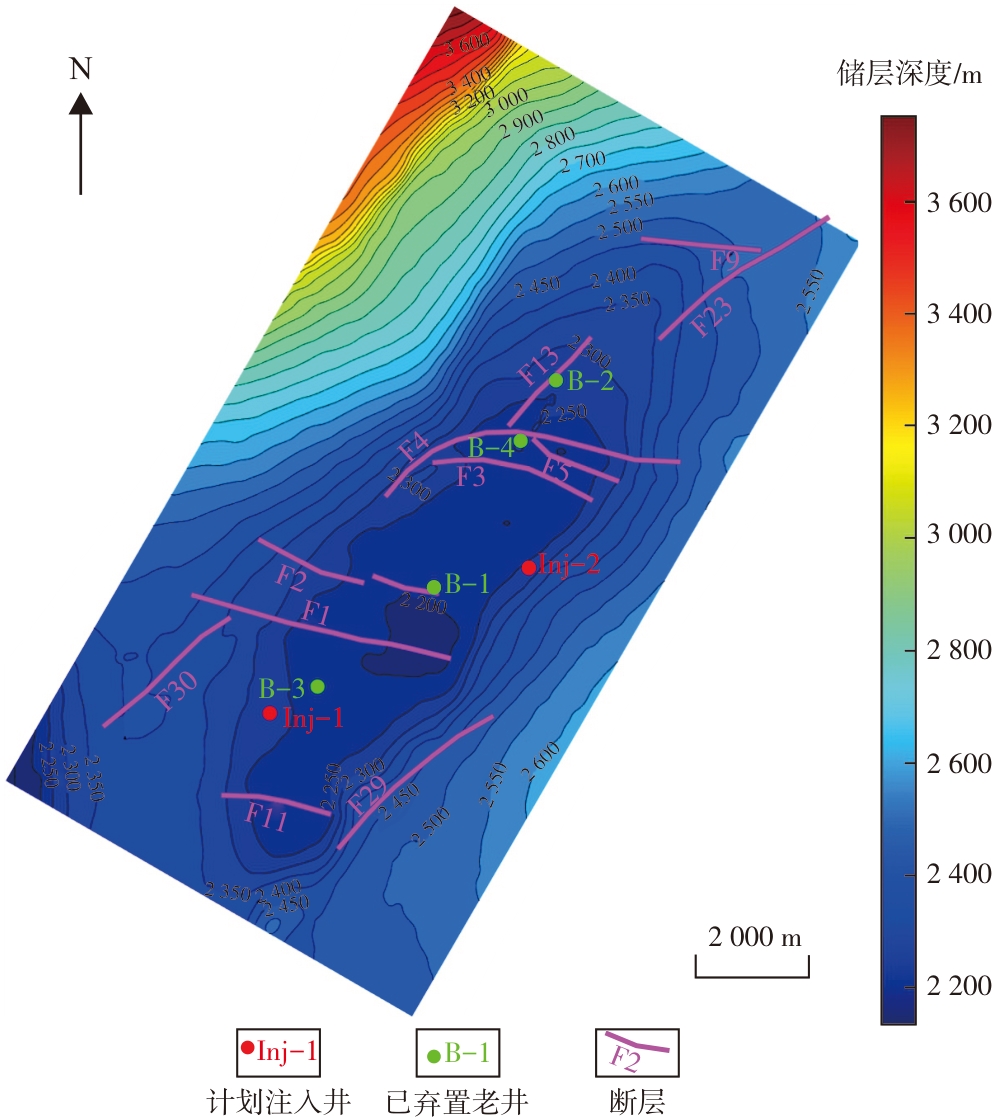

表 1
东海西湖凹陷X区块主要断层属性"
| 名称 | 分段编号 | 走向/(°) | 倾角/(°) | 长度/m |
|---|---|---|---|---|
| F1 | F1-1 | 106 | 81 | 1 818.2 |
| F1-2 | 102 | 81 | 807.0 | |
| F1-3 | 104 | 81 | 516.4 | |
| F1-4 | 98 | 81 | 543.2 | |
| F1-5 | 103 | 81 | 349.3 | |
| F1-6 | 104 | 81 | 757.1 | |
| F2 | F2-1 | 118 | 74 | 600.1 |
| F2-2 | 118 | 74 | 667.9 | |
| F2-3 | 104 | 74 | 795.7 | |
| F3 | F3-1 | 84 | 81 | 449.3 |
| F3-2 | 89 | 81 | 469.8 | |
| F3-3 | 101 | 81 | 818.7 | |
| F3-4 | 114 | 81 | 488.6 | |
| F3-5 | 118 | 81 | 796.7 | |
| F4 | F4-1 | 40 | 78 | 608.0 |
| F4-2 | 52 | 78 | 577.8 | |
| F4-3 | 65 | 78 | 474.8 | |
| F4-4 | 76 | 78 | 538.4 | |
| F4-5 | 88 | 78 | 545.7 | |
| F4-6 | 99 | 78 | 553.0 | |
| F4-7 | 104 | 78 | 766.3 | |
| F4-8 | 105 | 78 | 854.6 | |
| F4-9 | 93 | 78 | 826.6 | |
| F5 | F5-1 | 134 | 85 | 412.9 |
| F5-2 | 111 | 85 | 503.8 | |
| F5-3 | 111 | 85 | 834.6 | |
| F9 | F9-1 | 96 | 82 | 1 074.2 |
| F9-2 | 95 | 82 | 1 095.4 | |
| F10 | F10-1 | 111 | 83 | 616.4 |
| F10-2 | 99 | 83 | 621.5 | |
| F11 | F11-1 | 92 | 84 | 674.6 |
| F11-2 | 100 | 84 | 500.8 | |
| F11-3 | 106 | 84 | 834.7 | |
| F13 | F13-1 | 40 | 85 | 774.8 |
| F13-2 | 46 | 85 | 872.8 | |
| F13-3 | 41 | 85 | 534.3 | |
| F23 | F23-1 | 46 | 71 | 713.3 |
| F23-2 | 48 | 71 | 552.9 | |
| F23-3 | 54 | 71 | 679.5 | |
| F23-4 | 61 | 71 | 803.9 | |
| F23-5 | 58 | 71 | 1 022.1 | |
| F29 | F29-1 | 40 | 67 | 807.0 |
| F29-2 | 45 | 67 | 707.8 | |
| F29-3 | 51 | 67 | 872.8 | |
| F29-4 | 52 | 67 | 573.2 | |
| F29-5 | 60 | 67 | 733.3 | |
| F30 | F30-1 | 51 | 68 | 1 007.7 |
| F30-2 | 45 | 68 | 756.1 | |
| F30-3 | 46 | 68 | 632.8 | |
| F30-4 | 57 | 68 | 624.5 |
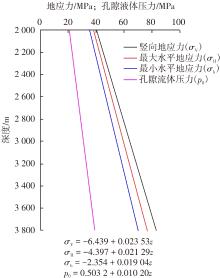
图4
东海西湖凹陷X区块地应力场随深度变化特征注:z为深度,单位m。"
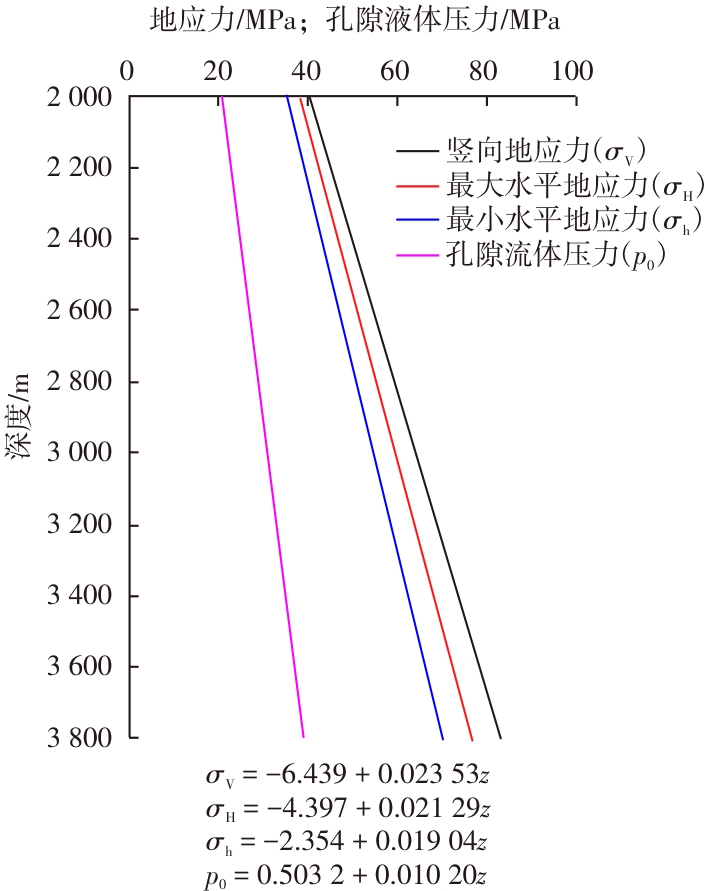
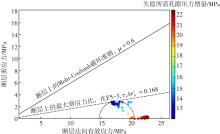
图 5
各分段断层的初始有效应力状态"
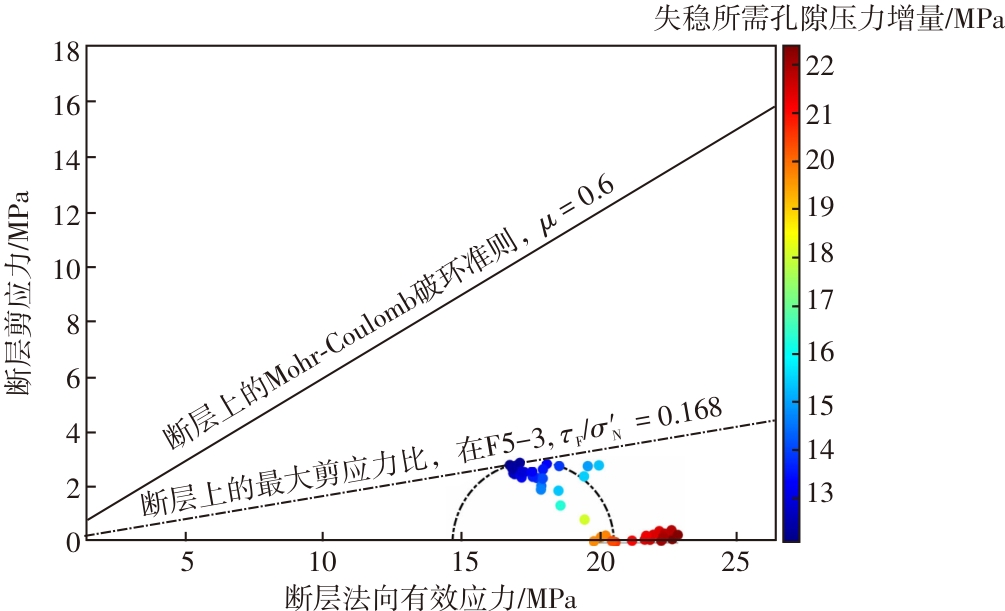
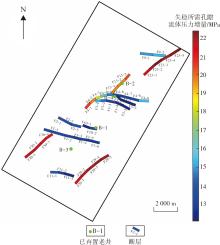
图 6
各分段断层失稳所需的孔隙流体压力增量"

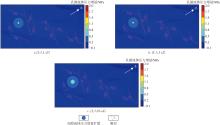
图 7
Inj-1注入点按60×10⁴ t/a封存规模注入CO2时的孔隙流体压力增量扩散"

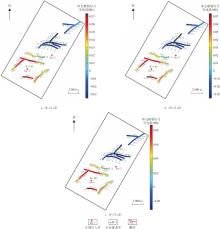
图 8
Inj-1注入点按60×10⁴ t/a封存规模注入CO2时各分段断层的库仑破裂应力变化"
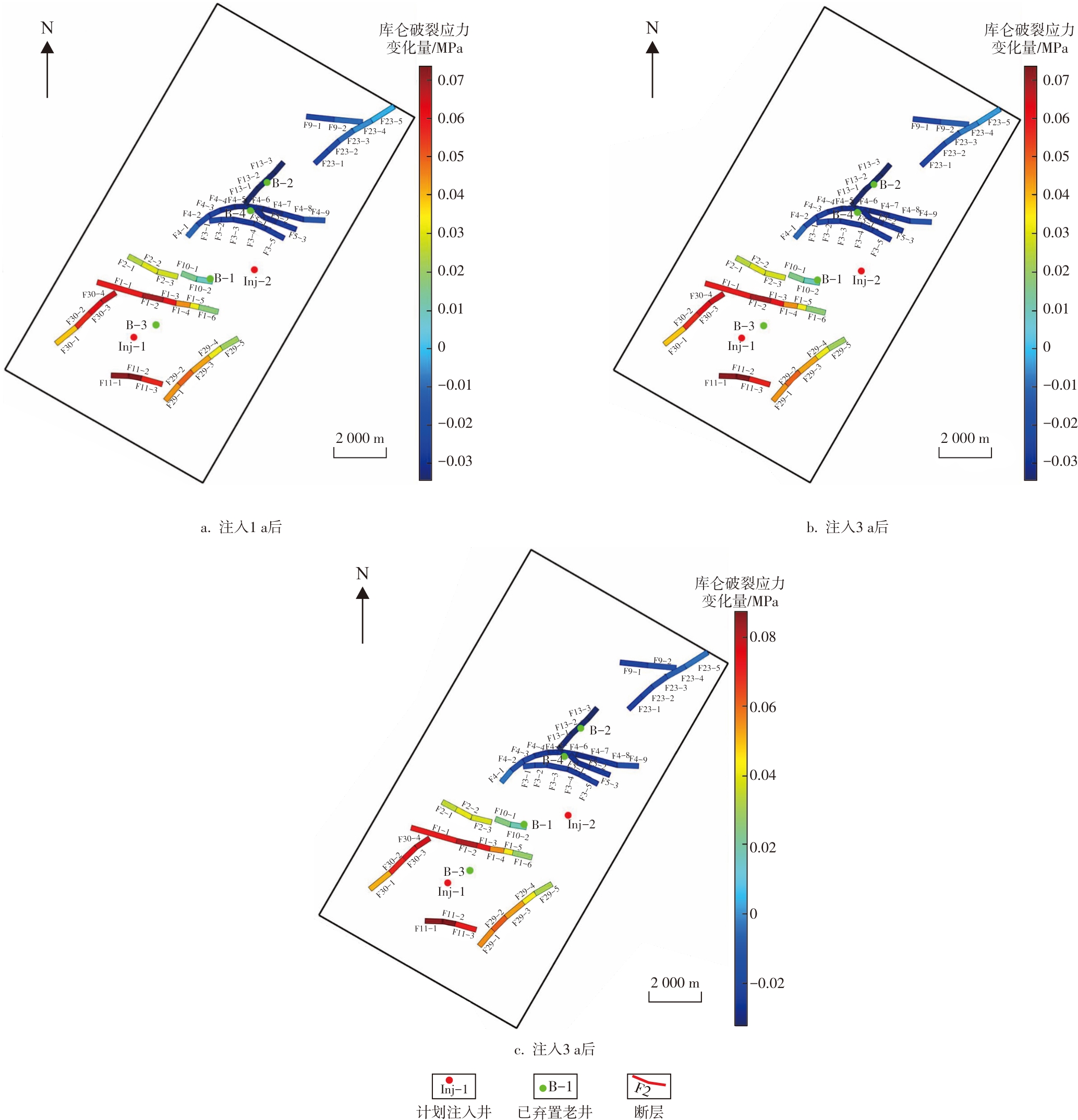
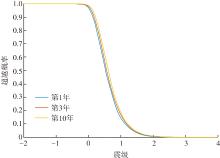
图9
Inj-1注入点按60×10⁴ t/a封存规模注入CO2时诱发地震震级超越概率"
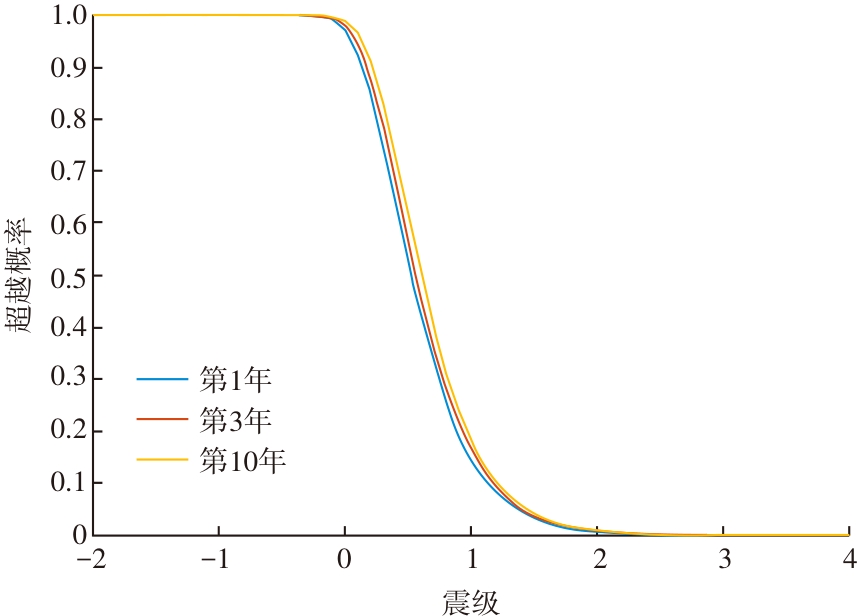
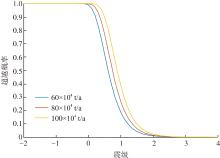
图10
Inj-1注入点以不同速率注入第10年诱发地震震级超越概率"
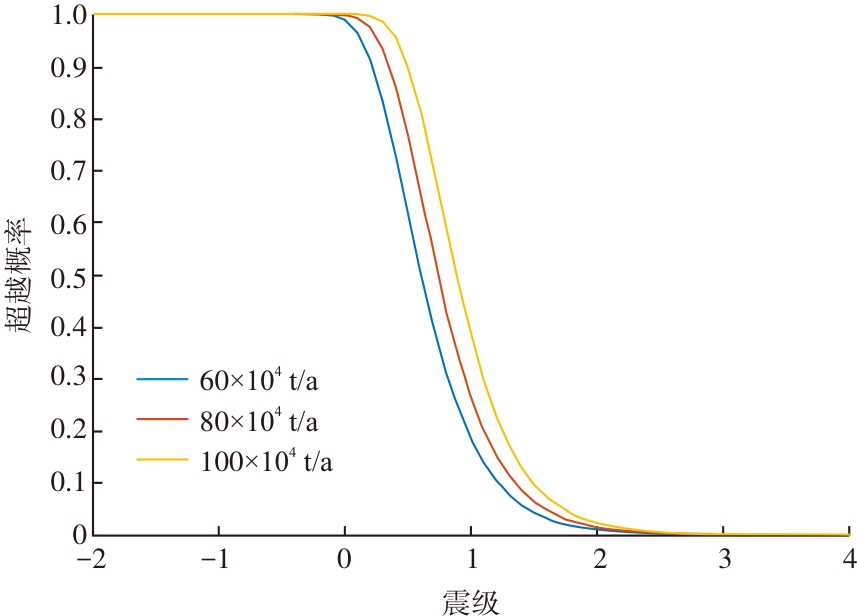
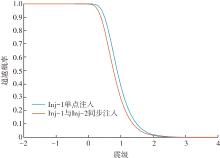
图 11
Inj-1与Inj-2注入点同步注入第10年诱发地震震级超越概率"
| [1] | 叶晓东, 陈军, 陈曦, 等. “双碳”目标下的中国CCUS技术挑战及对策[J]. 油气藏评价与开发, 2024, 14(1): 1-9. |
| YE Xiaodong, CHEN Jun, CHEN Xi, et al. China’s CCUS technology challenges and countermeasures under “double carbon” target[J]. Petroleum Reservoir Evaluation and Development, 2024, 14(1): 1-9. | |
| [2] | 何志勇, 郭本帅, 汪东, 等. CO2捕集和利用技术的应用与研发进展[J]. 油气藏评价与开发, 2024, 14(1): 70-75. |
| HE Zhiyong, GUO Benshuai, WANG Dong, et al. Application and research progress of CO2 capture and utilization technology[J]. Petroleum Reservoir Evaluation and Development, 2024, 14(1): 70-75. | |
| [3] | 姚红生, 邱伟生, 周德华, 等. 苏北盆地复杂断块油藏CCUS-EOR关键技术与实践[J]. 天然气工业, 2025, 45(9): 212-222. |
| YAO Hongsheng, QIU Weisheng, ZHOU Dehua, et al. Key technologies and practices of CCUS-EOR in complex fault-block reservoirs in the Subei Basin[J]. Natural Gas Industry, 2025, 45(9): 212-222. | |
| [4] | Global CCS Institute. The Global Status of CCS: 2023[R] Melbourne: Global CCS Institute, 2023. |
| [5] | 陈宏举, 刘强, 孙丽丽, 等. 海上油气低碳发展现状与展望[J]. 油气藏评价与开发, 2024, 14(6): 981-989. |
| CHEN Hongju, LIU Qiang, SUN Lili, et al. Status and prospects of low carbon development in offshore oil and gas industry[J]. Petroleum Reservoir Evaluation and Development, 2024, 14(6): 981-989. | |
| [6] | 新华社. 我国海域二氧化碳地质封存潜力2.58万亿吨[EB/OL]. (2023-1-13)[2025-01-12]. . |
| Xinhua News Agency. China’s offshore carbon dioxide geological storage potential reaches 2.58×10¹² tons[EB/OL]. (2023-1-13)[2025-01-12]. . | |
| [7] | CARROLL A G, PRZESLAWSKI R, RADKE L C, et al. Environmental considerations for subseabed geological storage of CO2: A review[J]. Continental Shelf Research, 2014, 83: 116-128. |
| [8] | 周冰, 伦增珉, 张杰, 等. CO2地质封存过程中盖层和裂缝的自封闭机制研究现状[J]. 石油实验地质, 2025, 47(5): 1177-1184. |
| ZHOU Bing, Zengmin LUN, ZHANG Jie, et al. Research status of self-sealing mechanisms of caprocks and fractures during CO2 geological storage[J]. Petroleum Geology & Experiment, 2025, 47(5): 1177-1184. | |
| [9] | 吴林强, 张涛, 睢雨璋, 等. 海域二氧化碳地质封存发展的国际经验与启示[J]. 中国国土资源经济, 2023, 36(4): 59-66. |
| WU Linqiang, ZHANG Tao, SUI Yuzhang, et al. International experience and enlightenment of the development of carbon dioxide geological storage in sea areas[J]. Natural Resource Economics of China, 2023, 36(4): 59-66. | |
| [10] | 柴愈坤, 任旭, 戴建文, 等. 海上咸水层CO2封存断层侧向封闭性评价: 以珠江口盆地恩平凹陷恩平A油田为例[J]. 石油实验地质, 2025, 47(5): 1185-1197. |
| CHAI Yukun, REN Xu, DAI Jianwen, et al. Evaluation of fault lateral sealing for CO2 storage in offshore saline aquifers: A case study of Enping A Oilfield in Enping Sag, Pearl River Mouth Basin[J]. Petroleum Geology & Experiment, 2025, 47(5): 1185-1197. | |
| [11] | KORBØL R, KADDOUR A. Sleipner vest CO2 disposal-injection of removed CO2 into the utsira formation[J]. Energy Conversion and Management, 1995, 36(6-9): 509-512. |
| [12] | FURRE A K, EIKEN O, ALNES H, et al. 20 years of monitoring CO2-injection at Sleipner[J]. Energy Procedia, 2017, 114: 3916-3926. |
| [13] | HANSEN O, GILDING D, NAZARIAN B, et al. Snøhvit: The history of injecting and storing 1 Mt CO2 in the fluvial Tubåen Fm[J]. Energy Procedia, 2013, 37: 3565-3573. |
| [14] | MARSHALL J P. A social exploration of the west Australian Gorgon gas, carbon capture and storage project[J]. Clean Technologies, 2022, 4(1): 67-90. |
| [15] | VAN DER MEER L G H. The K12-B CO2 injection project in the Netherlands[M]. Cambridge: Woodhead Publishing, 2013. |
| [16] | TANAKA Y, SAWADA Y, TANASE D, et al. Tomakomai CCS demonstration project of Japan, CO2 injection in process[J]. Energy Procedia, 2017, 114: 5836-5846. |
| [17] | 衣华磊, 郭欣, 贾津耀, 等. 恩平15-1油田开发CO2回注封存工程方案研究[J]. 中国海上油气, 2023, 35(1): 163-169. |
| YI Hualei, GUO Xin, JIA Jinyao, et al. Research on CO2 re-injection and storage engineering scenario of EP15-1 oilfield development[J]. China Offshore Oil and Gas, 2023, 35(1): 163-169. | |
| [18] | MCGARR A, SIMPSON D, SEEBER L. Case histories of induced and triggered seismicity[J]. International Geophysics, 2002, 81(Part A): 647-661. |
| [19] | 谢玉洪, 王建花, 袁全社. 中国海洋深水区油气地球物理勘探技术进展[J]. 石油物探, 2025, 64(3): 397-415. |
| XIE Yuhong, WANG Jianhua, YUAN Quanshe. Advances in deepwater hydrocarbon geophysical exploration technologies in China[J]. Geophysical Prospecting for Petroleum, 2025, 64(3): 397-415. | |
| [20] | HEALY J H, RUBEY W W, GRIGGS D T, et al. The Denver earthquakes[J]. Science, 1968, 161(3848): 1301-1310. |
| [21] | YEO I W, BROWN M R M, GE S, et al. Causal mechanism of injection-induced earthquakes through the Mw 5.5 Pohang earthquake case study[J]. Nature Communications, 2020, 11(1): 2614. |
| [22] | GOERTZ-ALLMANN B P, KÜHN D, OYE V, et al. Combining microseismic and geomechanical observations to interpret storage integrity at the In Salah CCS site[J]. Geophysical Journal International, 2014, 198(1): 447-461. |
| [23] | KAVEN J O, HICKMAN S H, MCGARR A F, et al. Surface monitoring of microseismicity at the Decatur, Illinois, CO2 sequestration demonstration site[J]. Seismological Research Letters, 2015, 86(4): 1096-1101. |
| [24] | QIN Y, LI J X, HUANG L J, et al. Microseismic monitoring at the Farnsworth CO2-EOR field[J]. Energies, 2023, 16(10): 4177. |
| [25] | 魏晓琛, 李琦, 邢会林, 等. 地下流体注入诱发地震机理及其对CO2地下封存工程的启示[J]. 地球科学进展, 2014, 29(11): 1226-1241. |
| WEI Xiaochen, LI Qi, XING Huilin, et al. Mechanism of underground fluid injection induced seismicity and its implications for CCS projects[J]. Advances in Earth Science, 2014, 29(11): 1226-1241. | |
| [26] | 白莹. 中国东部中、新生代盆地演化特征及构造迁移规律[D]. 北京: 中国地质大学(北京), 2014. |
| BAI Ying. Evolution features and tectonic migration trends of the Mesozoic and Cenozoic basins in Eastern China [D]. Beijing: China University of Geosciences (Beijing), 2014. | |
| [27] | 吴柘锟, 李琦, 张迎朝, 等. 东海陆架盆地丽水凹陷古新统物源分析及地质意义[J]. 石油实验地质, 2023, 45(1): 122-134. |
| WU Zhekun, LI Qi, ZHANG Yingzhao, et al. Provenance analysis and geological significance of Paleocene in Lishui Sag, East China Sea Shelf Basin[J]. Petroleum Geology & Experiment, 2023, 45(1): 122-134. | |
| [28] | 蒋一鸣, 赵洪, 唐贤君, 等. 东海盆地西湖凹陷平湖斜坡带平北区始新统宝石组沉积环境及沉积相类型[J]. 石油实验地质, 2025, 47(5): 941-950. |
| JIANG Yiming, ZHAO Hong, TANG Xianjun, et al. Sedimentary environment and facies types of Eocene Baoshi Formation in Pingbei area, Pinghu slope belt, Xihu Sag, East China Sea Basin[J]. Petroleum Geology & Experiment, 2025, 47(5): 941-950. | |
| [29] | 白冰, 李小春, 刘延锋, 等. 中国CO2集中排放源调查及其分布特征[J]. 岩石力学与工程学报, 2006, 25(): 2918-2923. |
| BAI Bing, LI Xiaochun, LIU Yanfeng, et al. Preliminary study on CO2 industrial point sources and their distribution in China [J]. Chinese Journal of Rock Mechanics and Engineering, 2006, 25(): 2918-2923. | |
| [30] | 霍传林. 我国近海二氧化碳海底封存潜力评估和封存区域研究[D]. 大连: 大连海事大学, 2014. |
| HUO Chuanlin. Study on the potential evaluation and the storage areas of the carbon dioxide seabed storage in offshore China[D]. Dalian: Dalian Maritime University, 2014. | |
| [31] | 赵勇, 李久娣, 杨鹏程, 等. 东海陆架盆地咸水层CO2封存地质条件适宜性评价[J]. 海洋地质与第四纪地质, 2023, 43(4): 129-139. |
| ZHAO Yong, LI Jiudi, YANG Pengcheng, et al. Evaluation on of geological suitability for CO2 storage in salty aquifers in the East China Sea Shelf Basin[J]. Marine Geology & Quaternary Geology, 2023, 43(4): 129-139. | |
| [32] | 可行, 陈建文, 龚建明, 等. 东海陆架盆地CO2地质封存适宜性评价[J]. 海洋地质前沿, 2023, 39(7): 1-12. |
| KE Xing, CHEN Jianwen, GONG Jianming, et al. Suitability evaluation of CO2 sequestration in the East China Sea shelf basin[J]. Marine Geology Frontiers, 2023, 39(7): 1-12. | |
| [33] | 陈建文, 孙晶, 杨长清, 等. 东海陆架盆地新生界咸水层二氧化碳封存地质条件及封存前景[J]. 海洋地质前沿, 2023, 39(10): 14-21. |
| CHEN Jianwen, SUN Jing, YANG Changqing, et al. Geological conditions and prospects of carbon dioxide storage in the Cenozoic saline water layers of the East China Sea Shelf Basin[J]. Marine Geology Frontiers, 2023, 39(10): 14-21. | |
| [34] | 王腊梅, 涂齐催, 毛云新, 等. 西湖凹陷斜坡带平湖组富煤地层弱煤优化处理[J]. 石油物探, 2025, 64(2): 379-387. |
| WANG Lamei, TU Qicui, MAO Yunxin, et al. Optimal treatment of weak coal in coal-rich strata of Pinghu formation in slope zone of Xihu sag[J]. Geophysical Prospecting for Petroleum, 2025, 64(2): 379-387. | |
| [35] | KANG J Q, ZHU J B, ZHAO J. A review of mechanisms of induced earthquakes: From a view of rock mechanics[J]. Geomechanics and Geophysics for Geo-Energy and Geo-Resources, 2019, 5: 171-196. |
| [36] | SHAPIRO S A, DINSKE C. Scaling of seismicity induced by nonlinear fluid-rock interaction[J]. Journal of Geophysical Research: Solid Earth, 2009, 114(B9): 1-14. |
| [37] | DENG K, LIU Y J, HARRINGTON R M. Poroelastic stress triggering of the December 2013 Crooked Lake, Alberta, induced seismicity sequence[J]. Geophysical Research Letters, 2016, 43(16): 8482-8491. |
| [38] | GUGLIELMI Y, CAPPA F, AVOUAC J P, et al. Seismicity triggered by fluid injection-induced aseismic slip[J]. Science, 2015, 348(6240): 1224-1226. |
| [39] | SHAPIRO S A, DINSKE C, KUMMEROW J. Probability of a given-magnitude earthquake induced by a fluid injection[J]. Geophysical Research Letters, 2007, 34(22): 1-5. |
| [40] | MCGARR A. Maximum magnitude earthquakes induced by fluid injection[J]. Journal of Geophysical Research: Solid Earth, 2014, 119(2): 1008-1019. |
| [41] | HAKIMHASHEMI A H, SCHOENBALL M, HEIDBACH O, et al. Forward modelling of seismicity rate changes in georeservoirs with a hybrid geomechanical–statistical prototype model[J]. Geothermics, 2014, 52: 185-194. |
| [42] | LUU K, SCHOENBALL M, OLDENBURG C M, et al. Coupled hydromechanical modeling of induced seismicity from CO2 injection in the Illinois Basin[J]. Journal of Geophysical Research: Solid Earth, 2022, 127(5): 1-19. |
| [43] | CHANG K W, YOON H. Mitigating injection-induced seismicity along basement faults by extraction: Application to 2016-2018 Pohang earthquakes[J]. Journal of Geophysical Research: Solid Earth, 2021, 126(4): 1-20. |
| [44] | DIETERICH J. A constitutive law for rate of earthquake production and its application to earthquake clustering[J]. Journal of Geophysical Research: Solid Earth, 1994, 99(B2): 2601-2618. |
| [45] | DIETERICH J, CAYOL V, OKUBO P. The use of earthquake rate changes as a stress meter at Kilauea volcano[J]. Nature, 2000, 408(6811): 457-460. |
| [46] | MARONE C. Laboratory-derived friction laws and their application to seismic faulting[J]. Annual Review of Earth and Planetary Sciences, 1998, 26(1): 643-696. |
| [47] | GUTENBERG B, RICHTER C F. Frequency of earthquakes in California[J]. Bulletin of the Seismological Society of America, 1944, 34(4): 185-188. |
| [48] | NAVAS-PORTELLA V, JIMÉNEZ A, CORRAL Á. No significant effect of Coulomb stress on the Gutenberg-Richter Law after the Landers earthquake[J]. Scientific Reports, 2020, 10(1): 2901. |
| [49] | 刘金水, 廖宗廷, 贾健谊. 东海陆架盆地地质结构及构造演化[J]. 上海地质, 2003, 87(3): 1-6. |
| LIU Jinshui, LIAO Zongting, JIA Jianyi. The geological structure and tectonic evolution of the East China Sea shelf basin[J]. Shanghai Geology, 2003, 87(3): 1-6. | |
| [50] | 祝建军, 王琪, 梁建设, 等. 东海陆架盆地南部新生代地质结构与构造演化特征研究[J]. 天然气地球科学, 2012, 23(2): 222-229. |
| ZHU Jianjun, WANG Qi, LIANG Jianshe, et al. Cenozoic geological structure and tectonic evolution of southern East China Sea shelf basin[J]. Natural Gas Geoscience, 2012, 23(2): 222-229. | |
| [51] | 张绍亮, 张建培, 唐贤君, 等. 东海西湖凹陷断裂系统几何学特征及其成因机制[J]. 海洋地质与第四纪地质, 2014, 34(1): 87-94. |
| ZHANG Shaoliang, ZHANG Jianpei, TANG Xianjun, et al. Geometry characteristic of the fault system in Xihu Sag in East China Sea and its formation mechanism[J]. Marine Geology & Quaternary Geology, 2014, 34(1): 87-94. | |
| [52] | 何新建, 唐贤君, 蒋一鸣, 等. 东海西湖凹陷中新世中晚期断裂活动特征及中浅层勘探启示[J]. 海洋地质与第四纪地质, 2023, 43(3): 167-174. |
| HE Xinjian, TANG Xianjun, JIANG Yiming, et al. Middle-late Miocene fault activity and its petroleum exploration significance of middle-shallow layers in the Xihu Sag, East China Sea[J]. Marine Geology & Quaternary Geology, 2023, 43(3): 167-174. | |
| [53] | 高战武, 缑亚森, 钟慧, 等. 中国东部海域断裂构造格架与地震活动研究[J]. 震灾防御技术, 2021, 16(1): 11-18. |
| GAO Zhanwu, GOU Yasen, ZHONG Hui, et al. Fault structure frame and seismicity in the sea on the Eastside of Chinese Mainland[J]. Technology for Earthquake Disaster Prevention, 2021, 16(1): 11-18. | |
| [54] | ELLSWORTH W L. Injection-induced earthquakes[J]. Science, 2013, 341(6142): 1225942. |
| [55] | WYNANTS-MOREL N, DE BARROS L, CAPPA F. Sensitivity of the seismic moment released during fluid injection to fault hydromechanical properties and background stress[J]. Frontiers in Earth Science, 2021, 9: 638723. |
| [56] | 王华忠, 曾同生, 吴成梁, 等. 深层超深层油气勘探技术路线及针对性地震波成像处理方法技术[J]. 石油物探, 2025, 64(3): 416-432. |
| WANG Huazhong, ZENG Tongsheng, WU Chengliang, et al. Deep-ultradeep oil and gas exploration methodology and targeted seismic wave imaging methodology[J]. Geophysical Prospecting for Petroleum, 2025, 64(3): 416-432. | |
| [57] | 易浩, 张卫卫, 肖张波, 等. 基于拉东变换的多尺度断裂识别方法及其应用[J]. 石油物探, 2024, 63(2): 289-301. |
| YI Hao, ZHANG Weiwei, XIAO Zhangbo, et al. Multi-scale fault identification method based on Radon transform and its application[J]. Geophysical Prospecting for Petroleum, 2024, 63(2): 289-301. | |
| [58] | 何叶, 张卫卫, 刘培, 等. 复杂断裂精细成像技术在南海东部惠州21洼的应用[J]. 石油物探, 2024, 63(2): 346-356. |
| HE Ye, ZHANG Weiwei, LIU Pei, et al. Application of high precision complex fault imaging in Huizhou 21 sag, eastern South China Sea[J]. Geophysical Prospecting for Petroleum, 2024, 63(2): 346-356. | |
| [59] | 伍海清, 白冰, 李小春, 等. CO2地质封存中储层流体压力演化规律的解析模型[J]. 岩土力学, 2018, 39(6): 2099-2105. |
| WU Haiqing, BAI Bing, LI Xiaochun, et al. Analytical model of fluid pressure evolution in the reservoir for CO2 geological storage[J].Rock and Soil Mechanics, 2018, 39(6): 2099-2105. | |
| [60] | KING G C P, STEIN R S, LIN J. Static stress changes and the triggering of earthquakes[J]. Bulletin of the Seismological Society of America, 1994, 84(3): 935-953. |
| [61] | 万永革, 吴忠良, 周公威, 等. 地震应力触发研究[J]. 地震学报, 2002, 24(5): 533-551. |
| WAN Yongge, WU Zhongliang, ZHOU Gongwei, et al. Research on seismic stress triggering[J]. Acta Seismologica Sinca, 2002(5): 533-551. | |
| [62] | BAKER J W, BRADLEY B A, STAFFORD P J. Seismic hazard and risk analysis[M]. Cambridge: Cambridge University Press, 2021. |
| [1] | 林千果, 王冀星. CO2地质封存泄漏迁移转化模拟研究综述与展望 [J]. 油气藏评价与开发, 2026, 16(1): 11-22. |
| [2] | 杨龙, 许寻, 郭立强, 张艺钟, 王坤, 郑晶晶. 深部咸水层CO2地质封存相平衡参数修正模型 [J]. 油气藏评价与开发, 2026, 16(1): 61-73. |
| [3] | 阴国锋, 赵勇. 东海陆架盆地西湖凹陷障壁滨岸沉积体系及特征——以平北地区平湖组早期为例 [J]. 油气藏评价与开发, 2026, 16(1): 186-197. |
| [4] | 王能昊, 连威, 李军, 李佳琦. CO2深部咸水层封存羽流演变与储盖层完整性影响因素研究——以神华CCS项目为例 [J]. 油气藏评价与开发, 2026, 16(1): 128-140. |
| [5] | 李经纬, 彭勃, 王泽滕, 陈晓倩, 张正昊, 刘金栋, 刘双星, 李晓枫. 油气藏CO2封存潜力评估模型与实践进展 [J]. 油气藏评价与开发, 2026, 16(1): 141-152. |
| [6] | 王健伟, 吕鹏, 王泽群, 严曙梅, 潘潞, 林立新, 王瑞, 徐晨, 刘舒, 黄小娟. 平湖组砂层组级别沉积演化及主控因素——以东海陆架盆地西湖凹陷W井区为例 [J]. 油气藏评价与开发, 2025, 15(5): 773-787. |
| [7] | 张沛, 李昆, 庄建建, 谭毅滢. 东海陆架盆地西湖凹陷三潭深凹储层差异成岩演化与评价 [J]. 油气藏评价与开发, 2025, 15(5): 760-772. |
| [8] | 江东辉, 庄建建, 杏绿芽, 张传运, 袁忠鹏, 杨超. 西湖凹陷迎翠轩地区钻遇古新统证据探讨及意义 [J]. 油气藏评价与开发, 2025, 15(5): 750-759. |
| [9] | 李久娣, 田彬, 李基伟, 王健伟, 赵天沛, 丁利. 东海低渗气藏开发实践与思考 [J]. 油气藏评价与开发, 2025, 15(5): 734-739. |
| [10] | 张尚虎, 李昆, 庄建建, 朱宝衡, 郑欣, 杨超. 断陷期源汇系统及勘探方向——以东海陆架盆地西湖凹陷平北地区为例 [J]. 油气藏评价与开发, 2025, 15(5): 722-733. |
| [11] | 赵勇, 李久娣, 严曙梅, 李基伟, 田彬, 潘潞, 徐晨, 陈磊, 雷蕾, 吕鹏. 东海陆架盆地西湖凹陷油气开发技术及攻关方向 [J]. 油气藏评价与开发, 2025, 15(5): 711-721. |
| [12] | 杨术刚, 任金蔓, 蔡明玉, 刘浩童, 刘双星, 薛明, 张坤峰. 气田采出水回注地层CO2封存赋存状态研究 [J]. 油气藏评价与开发, 2025, 15(4): 656-663. |
| [13] | 孙东升, 张顺康, 王智林, 葛政俊, 林波. 苏北断块型圈闭基于安全性CO2地质封存能力计算方法研究 [J]. 油气藏评价与开发, 2025, 15(4): 641-645. |
| [14] | 李士伦,汤勇,段胜才,秦佳正,陈一诺,刘雅昕,郑鹏,赵国庆. CO2地质封存源汇匹配及安全性评价进展 [J]. 油气藏评价与开发, 2023, 13(3): 269-297. |
|
||
