
油气藏评价与开发 ›› 2026, Vol. 16 ›› Issue (1): 43-51.doi: 10.13809/j.cnki.cn32-1825/te.2025034
林雨彤1( ), 张琦2, 刘成果1, 彭明国1(), 李雨洁1, 赵静1, 刘润1, 李秋1, 刘雅莉1
收稿日期:2025-01-17
发布日期:2026-01-06
出版日期:2026-01-26
通讯作者:
彭明国(1976—),男,博士,教授,从事油气田开发研究。地址:江苏省常州市武进区滆湖中路21号常州大学,邮政编码:213164。E-mail:pmg@cczu.edu.cn作者简介:林雨彤(2000—),女,在读硕士研究生,从事油气田开发研究。地址:江苏省常州市武进区滆湖中路21号常州大学,邮政编码:213164。E-mail:s23040857033@smail.cczu.edu.cn
基金资助:
LIN Yutong1(), ZHANG Qi2, LIU Chengguo1, PENG Mingguo1(), LI Yujie1, ZHAO Jing1, LIU Run1, LI Qiu1, LIU Yali1
Received:2025-01-17
Online:2026-01-06
Published:2026-01-26
摘要:
稠油储量约占全球石油剩余探明储量的70%,但其有效开发仍属于世界级难题。研究基于碳捕集、利用与封存(CCUS)技术背景,构建表面完全羟基化的SiO2纳米孔道模拟真实油藏环境,采用分子动力学模拟(MD)方法,深入剖析“CO2-热剂协同”作用下深层稠油乳化过程的微观机理。研究内容聚焦三个方面:一是探究表面活性剂SDS(十二烷基硫酸钠)对深层稠油在SiO2纳米孔中乳化效果的影响,对比有无表面活性剂时油滴的乳化行为与稳定性;二是通过拉伸动力学模拟(SMD),分析油滴在SiO2孔道中受力与运动过程,揭示油滴拉伸与破裂的关键因素;三是研究150 ℃高温下“热+化学剂+CO2”协同作用的深层稠油乳化机理,探讨CO2-热剂协同的乳化效果。结果表明:①添加表面活性剂可显著改善乳化稳定性,使油滴溶剂可及表面积平均增加7.4%,并优化油滴空间分布;②油滴运动需克服孔道表面水化层阻力,质心位移与外力呈三阶段演化关系;③CO2分子与热剂协同作用能有效促进深层稠油乳化,使油滴扩散系数达5.733×10⁻⁹ m2/s,较单独热剂条件提高31.0%。该研究为CO2-热剂协同条件下深层稠油乳化提供了新的理论依据,也为实际油田开采中深层稠油的高效提取提供了潜在技术参考。
中图分类号:
LIN Yutong,ZHANG Qi,LIU Chengguo, et al. Study on microscopic mechanism of deep heavy oil emulsification under synergistic CO2-thermal agent conditions[J]. Petroleum Reservoir Evaluation and Development, 2026, 16(1): 43-51.
图1
模拟中使用的沥青质和胶质分子"
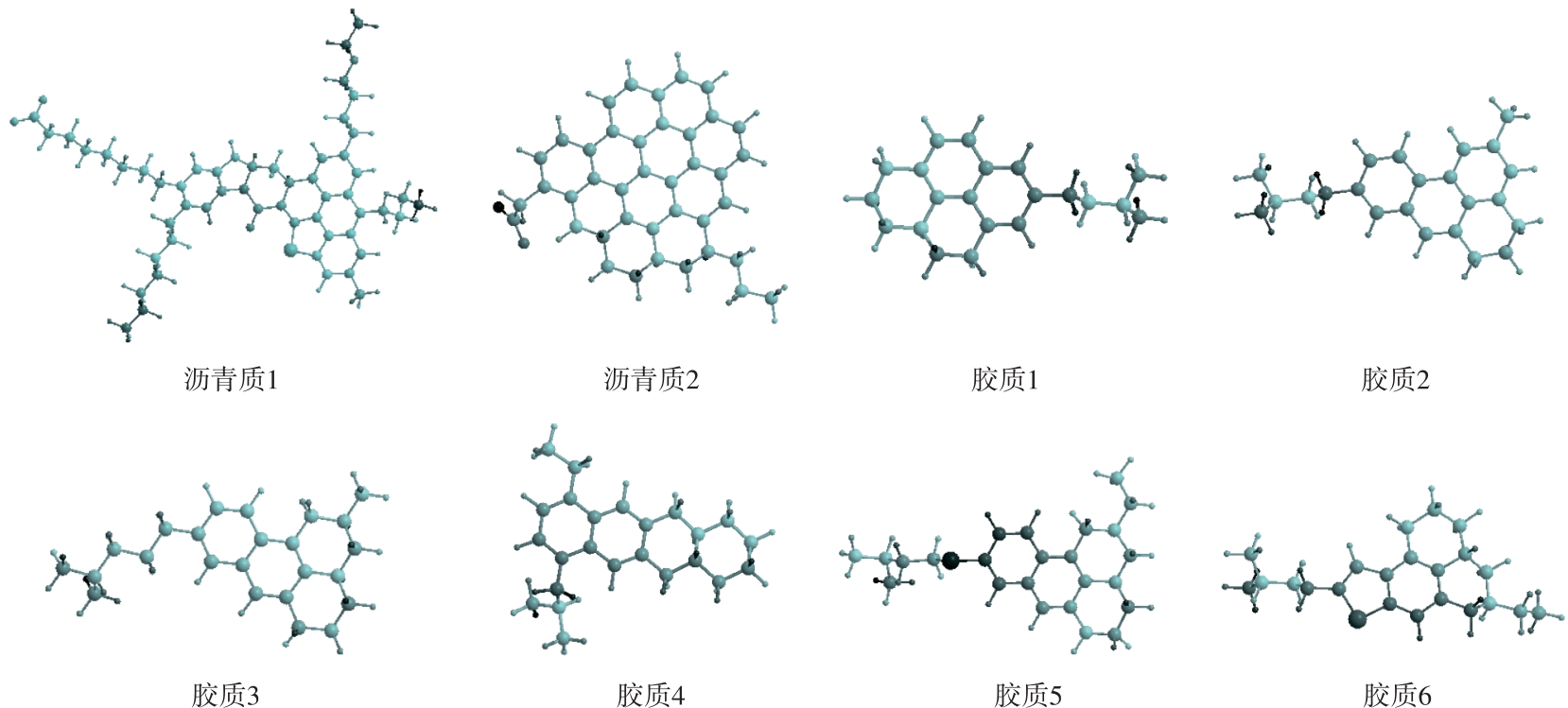

表1
原油组分及分子数"
| 组分类型 | 具体组分 | 分子数 | 组分类型 | 具体组分 | 分子数 | |
|---|---|---|---|---|---|---|
| 重质组分 | 沥青质 | 沥青质 1 | 4 | 轻质组分 | 苯 | 13 |
| 沥青质 2 | 4 | 环庚烷 | 35 | |||
| 胶质 | 胶质 1 | 5 | 环己烷 | 22 | ||
| 胶质 2 | 5 | 庚烷 | 29 | |||
| 胶质 3 | 5 | 己烷 | 32 | |||
| 胶质 4 | 5 | 壬烷 | 40 | |||
| 胶质 5 | 5 | 辛烷 | 34 | |||
| 胶质 6 | 5 | 甲苯 | 35 | |||

图2
油滴形成过程(忽略水分子)"
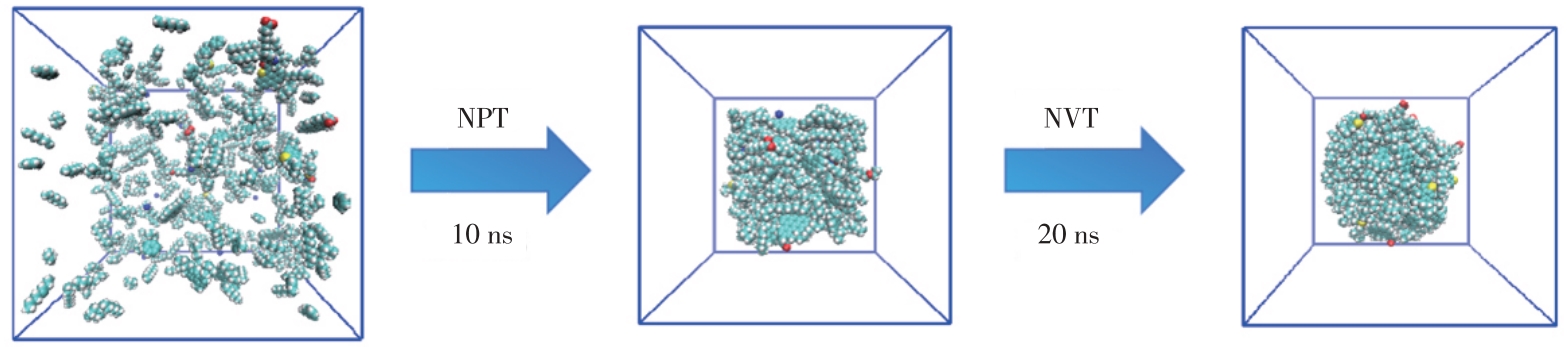
图3
表面活性剂乳化油滴过程(忽略水分子)"
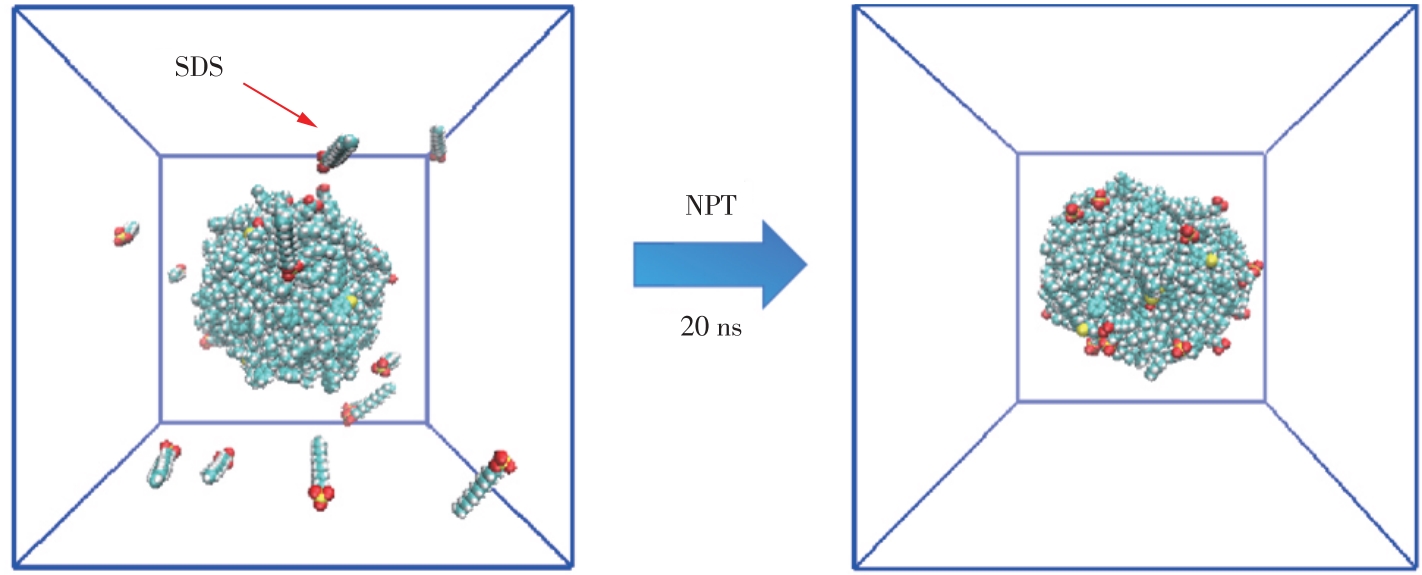
图4
CO2-热剂协同作用下稠油体系构建"
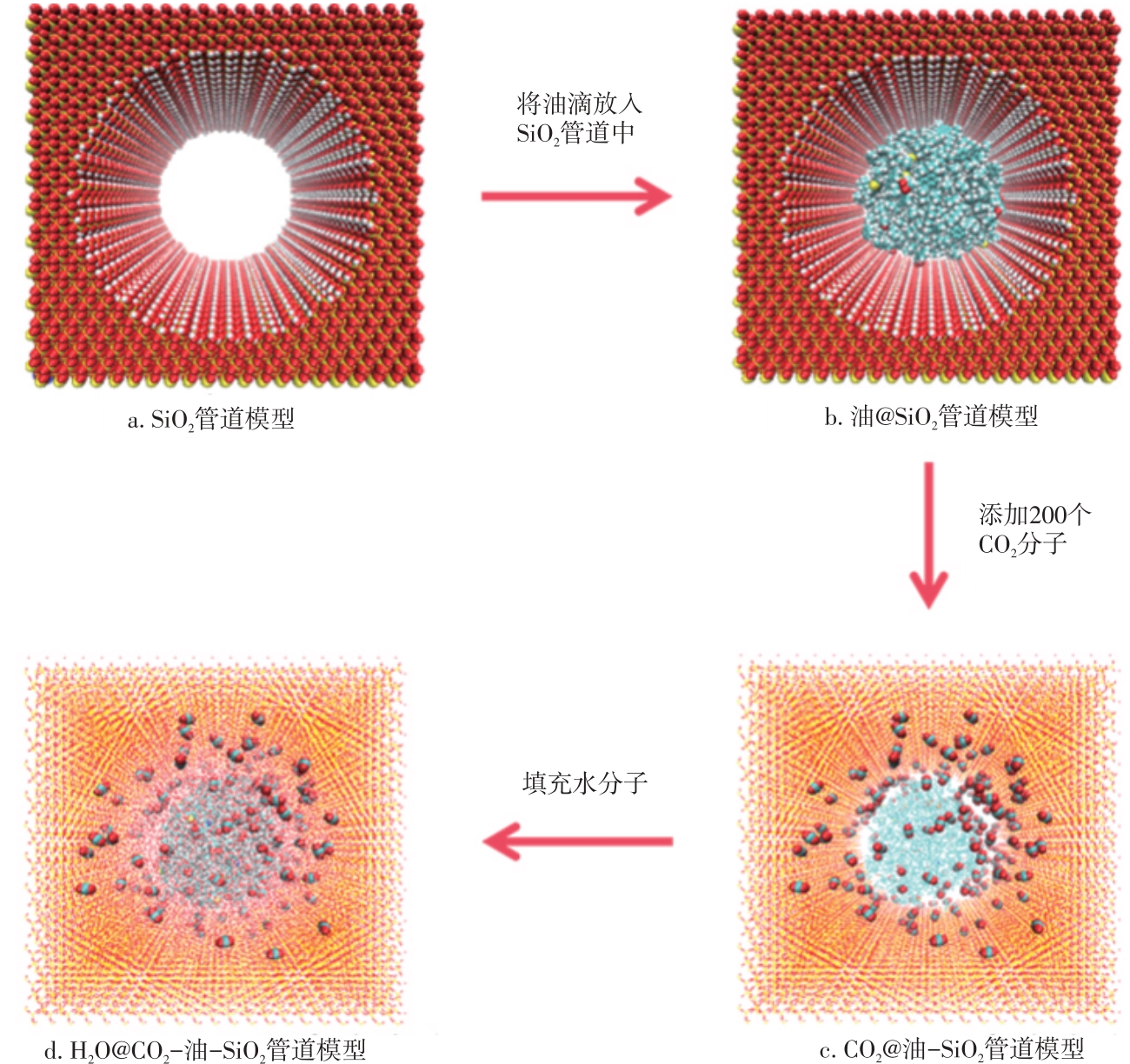
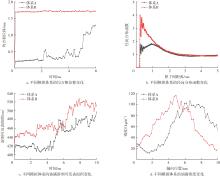
图5
表面活性剂对稠油乳化行为的多维特征影响"

图6
油滴迁移过程中质心位移随模拟时间的变化"
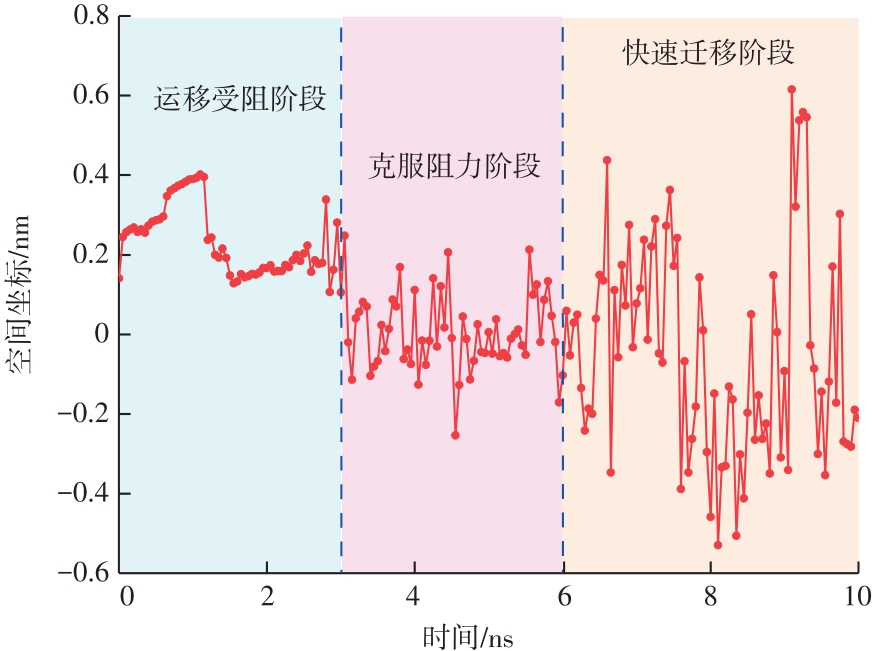
图7
油滴迁移过程中外力随模拟时间的变化"
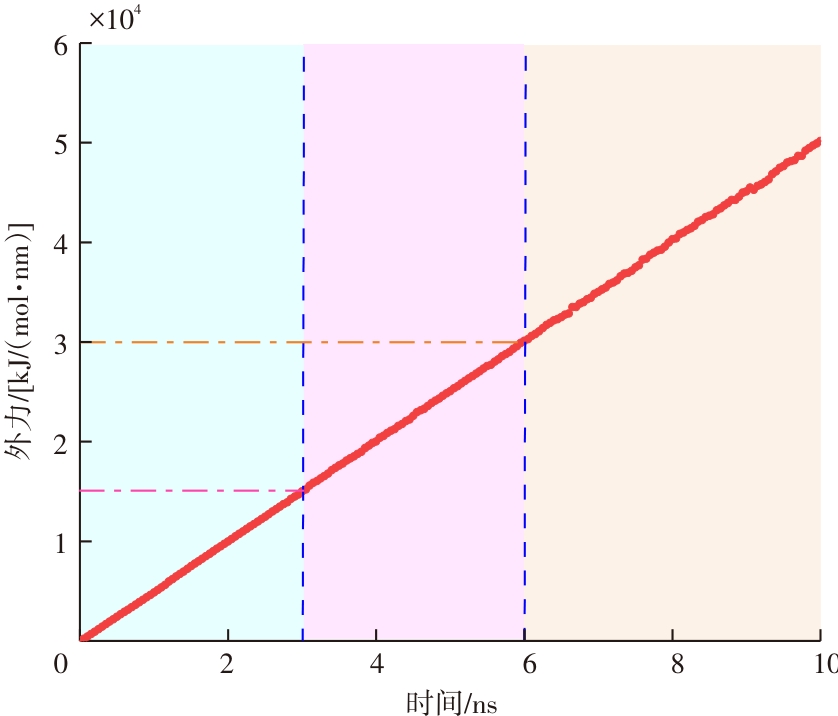
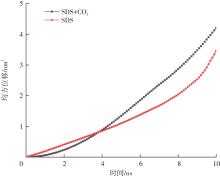
图8
均方位移与模拟时间的变化"
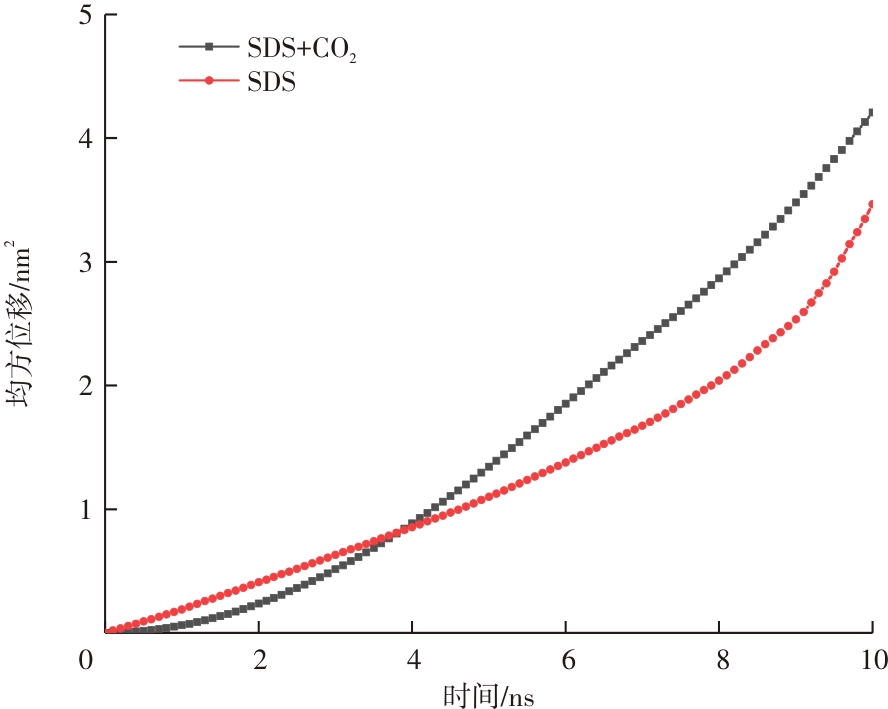
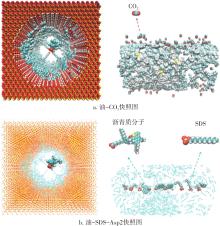
图9
模拟结果快照图(忽略水分子)"

| [1] | 刘晓瑜, 赵德喜, 李元庆, 等. 稠油开采技术及研究进展[J]. 精细石油化工进展, 2018, 19(1): 10-13. |
| LIU Xiaoyu, ZHAO Dexi, LI Yuanqing, et al. Progress of research on viscous crude production techniques[J]. Advances in Fine Petrochemicals, 2018, 19(1): 10-13. | |
| [2] | 黄琴, 桑丹, 张俊, 等. 渤海稠油多轮次蒸汽吞吐井开发后期接替技术研究[J]. 重庆科技大学学报(自然科学版), 2024, 26(5): 9-16. |
| HUANG Qin, SANG Dan, ZHANG Jun, et al. Replacement technology in the later stage of Bohai heavy oil multi-cycle steam stimulation well development[J]. Journal of Chongqing University of Science and Technology (Natural Science Edition), 2024, 26(5): 9-16. | |
| [3] | 石彦, 谢俊辉, 郭小婷, 等. 新疆油田中深层稠油CO2驱/吞吐实验研究[J]. 油气藏评价与开发, 2024, 14(1): 76-82. |
| SHI Yan, XIE Junhui, GUO Xiaoting, et al. Experimental study on CO2 flooding/huff and puff of medium-deep heavy oil in Xinjiang Oilfield[J]. Petroleum Reservoir Evaluation and Development, 2024, 14(1): 76-82. | |
| [4] | 李建山, 高浩, 鄢长灏, 等. 原油-CO2相互作用机理分子动力学模拟研究[J]. 油气藏评价与开发, 2024, 14(1): 26-34. |
| LI Jianshan, GAO Hao, YAN Changhao, et al. Molecular dynamics simulation on interaction mechanisms of crude oil and CO2 [J]. Petroleum Reservoir Evaluation and Development, 2024, 14(1): 26-34. | |
| [5] | 卢川. 稠油油藏气体-化学剂辅助注蒸汽改善开发效果研究[D]. 北京: 中国石油大学(北京), 2015. |
| LU Chuan. The improvement effects of gas and chemical agent during steam injection process for heavy oil[D]. Beijing: China University of Petroleum (Beijing), 2015. | |
| [6] | 柏明星, 张志超, 陈巧珍, 等. 二氧化碳置换法开采天然气水合物研究进展[J]. 石油与天然气地质, 2024, 45(2): 553-564. |
| BAI Mingxing, ZHANG Zhichao, CHEN Qiaozhen, et al. Advances in research on CO2 replacement for natural gas hydrate exploitation[J]. Oil & Gas Geology, 2024, 45(2): 553-564. | |
| [7] | 姚红生, 邱伟生, 周德华, 等. 苏北盆地复杂断块油藏CCUS-EOR关键技术与实践[J]. 天然气工业, 2025, 45(9): 212-222. |
| YAO Hongsheng, QIU Weisheng, ZHOU Dehua, et al. Key technologies and practices of CCUS-EOR in complex fault-block reservoirs in the Subei Basin[J]. Natural Gas Industry, 2025, 45(9): 212-222. | |
| [8] | 陈玉祥, 陈军, 潘成松, 等. 沥青质/胶质影响稠油乳状液稳定性的研究[J]. 应用化工, 2009, 38(2): 194-200. |
| CHEN Yuxiang, CHEN Jun, PAN Chengsong, et al. Influence of asphaltenes and resins on the stability of heavy crude emulsions[J]. Applied Chemical Industry, 2009, 38(2): 194-200. | |
| [9] | LI H, ZHENG S, YANG D. Enhanced swelling effect and viscosity reduction of solvent(s)/CO2/heavy-oil systems[J]. SPE Journal, 2013, 18(4): 695-707. |
| [10] | 张伟, 孙永涛, 林涛, 等. 海上稠油多元热流体吞吐增产机理室内实验研究[J]. 石油化工应用, 2013, 32(1): 34-36. |
| ZHANG Wei, SUN Yongtao, LIN Tao, et al. Experimental study on mechanisms of the multi-fluid thermal recovery on offshore heavy oil[J]. Petrochemical Industry Application, 2013, 32(1): 34-36. | |
| [11] | DONG X, LIU H, HOU J, et al. Multi-thermal fluid assisted gravity drainage process: A new improved-oil-recovery technique for thick heavy oil reservoir[J]. Journal of Petroleum Science and Engineering, 2015, 133: 1-11. |
| [12] | LI Z, LU T, TAO L, et al. CO2 and viscosity breaker assisted steam huff and puff technology for horizontal wells in a super-heavy oil reservoir[J]. Petroleum Exploration and Development, 2011, 38(5): 600-605. |
| [13] | 刘沙沙, 张恒, 王华, 等. 改性氧化石墨烯去除重金属离子的分子动力学模拟[J]. 高等学校化学学报, 2017, 38(1): 63-71. |
| LIU Shasha, ZHANG Heng, WANG Hua, et al. Molecular dynamics simulations of EDTA-modified graphene oxide for Pb(Ⅱ) and Na(Ⅰ) removal[J]. Chemical Journal of Chinese Universities, 2017, 38(1): 63-71. | |
| [14] | 刘沙沙, 王琳, 苑世领, 等. 不同构型聚α-烯烃分子润滑性的分子动力学模拟[J]. 高等学校化学学报, 2019, 40(7): 1472-1479. |
| LIU Shasha, WANG Lin, YUAN Shiling, et al. Molecular dynamics simulation of different configurations of PAO molecules in shear iron plates[J]. Chemical Journal of Chinese Universities, 2019, 40(7): 1472-1479. | |
| [15] | SONG S, ZHANG H, SUN L, et al. Molecular dynamics study on aggregating behavior of asphaltene and resin in emulsified heavy oil droplets with sodium dodecyl sulfate[J]. Energy & Fuels, 2018, 32(12): 12383-12393. |
| [16] | LIU B, SHI J, SUN B, et al. Molecular dynamics simulation on volume swelling of CO2-alkane system[J]. Fuel, 2015, 143: 194-201. |
| [17] | ZHANG J, PAN Z, LIU K, et al. Molecular simulation of CO2 solubility and its effect on octane swelling[J]. Energy & Fuels, 2013, 27(5): 2741-2747. |
| [18] | LIU B, SHI J, WANG M, et al. Reduction in interfacial tension of water-oil interface by supercritical CO2 in enhanced oil recovery processes studied with molecular dynamics simulation[J]. The Journal of Supercritical Fluids, 2016, 111: 171-178. |
| [19] | ZARGARTALEBI M, KHARRAT R, BARATI N. Enhancement of surfactant flooding performance by the use of silica nanoparticles[J]. Fuel, 2015, 143: 21-27. |
| [20] | LE T, OGBE S, STRIOLO A, et al. N-octane diffusivity enhancement via carbon dioxide in silica slit-shaped nanopores-a molecular dynamics simulation[J]. Molecular Simulation, 2016, 42(9): 745-752. |
| [21] | OLIVEIRA N F B, PIRES I D S, MACHUQUEIRO M. Improved GROMOS 54A7 charge sets for phosphorylated Tyr, Ser, and Thr to deal with pH-dependent binding phenomena[J]. Journal of Chemical Theory and Computation, 2020, 16(10): 6368-6376. |
| [22] | KOZIARA K B, STROET M, MALDE A K, et al. Testing and validation of the automated topology builder (ATB) version 2. 0: Prediction of hydration free enthalpies[J]. Journal of Computer-Aided Molecular Design, 2014, 28(3): 221-233. |
| [23] | MALDE A K, ZUO L, BREEZE M, et al. An automated force field topology builder (ATB) and repository: Version 1. 0[J]. Journal of Chemical Theory and Computation, 2011, 7(12): 4026-4037. |
| [24] | BERENDSEN H J C, GRIGERA J R, STRAATSMA T P. The missing term in effective pair potentials[J]. The Journal of Physical Chemistry, 1987, 91(24): 6269-6271. |
| [25] | APOSTOLAKIS J, FERRARA P, CAFLISCH A. Calculation of conformational transitions and barriers in solvated systems: Application to the alanine dipeptide in water[J]. The Journal of Chemical Physics, 1999, 110(4): 2099-2108. |
| [26] | BUSSI G, DONADIO D, PARRINELLO M. Canonical sampling through velocity rescaling[J]. The Journal of Chemical Physics, 2007, 126(1): 014101. |
| [27] | BERENDSEN H J C, POSTMA J P M, VAN GUNSTEREN W F, et al. Molecular dynamics with coupling to an external bath[J]. The Journal of Chemical Physics, 1984, 81(8): 3684-3690. |
| [28] | DARDEN T, YORK D, PEDERSEN L. Particle mesh Ewald: An N⋅log(N) method for Ewald sums in large systems[J]. The Journal of Chemical Physics, 1993, 98(12): 10089-10092. |
| [29] | SHELLEY J C, SPRIK M, KLEIN M L. Molecular dynamics simulation of an aqueous sodium octanoate micelle using polarizable surfactant molecules[J]. Langmuir, 1993, 9(4): 916-926. |
| [30] | BOEK E S, YAKOVLEV D S, HEADEN T F. Quantitative molecular representation of asphaltenes and molecular dynamics simulation of their aggregation[J]. Energy & Fuels, 2009, 23(3): 1209-1219. |
| [31] | CASTELLANO O, GIMON R, CANELON C, et al. Molecular interactions between Orinoco Belt resins[J]. Energy & Fuels, 2012, 26(5): 2711-2720. |
| [32] | 刘沙沙, 张恒, 苑世领, 等. 脉冲电场O/W乳状液破乳的分子动力学模拟[J]. 高等学校化学学报, 2021, 42(7): 2170-2177. |
| LIU Shasha, ZHANG Heng, YUAN Shiling, et al. Molecular dynamics simulation of pulsed electric field O/W emulsion demulsification[J]. Chemical Journal of Chinese Universities, 2021, 42(7): 2170-2177. | |
| [33] | ZHANG H, LIU S, WANG X, et al. Molecular dynamics study on emulsified oil droplets with nonionic surfactants[J]. Journal of Molecular Liquids, 2022, 346: 117102. |
| [34] | ELOLA M D, RODRIGUEZ J, LARIA D. Structure and dynamics of liquid methanol confined within functionalized silica nanopores[J]. The Journal of Chemical Physics, 2010, 133(15): 154707. |
| [35] | ELOLA M D, RODRIGUEZ J, LARIA D. Liquid methanol confined within functionalized silica nanopores. 2. Solvation dynamics of coumarin 153[J]. The Journal of Physical Chemistry B, 2011, 115(44): 12859-12867. |
| [36] | ZHURAVLEV L T. The surface chemistry of amorphous silica. Zhuravlev model[J]. Colloids and Surfaces A: Physicochemical and Engineering Aspects, 2000, 173(1-3): 1-38. |
| [37] | EMAMI F S, PUDDU V, BERRY R J, et al. Force field and a surface model database for silica to simulate interfacial properties in atomic resolution[J]. Chemistry of Materials, 2014, 26(8): 2647-2658. |
| [38] | EMAMI F S, PUDDU V, BERRY R J, et al. Prediction of specific biomolecule adsorption on silica surfaces as a function of pH and particle size[J]. Chemistry of Materials, 2014, 26(19): 5725-5734. |
| [39] | GHOUFI A, HUREAU I, MORINEAU D, et al. Confinement of tert-butanol nanoclusters in hydrophilic and hydrophobic silica nanopores[J]. The Journal of Physical Chemistry C, 2013, 117(29): 15203-15212. |
| [40] | 马莹. 预交联凝胶颗粒堵水调剖与表面活性剂驱油体系的分子动力学模拟[D]. 济南: 山东大学, 2017. |
| MA Ying. Molecular dynamic study on mechanism of preformed particle gel treatment for conformance control and surfactant flooding[D]. Jinan: Shandong University, 2017. | |
| [41] | CHENG Y, YUAN S. Emulsification of surfactant on oil droplets by molecular dynamics simulation[J]. Molecules, 2020, 25(13): 3008. |
| [42] | MA J, YAO M, YANG Y, et al. Comprehensive review on stability and demulsification of unconventional heavy oil-water emulsions[J]. Journal of Molecular Liquids, 2022, 350: 118510. |
| [43] | 陈汉钊, 吴正彬, 李轩, 等. 基于分子动力学模拟的致密储层CO2/N2换油机理研究[J]. 地质科技通报, 2025, 44(1): 36-47. |
| CHEN Hanzhao, WU Zhengbin, LI Xuan, et al. Mechanism of CO2/N2 oil exchange in tight reservoirs based on molecular dynamics simulation[J]. Bulletin of Geological Science and Technology, 2025, 44(1): 36-47. | |
| [44] | 姚远欣, 周雪冰, 李栋梁, 等. 水合物法模拟海底封存CO2气体的实验[J]. 化工进展, 2021, 40(6): 3489-3498. |
| YAO Yuanxin, ZHOU Xuebing, LI Dongliang, et al. Experiments of CO2 gas sequestration on the seabed by hydrate method[J]. Chemical Industry and Engineering Progress, 2021, 40(6): 3489-3498. | |
| [45] | 李延霞, 李杨, 沈龙, 等. N-甲基二乙醇胺溶液中CO2气体吸收与水合物生成特性实验研究[J]. 石油与天然气化工, 2024, 53(3): 79-85. |
| LI Yanxia, LI Yang, SHEN Long, et al. Experimental study on CO2 gas absorption and hydrate formation of N-methyldiethanolamine solution[J]. Chemical Engineering of Oil & Gas, 2024, 53(3): 79-85. | |
| [46] | 李保振, 康晓东, 张健, 等. 海上CO2驱研究进展及潜力评价[J]. 科技导报, 2018, 36(6): 83-89. |
| LI Baozhen, KANG Xiaodong, ZHANG Jian, et al. Offshore CO2 flooding projects and the potential evaluation in offshore oilfield[J]. Science & Technology Review, 2018, 36(6): 83-89. | |
| [47] | 王光付, 李阳, 王锐, 等. 二氧化碳地质封存与利用新进展[J]. 石油与天然气地质, 2024, 45(4): 1168-1179. |
| WANG Guangfu, LI Yang, WANG Rui, et al. Recent advances in geological carbon dioxide storage and utilization[J]. Oil & Gas Geology, 2024, 45(4): 1168-1179. |
| [1] | 李经纬, 彭勃, 王泽滕, 陈晓倩, 张正昊, 刘金栋, 刘双星, 李晓枫. 油气藏CO2封存潜力评估模型与实践进展 [J]. 油气藏评价与开发, 2026, 16(1): 141-152. |
| [2] | 王能昊, 连威, 李军, 李佳琦. CO2深部咸水层封存羽流演变与储盖层完整性影响因素研究——以神华CCS项目为例 [J]. 油气藏评价与开发, 2026, 16(1): 128-140. |
| [3] | 王继伟, 刘建, 王选茹, 石璐铭, 郝栋, 宋鹏, 任吉田, 肖文联. 鄂尔多斯盆地长8段致密油超前注CO2驱原油动用特征 [J]. 油气藏评价与开发, 2026, 16(1): 107-117. |
| [4] | 赵勇, 冯勤, 孙鑫, 王庆. 东海西湖凹陷X区块CO2地质封存诱发地震危险性探讨 [J]. 油气藏评价与开发, 2026, 16(1): 23-33. |
| [5] | 陈秋宇, 赵众从, 李大铭, 赵小龙, 周鹏程, 徐德培, 孙晓辉, 侯艳鑫, 华长俊. 超临界CO2对深层超低渗火山岩储层扩孔增渗效果研究 [J]. 油气藏评价与开发, 2026, 16(1): 52-60. |
| [6] | 毕永斌, 马晓丽, 钟会影, 蒋明洁, 顾潇, 陈少勇. 深层低渗透油藏CO2混相前缘运移特征及微观动用机理研究 [J]. 油气藏评价与开发, 2026, 16(1): 34-42. |
| [7] | 杨龙, 许寻, 郭立强, 张艺钟, 王坤, 郑晶晶. 深部咸水层CO2地质封存相平衡参数修正模型 [J]. 油气藏评价与开发, 2026, 16(1): 61-73. |
| [8] | 林千果, 王冀星. CO2地质封存泄漏迁移转化模拟研究综述与展望 [J]. 油气藏评价与开发, 2026, 16(1): 11-22. |
| [9] | 毛振强, 樊超, 刘赛军, 杨志凯, 高同, 王圆圆. 中深层油藏CCUS示范工程开发关键技术研究与实践 [J]. 油气藏评价与开发, 2026, 16(1): 118-127. |
| [10] | 李阳, 王锐, 陈祖华, 张尧, 姬洪明, 刘昀枫, 赵清民. 深层低渗透油藏CO2驱替特征及开发实践 [J]. 油气藏评价与开发, 2026, 16(1): 1-10. |
| [11] | 赵梓寒, 彭先, 王梦雨, 周源, 李隆新, 罗瑜, 徐世昊, 汪永朝, 任运波, 熊伟, 赵玉龙, 曹成. 碳酸盐岩气藏注CO2提高采收率与埋存潜力评价指标研究 [J]. 油气藏评价与开发, 2026, 16(1): 74-83. |
| [12] | 宋学梅, 张琨, 董良, 马萌芽, 刘会虎, 徐宏杰, 王智. 超临界CO2-H2O作用下不同煤阶煤体孔隙结构演化及分形特征 [J]. 油气藏评价与开发, 2025, 15(6): 995-1006. |
| [13] | 陈军, 王海妹, 陈曦, 汤勇, 唐良睿, 斯容, 王慧珺, 黄显著, 冷冰. 页岩油藏CO2吞吐增油及埋存主控因素研究 [J]. 油气藏评价与开发, 2025, 15(4): 537-544. |
| [14] | 张超, 朱鹏宇, 黄天镜, 鄢长灏, 柳洁, 王博, 张斌, 张益. 储层条件下CO2-水岩反应对砂岩储层地化性质影响研究 [J]. 油气藏评价与开发, 2025, 15(4): 545-553. |
| [15] | 吴潇, 刘润昌. CO2作用下碳酸盐岩物性及孔喉结构变化特征 [J]. 油气藏评价与开发, 2025, 15(4): 571-578. |
|
||
