
Petroleum Reservoir Evaluation and Development ›› 2026, Vol. 16 ›› Issue (1): 174-185.doi: 10.13809/j.cnki.cn32-1825/te.2024484
• Comprehensive Research • Previous Articles Next Articles
ZHANG Zhibo1( ), WANG Dianlin1, ZHANG Wen2, ZHANG Xiao2, QU Bochao2, LI Liang2, MAO Runxue1, SAGYNDIKOV Marat3, WEI Bing1()
Received:2024-10-28
Online:2026-01-06
Published:2026-01-26
CLC Number:
ZHANG Zhibo,WANG Dianlin,ZHANG Wen, et al. Research on gel-inorganic particle synergistic damming method for water control and oil enhancement in fracture-cavity reservoirs[J]. Petroleum Reservoir Evaluation and Development, 2026, 16(1): 174-185.
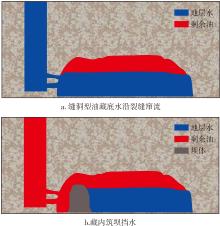
Fig.1
Schematic diagram of in-reservoir damming for water control"
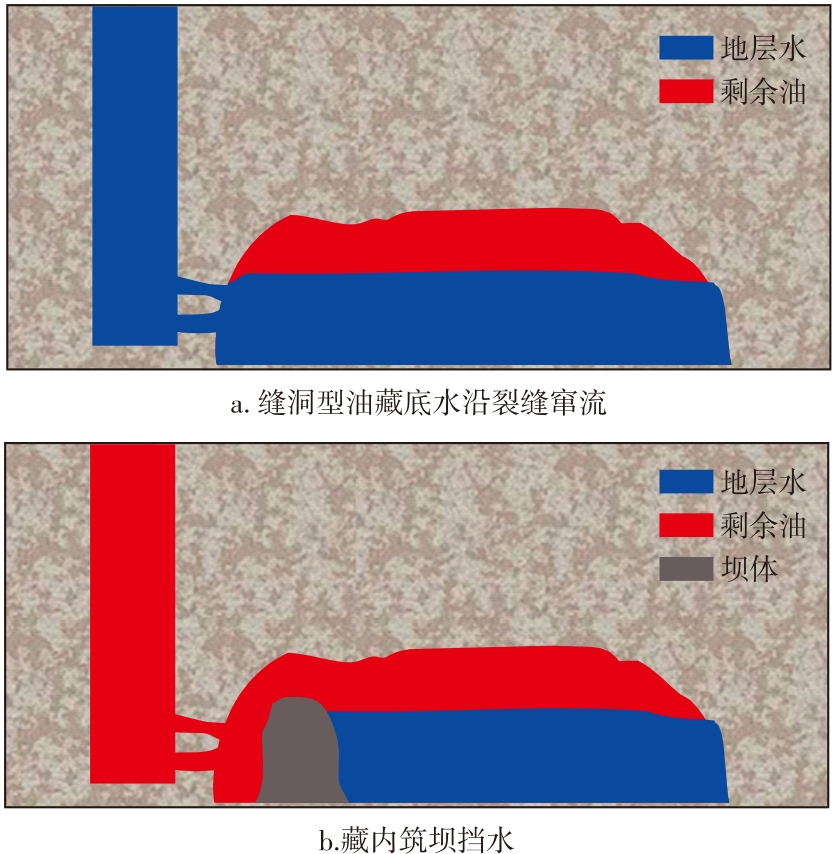
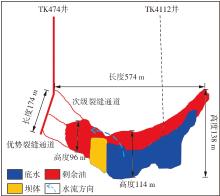
Fig.2
Actual geological model of well TK474 in Tahe oilfield"
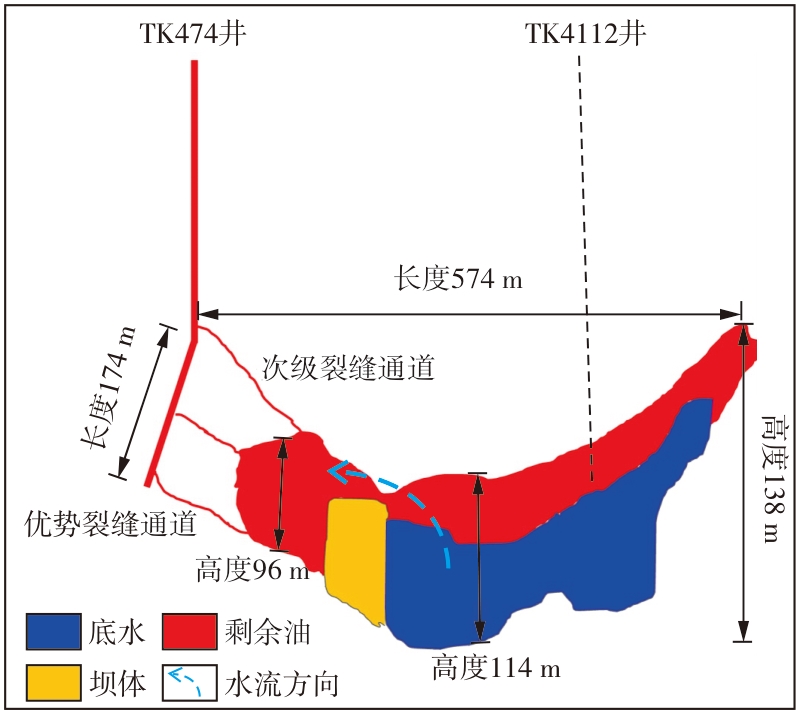
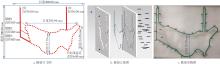
Fig.3
Dimensions, 3D view, and photo of equivalent visual physical model"
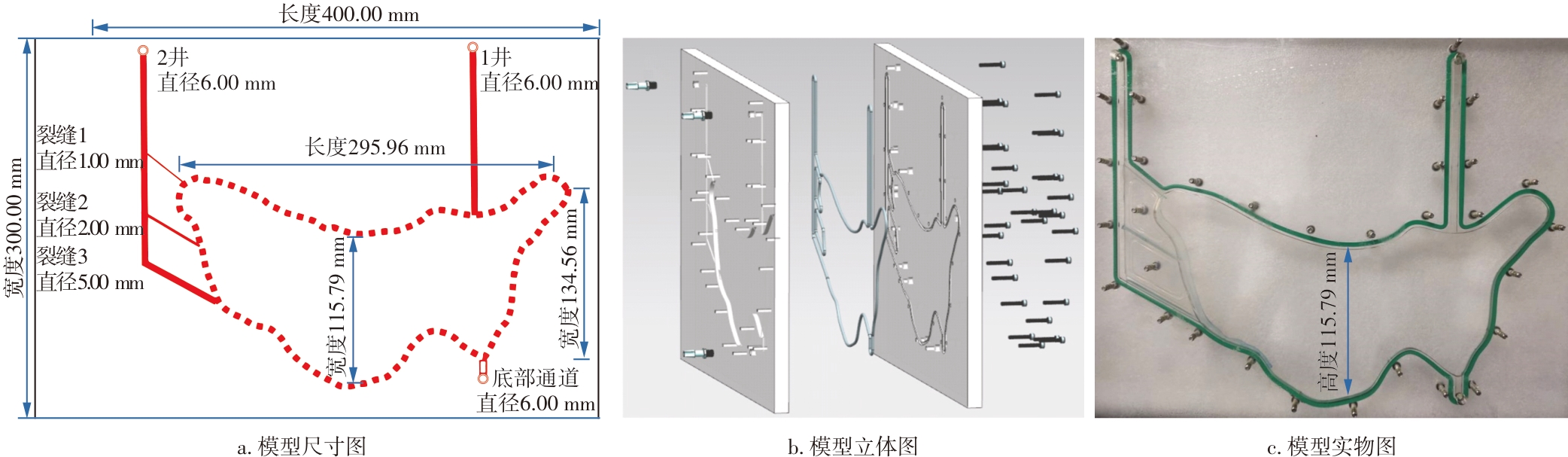

Table 1
Physical properties of equivalent plugging agents"
| 分类 | 密度/(g/cm3) | 黏度(温度25 ℃)/(mPa·s) | 静态成胶时间/h | 成胶强度 | 固相质量分数/% |
|---|---|---|---|---|---|
| 现场凝胶 | 1.14 | 500 | 1~3(温度130 ℃) | H级 | |
| 实验室凝胶 | 1.10 | 506 | 4~6(温度40 ℃) | H级 | |
| 现场无机堵剂 | 1.14 | 30~35 | 20 | ||
| 实验室无机颗粒 | 1.16 | 60 | 20 |
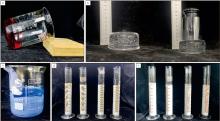
Fig.4
Equivalent plugging agent system used in laboratory simulation"

Table 2
Equivalent experimental parameters"
| 相似准数 | 物理意义 | 相似性 |
|---|---|---|
| 驱替压差与重力之比 | 动力相似 | |
| 雷诺数 | 动力相似 | |
| 注入量与缝洞总体积之比 | 运动相似 |
Table 3
Actual reservoir parameters and physical model parameters"
| 参数 | 注采压差/MPa | 原油密度/(g/cm3) | 凝胶密度/(g/cm3) | 无机颗粒密度/(g/cm3) | 模型尺寸/m | 凝胶黏度/(mPa·s) | 无机颗粒黏度/(mPa·s) | 注入速度/(mL/min) | 孔隙度/% |
|---|---|---|---|---|---|---|---|---|---|
| 实际油藏参数 | 2.00~20.00 | 0.8~1.0 | 1.14 | 1.14 | 200.0~600.0 | 500 | 30~35 | 30 000~60 000 | 3.0~20.0 |
| 物理模型参数 | 0.01~0.10 | 0.9 | 1.10 | 1.16 | 0.3~0.4 | 506 | 60 | 0.78~1.30 | 2.0~3.0 |
Table 4
Parameter similarity coefficients"
| 参数 | 注采压差 | 原油密度 | 凝胶密度 | 无机颗粒密度 | 模型尺寸 | 凝胶黏度 | 无机颗粒黏度 | 注入速度 | 孔隙度 |
|---|---|---|---|---|---|---|---|---|---|
| 相似系数 | 20~2 000 | ≈ 1 | ≈ 1 | ≈ 1 | 500~2 000 | ≈ 1 | ≈ 0.5 | 23 000~77 000 | 1.0~10.0 |
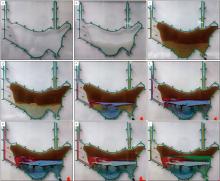
Fig.5
Experimental process of in-reservoir damming for water plugging"

Table 5
Experimental schemes"
| 实验方案 | 研究内容 | 研究参数 | 固定参数 |
|---|---|---|---|
| 1 | 堵剂组合模式 | 单一凝胶堵剂 | 凝胶黏度500 mPa·s,密度1.14 g/cm3,无机颗粒黏度60 mPa·s,密度1.16 g/cm3 |
| 2 | 单一无机颗粒堵剂 | ||
| 3 | 凝胶+无机颗粒组合 | ||
| 4 | 段塞数量 | 二段塞 | 填充度60%,堵剂总量0.2 PV,注入速度0.8 cm3/min,凝胶与无机颗粒比为1∶2 |
| 5 | 三段塞 | ||
| 6 | 四段塞 | ||
| 7 | 堵剂总量 | 0.1 PV | 填充度60%,二段塞,注入速度0.8 cm3/min,凝胶与无机颗粒比为1∶2 |
| 8 | 0.2 PV | ||
| 9 | 0.3 PV | ||
| 10 | 0.4 PV | ||
| 11 | 堵剂比例 | 凝胶与无机颗粒比1∶2 | 填充度60%,堵剂总量0.2 PV,二段塞,注入速度0.8 cm3/min |
| 12 | 凝胶与无机颗粒比1∶6 | ||
| 13 | 凝胶与无机颗粒比1∶10 | ||
| 14 | 注入速度 | 0.8 cm3/min | 填充度60%,堵剂总量0.2 PV,二段塞,凝胶与无机颗粒比为1∶2 |
| 15 | 1.0 cm3/min | ||
| 16 | 1.2 cm3/min | ||
| 17 | 溶洞填充程度 | 未填充 | 堵剂总量0.2 PV,二段塞,注入速度0.8 cm3/min,凝胶与无机颗粒比为1∶2 |
| 18 | 填充度30% | ||
| 19 | 填充度60% |
Table 6
Damming heights and enhanced oil recovery amplitudes under different schemes"
| 实验方案 | 研究内容 | 研究参数 | 坝体高度/mm | 提高采收率/% |
|---|---|---|---|---|
| 1 | 堵剂组合模式 | 单一凝胶堵剂 | 52.9 | 0.8 |
| 2 | 单一无机颗粒堵剂 | 20.4 | 3.2 | |
| 3 | 凝胶+无机颗粒组合 | 36.6 | 14.4 | |
| 4 | 段塞数量 | 二段塞 | 58.5 | 14.4 |
| 5 | 三段塞 | 57.0 | 11.1 | |
| 6 | 四段塞 | 53.3 | 10.3 | |
| 7 | 堵剂总量 | 0.1 PV | 49.0 | 4.0 |
| 8 | 0.2 PV | 58.5 | 14.4 | |
| 9 | 0.3 PV | 59.5 | 16.1 | |
| 10 | 0.4 PV | 63.7 | 13.2 | |
| 11 | 堵剂比例 | 凝胶与无机颗粒比为1∶2 | 58.5 | 14.4 |
| 12 | 凝胶与无机颗粒比为1∶6 | 56.8 | 6.4 | |
| 13 | 凝胶与无机颗粒比为1∶10 | 56.2 | 5.8 | |
| 14 | 注入速度 | 0.8 cm3/min | 69.1 | 11.0 |
| 15 | 1.0 cm3/min | 61.0 | 5.6 | |
| 16 | 1.2 cm3/min | 69.5 | 9.3 | |
| 17 | 溶洞填充程度 | 无填充 | 47.0 | 15.5 |
| 18 | 填充度30% | 36.6 | 12.5 | |
| 19 | 填充度60% | 53.3 | 14.4 |
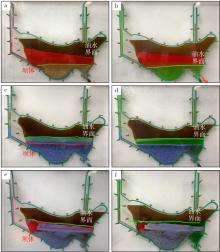
Fig.6
Dam morphology and water-oil contact after secondary bottom-water drive under different plugging agent combination modes"

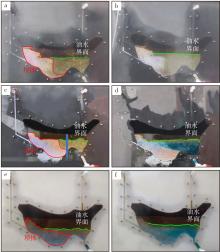
Fig.7
Dam morphology and water-oil contact after secondary bottom-water drive with different slug numbers"

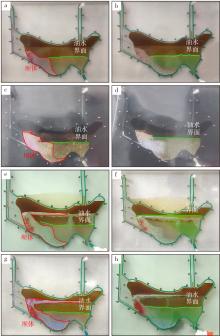
Fig.8
Dam morphology and water-oil contact after secondary bottom-water drive with different total plugging agent volumes"

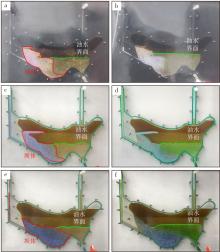
Fig.9
Dam morphology and water-oil contact after secondary bottom-water drive at different plugging agent ratios"

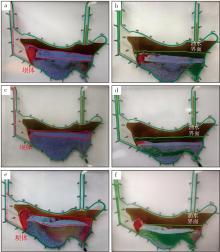
Fig.10
Dam morphology and water-oil contact after secondary bottom-water drive at different injection rates"

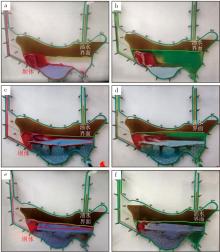
Fig.11
Dam morphology and water-oil contact after secondary bottom-water drive at different cavity filling degrees"
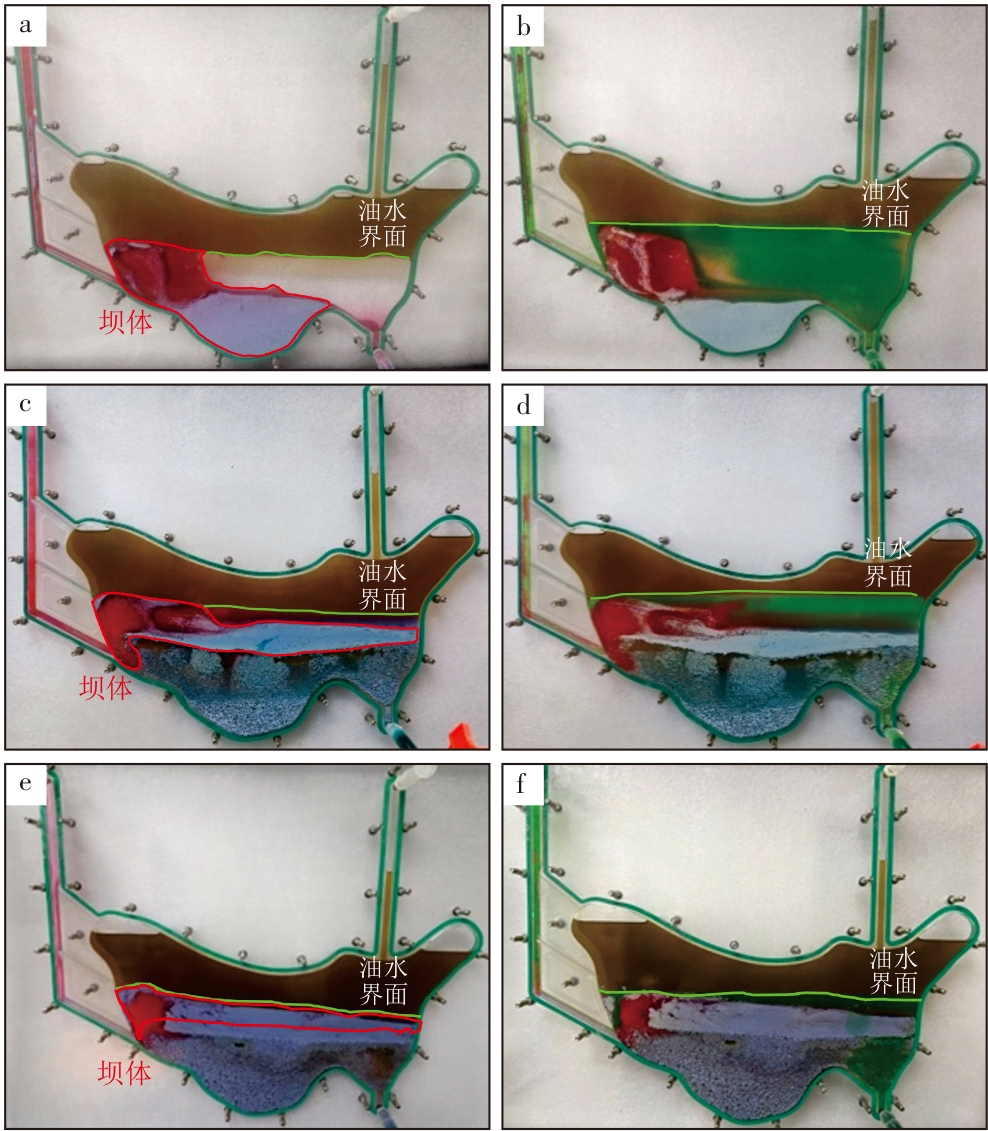
Table7
Hyperparameter optimization results of BP neural network model"
| 模型参数 | 寻优范围 | 最优值 |
|---|---|---|
| 隐藏层1神经元个数 | 32 | 32 |
| 48 | ||
| 64 | ||
| 96 | ||
| 128 | ||
| 隐藏层2神经元个数 | 16 | 16 |
| 24 | ||
| 32 | ||
| 48 | ||
| 64 | ||
| 学习率 | 0.000 5 | 0.01 |
| 0.001 0 | ||
| 0.002 0 | ||
| 0.005 0 | ||
| 0.010 0 | ||
| 批量大小 | 16 | 16 |
| 32 | ||
| 48 | ||
| 64 | ||
| 128 | ||
| 训练轮数 | 500 | 1 000 |
| 1 000 | ||
| 2 000 | ||
| 5 000 |
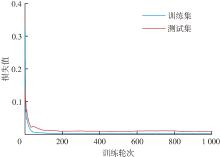
Fig.12
Model training curves"
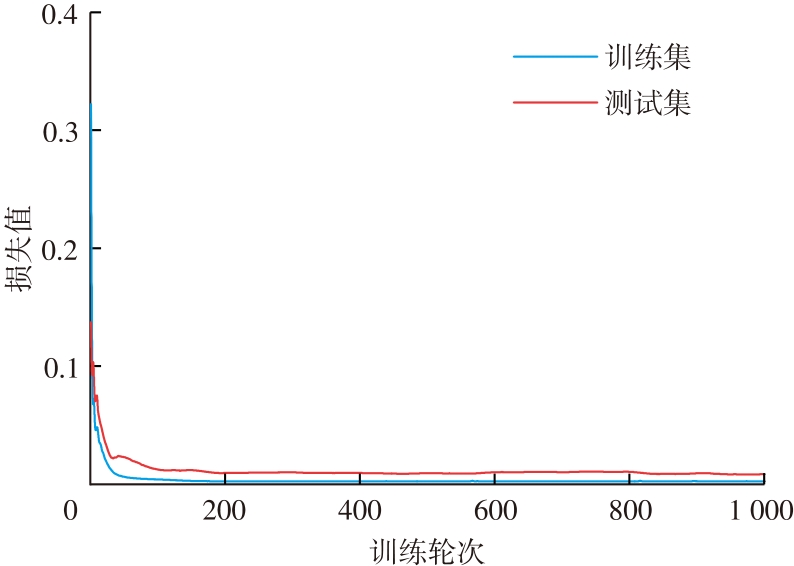
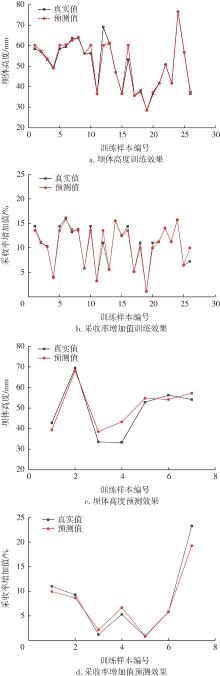
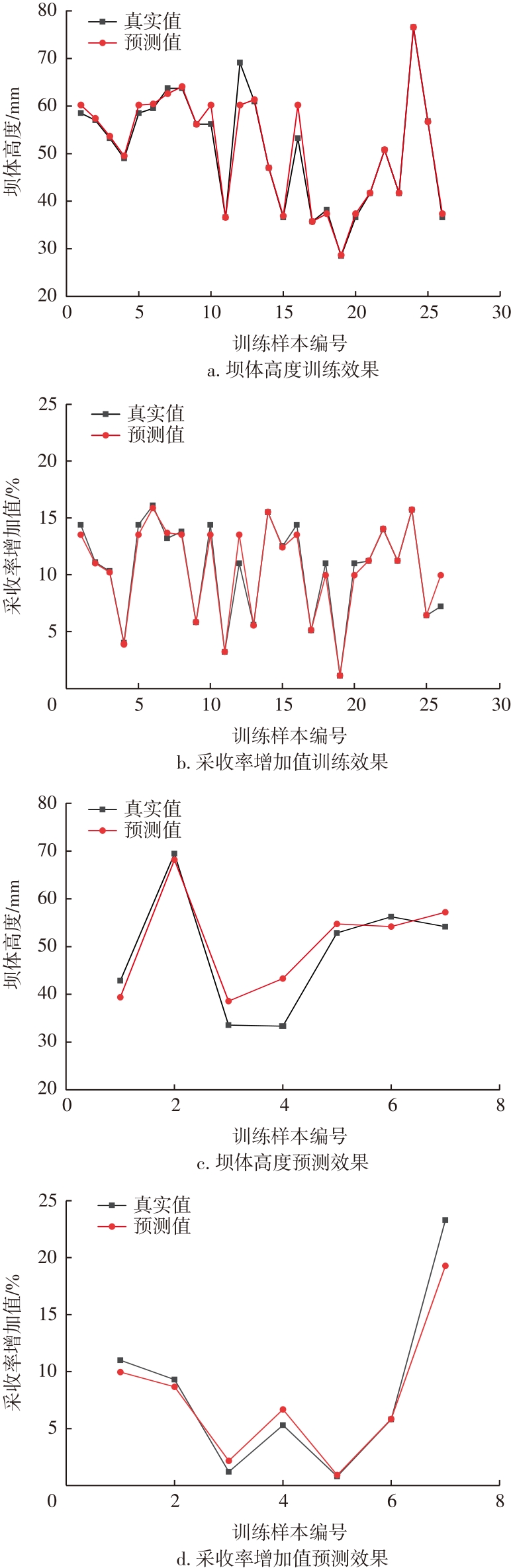
Fig.13
Training and prediction performance of BP neural network model"
| [1] | 李阳, 康志江, 薛兆杰, 等. 中国碳酸盐岩油气藏开发理论与实践[J]. 石油勘探与开发, 2018, 45(4): 669-678. |
| LI Yang, KANG Zhijiang, XUE Zhaojie, et al. Theories and practices of carbonate reservoirs development in China[J]. Petroleum Exploration and Development, 2018, 45(4): 669-678. | |
| [2] | 吕心瑞, 孙建芳, 李红凯, 等. 塔里木盆地深层碳酸盐岩缝洞型油藏精细地质建模技术[J]. 石油与天然气地质, 2024, 45(5): 1195-1210. |
| Xinrui LYU, SUN Jianfang, LI Hongkai, et al. Fine geological modelling technology for deep fractured-vuggy carbonate oil reservoirs in the Tarim Basin[J]. Oil & Gas Geology, 2024, 45(5): 1195-1210. | |
| [3] | 郑松青, 杨敏, 康志江, 等. 塔河油田缝洞型碳酸盐岩油藏水驱后剩余油分布主控因素与提高采收率途径[J]. 石油勘探与开发, 2019, 46(4): 746-754. |
| ZHENG Songqing, YANG Min, KANG Zhijiang, et al. Controlling factors of remaining oil distribution after water flooding and enhanced oil recovery methods for fracture-cavity carbonate reservoirs in Tahe Oilfield[J]. Petroleum Exploration and Development, 2019, 46(4): 746-754. | |
| [4] | 王敬, 齐向生, 刘慧卿, 等. 缝洞型油藏水驱剩余油形成机制及换向注水增油机理[J]. 石油勘探与开发, 2022, 49(5): 965-976. |
| WANG Jing, QI Xiangsheng, LIU Huiqing, et al. Mechanisms of remaining oil formation by water flooding and enhanced oil recovery by reversing water injection in fractured-vuggy reservoirs[J]. Petroleum Exploration and Development, 2022, 49(5): 965-976. | |
| [5] | 季晓靖, 蒲万芬, 金发扬, 等. 缝洞型油藏提高“阁楼油”采出程度物理模拟实验[J]. 断块油气田, 2016, 23(3): 375-379. |
| JI Xiaojing, PU Wanfen, JIN Fayang, et al. Physical simulation experiment research on enhancing “attic oil” recovery in fracture-cavity reservoir[J]. Fault-Block Oil & Gas Field, 2016, 23(3): 375-379. | |
| [6] | 孙瑞仪, 付美龙, 徐传奇, 等. 缝洞型油藏微观驱替规律可视化实验研究[J]. 新疆地质, 2021, 39(1): 167-170. |
| SUN Ruiyi, FU Meilong, XU Chuanqi, et al. Visualization of water yielding mechanism of oil well based on the fracture-cave reservoir in Tahe oilfield[J]. Xinjiang Geology, 2021, 39(1): 167-170. | |
| [7] | 代玲, 江任开, 孙常伟, 等. 缝洞型碳酸盐岩油藏大漏失水平井颗粒吞吐控水技术[J]. 石油钻探技术, 2024, 52(3): 91-97. |
| DAI Ling, JIANG Renkai, SUN Changwei, et al. Water control through particle huff and puff for horizontal wells with severe fluid loss in fractured-vuggy carbonate reservoirs[J]. Petroleum Drilling Techniques, 2024, 52(3): 91-97. | |
| [8] | 刘广燕, 张潇, 郭娜, 等. 缝洞型碳酸盐岩油藏堵水技术[J]. 精细石油化工, 2021, 38(1): 1-7. |
| LIU Guangyan, ZHANG Xiao, GUO Na, et al. Study of water shutoff technology for fracture-cavity carbonate reservoir[J]. Speciality Petrochemicals, 2021, 38(1): 1-7. | |
| [9] | 李亮, 张汝生, 伍亚军, 等. 缓膨颗粒对塔河油田缝洞型油藏的调堵机理分析[J]. 油田化学, 2020, 37(2): 245-249. |
| LI Liang, ZHANG Rusheng, WU Yajun, et al. Analysis on mechanism of blocking and profile control of slow-expanding particles to fracture-vuggy reservoirs in Tahe oilfield[J]. Oilfield Chemistry, 2020, 37(2): 245-249. | |
| [10] | 袁飞宇, 王鸿鹏, 乐平, 等. 缝洞型碳酸盐岩油藏单井注气影响因素模拟分析[J]. 非常规油气, 2023, 10(4): 86-94. |
| YUAN Feiyu, WANG Hongpeng, YUE Ping, et al. Simulation analysis of influencing factors of single well gas injection in fracture-vuggy carbonate reservoir[J]. Unconventional Oil & Gas, 2023, 10(4): 86-94. | |
| [11] | 邓惠, 杨胜来, 刘义成, 等. 缝洞型碳酸盐岩底水气藏水侵规律预测新方法[J]. 天然气勘探与开发, 2023, 46(2): 37-43. |
| DENG Hui, YANG Shenglai, LIU Yicheng, et al. A new method for predicting water invasion laws in fractured-vuggy carbonate gas reservoirs with bottom water[J]. Natural Gas Exploration and Development, 2023, 46(2): 37-43. | |
| [12] | 刘玉章, 吕静, 王家禄, 等. 水平井置胶成坝深部液流转向物理模拟[J]. 石油勘探与开发, 2011, 38(3): 332-335. |
| LIU Yuzhang, Jing LYU, WANG Jialu, et al. Physical modeling of in-depth fluid diversion by “gel dam” placed with horizontal wells[J]. Petroleum Exploration and Development, 2011, 38(3): 332-335. | |
| [13] | 吕静, 刘玉章, 王家禄, 等. 水平井置胶成坝深部液流转向数值模拟[J]. 西南石油大学学报(自然科学版), 2011, 33(4): 116-120. |
| Jing LYU, LIU Yuzhang, WANG Jialu, et al. Numerical simulation of “gel dam” in-depth fluid diversion technique in horizontal wells[J]. Journal of Southwest Petroleum University (Science & Technology Edition), 2011, 33(4): 116-120. | |
| [14] | 吕静, 刘玉章, 高建, 等. 应用CT研究水平井置胶成坝深部液流转向机理[J]. 石油勘探与开发, 2011, 38(6): 733-737. |
| Jing LYU, LIU Yuzhang, GAO Jian, et al. Mechanism research of in-depth fluid diversion by “gel dam” place with horizontal well using X-ray CT[J]. Petroleum Exploration and Development, 2011, 38(6): 733-737. | |
| [15] | 许可, 刘卫东, 郭英, 等. 置胶成坝调剖技术的实验研究[J]. 科学技术与工程, 2015, 15(11): 187-190. |
| XU Ke, LIU Weidong, GUO Ying, et al. Experimental study of profile control with gel-dam[J]. Science Technology and Engineering, 2015, 15(11): 187-190. | |
| [16] | 徐传奇, 付美龙, 秦天宝, 等. 缝洞型碳酸盐岩油藏出水规律可视化物模实验[J]. 石油钻采工艺, 2020, 42(2): 195-200. |
| XU Chuanqi, FU Meilong, QIN Tianbao, et al. Visual physical simulation experiment on the water production laws of fractured-vuggy carbonate reservoirs[J]. Oil Drilling & Production Technology, 2020, 42(2): 195-200. | |
| [17] | 王敬, 徐智远, 刘俊源, 等. 断控缝洞型油藏底水驱剩余油分布规律及挖潜策略[J]. 石油勘探与开发, 2024, 51(5): 1101-1113. |
| WANG Jing, XU Zhiyuan, LIU Junyuan, et al. Distribution rules of remaining oil by bottom water flooding and potential exploitation strategy in fault-controlled fractured-vuggy reservoirs[J]. Petroleum Exploration and Development, 2024, 51(5): 1101-1113. | |
| [18] | 郭万江, 付帅师, 李爱芬, 等. 缝洞型油藏物理实验模型制作新方法[J]. 科学技术与工程, 2021, 21(23): 9830-9836. |
| GUO Wanjiang, FU Shuaishi, LI Aifen, et al. A new method for manufacturing physical experimental models of fracture-cavity reservoir[J]. Science Technology and Engineering, 2021, 21(23): 9830-9836. | |
| [19] | 程晓军. 塔河油田缝洞型油藏水驱后气驱提高采收率可视化实验[J]. 新疆石油地质, 2018, 39(4): 473-479. |
| CHENG Xiaojun. Visualized gas drive EOR experiments in fractured-vuggy reservoirs after waterflooding in Tahe oilfield[J]. Xinjiang Petroleum Geology, 2018, 39(4): 473-479. | |
| [20] | 范劲, 郭艳, 李茂森, 等. 四川盆地抗CO2污染高密度水基钻井液[J]. 天然气勘探与开发, 2024, 47(4): 99-105. |
| FAN Jin, GUO Yan, LI Maosen, et al. High-density water-based drilling fluid with resistance to CO2 contamination and its application to Sichuan Basin[J]. Natural Gas Exploration and Development, 2024, 47(4): 99-105. | |
| [21] | 张驰, 郭媛, 黎明. 人工神经网络模型发展及应用综述[J]. 计算机工程与应用, 2021, 57(11): 57-69. |
| ZHANG Chi, GUO Yuan, LI Ming. Review of development and application of artificial neural network models[J]. Computer Engineering and Applications, 2021, 57(11): 57-69. | |
| [22] | 孙宝财, 武建文, 李雷, 等. 改进GA-BP算法的油气管道腐蚀剩余强度预测[J]. 西南石油大学学报(自然科学版), 2013, 35(3): 160-167. |
| SUN Baocai, WU Jianwen, LI Lei, et al. Prediction of remaining strength of corroded oil and gas pipeline based on improved GA-BP algorithm[J]. Journal of Southwest Petroleum University (Science & Technology Edition), 2013, 35(3): 160-167. | |
| [23] | 闫绍栋, 刘斌, 李卫东, 等. 基于BP神经网络的油气管道振动检测系统[J]. 化工设备与管道, 2023, 60(5): 68-75. |
| YAN Shaodong, LIU Bin, LI Weidong, et al. Oil and gas pipeline vibration detection system based on BP neural network[J]. Process Equipment & Piping, 2023, 60(5): 68-75. | |
| [24] | 段艳强. 基于BP神经网络优化算法的煤岩识别误差分析[J]. 能源与节能, 2024, 29 (7): 4-7. |
| DUAN Yanqiang. Error analysis of coal-rock identification based on BP neural network optimization algorithm[J]. Energy and Energy Conservation, 2024, 29 (7): 4-7. | |
| [25] | 崔海, 余鑫磊, 庞继伟, 等. 采用BP-ANN和改进SVR的进水BOD软测量模型[J]. 哈尔滨工业大学学报, 2022, 54(2): 59-66. |
| CUI Hai, YU Xinlei, PANG Jiwei, et al. Influent BOD soft sensing models based on BP-ANN and improved SVR[J]. Journal of Harbin Institute of Technology, 2022, 54(2): 59-66. |
| [1] | LI Jingwei, PENG Bo, WANG Zeteng, CHEN Xiaoqian, ZHANG Zhenghao, LIU Jindong, LIU Shuangxing, LI Xiaofeng. CO2 storage potential assessment models and their practical progress in oil and gas reservoirs [J]. Petroleum Reservoir Evaluation and Development, 2026, 16(1): 141-152. |
| [2] | WANG Jiwei, LIU Jian, WANG Xuanru, SHI Luming, HAO Dong, SONG Peng, REN Jitian, XIAO Wenlian. Characterization of crude oil mobilization under advanced CO2 injection in tight oil of Chang 8 member, Ordos Basin [J]. Petroleum Reservoir Evaluation and Development, 2026, 16(1): 107-117. |
| [3] | CHEN Jun, WANG Haimei, CHEN Xi, TANG Yong, TANG Liangrui, SI Rong, WANG Huijun, HUANG Xianzhu, LENG Bing. Study on main controlling factors of CO2 huff-n-puff for enhanced oil recovery and storage in shale oil reservoirs [J]. Petroleum Reservoir Evaluation and Development, 2025, 15(4): 537-544. |
| [4] | TANG Yong, YUAN Chengang, HE Youwei, HUANG Liang, YU Fuji, LIANG Xiuli. Experimental study on injection media and methods for enhanced oil recovery in tight oil reservoirs: A case study of Fuyu reservoir in Daqing [J]. Petroleum Reservoir Evaluation and Development, 2025, 15(4): 554-563. |
| [5] | HUI Jian. Study on simulation methods for flow experiments in fracture-cavity reservoirs [J]. Petroleum Reservoir Evaluation and Development, 2025, 15(4): 704-710. |
| [6] | ZHANG Wen, LIANG Lixi, LIU Xiangjun, XIONG Jian, ZHANG Yinan. Etching morphology and mechanical properties of carbonate rocks under acid action [J]. Petroleum Reservoir Evaluation and Development, 2024, 14(2): 247-255. |
| [7] | ZHANG Lianfeng, ZHANG Yilin, GUO Huanhuan, LI Hongsheng, LI Junjie, LIANG Limei, LI Wenjing, HU Shukui. Development adjustment technology of extending life cycle for nearly-abandoned reservoirs [J]. Petroleum Reservoir Evaluation and Development, 2024, 14(1): 124-132. |
| [8] | TANG Jiandong, WANG Zhilin, GE Zhengjun. CO2 flooding technology and its application in Jiangsu Oilfield in Subei Basin [J]. Petroleum Reservoir Evaluation and Development, 2024, 14(1): 18-25. |
| [9] | XU Guochen, LIU Xiaowen. Research and application of supporting technologies for improving success rate of water injection well testing [J]. Petroleum Reservoir Evaluation and Development, 2023, 13(6): 773-780. |
| [10] | MA Dongmin,WANG Xin,TENG Jinxiang,JI Changjiang,SHAO Kai,ZHENG Chao,JI Yusong,HUI Peng. Experimental study on interfacial interaction between methane and vitrinite and durain: A case study of bituminous coal in Minhe Basin [J]. Petroleum Reservoir Evaluation and Development, 2022, 12(4): 556-563. |
| [11] | YE Shen,QIAO Jiangmei,LI Tongchun. Numerical simulation of influence of water injection pressure and cave internal pressure on fracture propagation [J]. Reservoir Evaluation and Development, 2022, 12(2): 382-390. |
| [12] | LI Yang,HUANG Wenhuan,JIN Yong,HE Yingfu,CHEN Zuhua,TANG Yong,WU Gongyi. Different reservoir types of CO2 flooding in Sinopec EOR technology development and application under “dual carbon” vision [J]. Petroleum Reservoir Evaluation and Development, 2021, 11(6): 793-804. |
| [13] | FAN Xibin,PU Wanfen,SHAN Jiangtao,DU Daijun,QIN Jianhua,GAO Yang. Feasibility of enhanced oil recovery by CO2 huff-n-puff in tight conglomerate reservoir [J]. Petroleum Reservoir Evaluation and Development, 2021, 11(6): 831-836. |
| [14] | SHI Leiting,ZHANG Yulong,YE Zhongbin,ZHANG Jing,WANG Yingwei,WANG Ruiqi,WU Sitong. Field test effect analysis of CO2 huff and puff for EOR of horizontal wells in tight glutenite reservoir of Mahu Oilfield [J]. Petroleum Reservoir Evaluation and Development, 2021, 11(6): 871-877. |
| [15] | XU Jianping,YUAN Yuanda,XIE Qing,WEI Xuegang,FENG Zhen. Advance in application of molecular dynamics simulation in polymer flooding [J]. Petroleum Reservoir Evaluation and Development, 2021, 11(3): 414-421. |
|
||
