
Petroleum Reservoir Evaluation and Development ›› 2026, Vol. 16 ›› Issue (1): 43-51.doi: 10.13809/j.cnki.cn32-1825/te.2025034
• Methodological Theory • Previous Articles Next Articles
LIN Yutong1( ), ZHANG Qi2, LIU Chengguo1, PENG Mingguo1(), LI Yujie1, ZHAO Jing1, LIU Run1, LI Qiu1, LIU Yali1
Received:2025-01-17
Online:2026-01-06
Published:2026-01-26
CLC Number:
LIN Yutong,ZHANG Qi,LIU Chengguo, et al. Study on microscopic mechanism of deep heavy oil emulsification under synergistic CO2-thermal agent conditions[J]. Petroleum Reservoir Evaluation and Development, 2026, 16(1): 43-51.
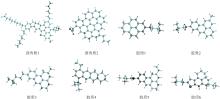
Fig.1
Asphaltene and resin molecules used in simulations"
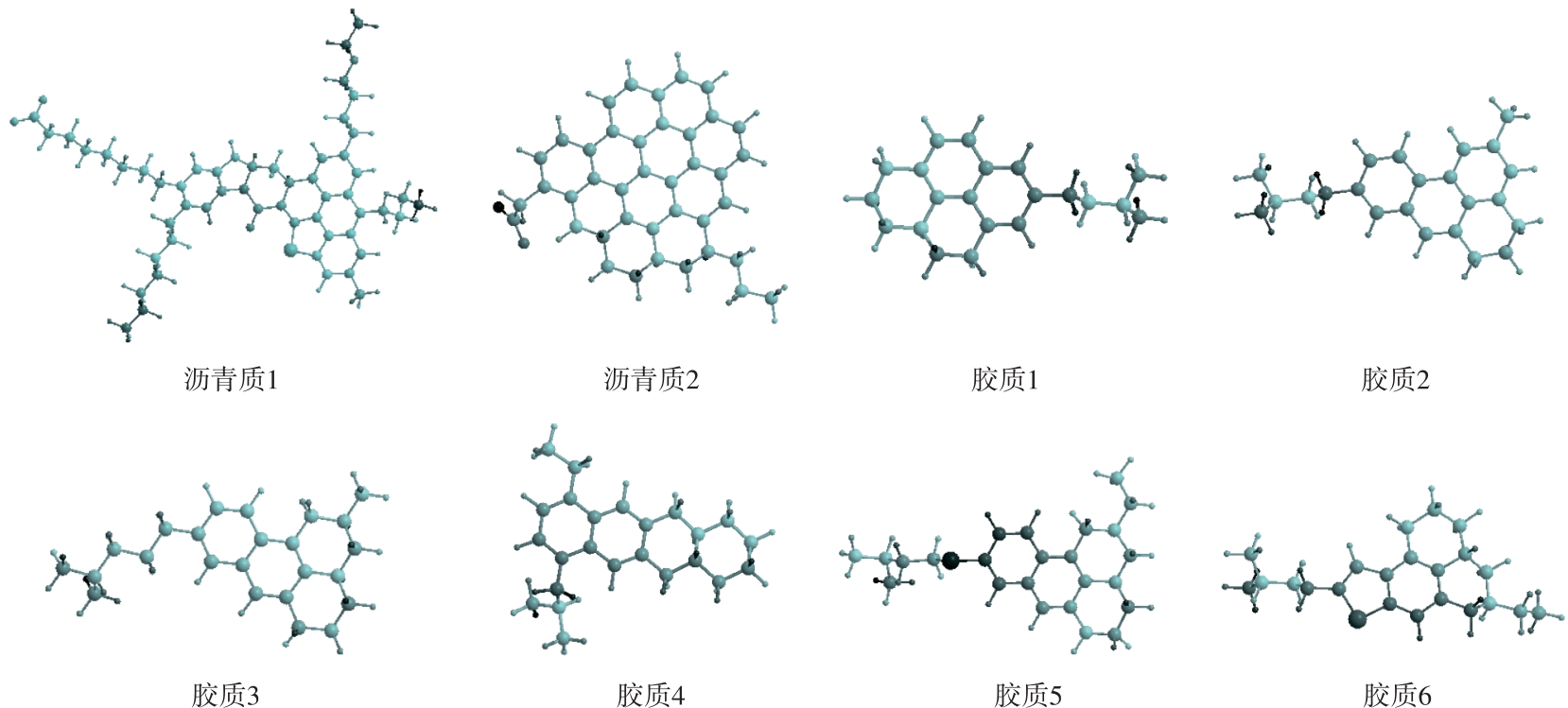

Table 1
Crude oil components and molecular counts"
| 组分类型 | 具体组分 | 分子数 | 组分类型 | 具体组分 | 分子数 | |
|---|---|---|---|---|---|---|
| 重质组分 | 沥青质 | 沥青质 1 | 4 | 轻质组分 | 苯 | 13 |
| 沥青质 2 | 4 | 环庚烷 | 35 | |||
| 胶质 | 胶质 1 | 5 | 环己烷 | 22 | ||
| 胶质 2 | 5 | 庚烷 | 29 | |||
| 胶质 3 | 5 | 己烷 | 32 | |||
| 胶质 4 | 5 | 壬烷 | 40 | |||
| 胶质 5 | 5 | 辛烷 | 34 | |||
| 胶质 6 | 5 | 甲苯 | 35 | |||

Fig.2
Oil droplet formation process (water molecules omitted)"
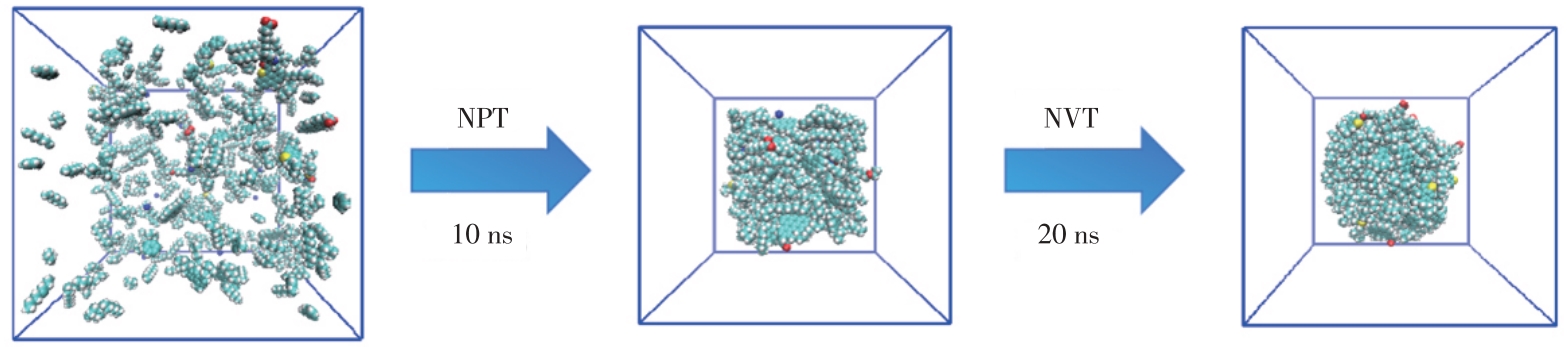
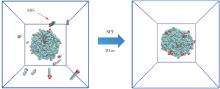
Fig.3
Surfactant emulsification of oil droplets (water molecules omitted)"
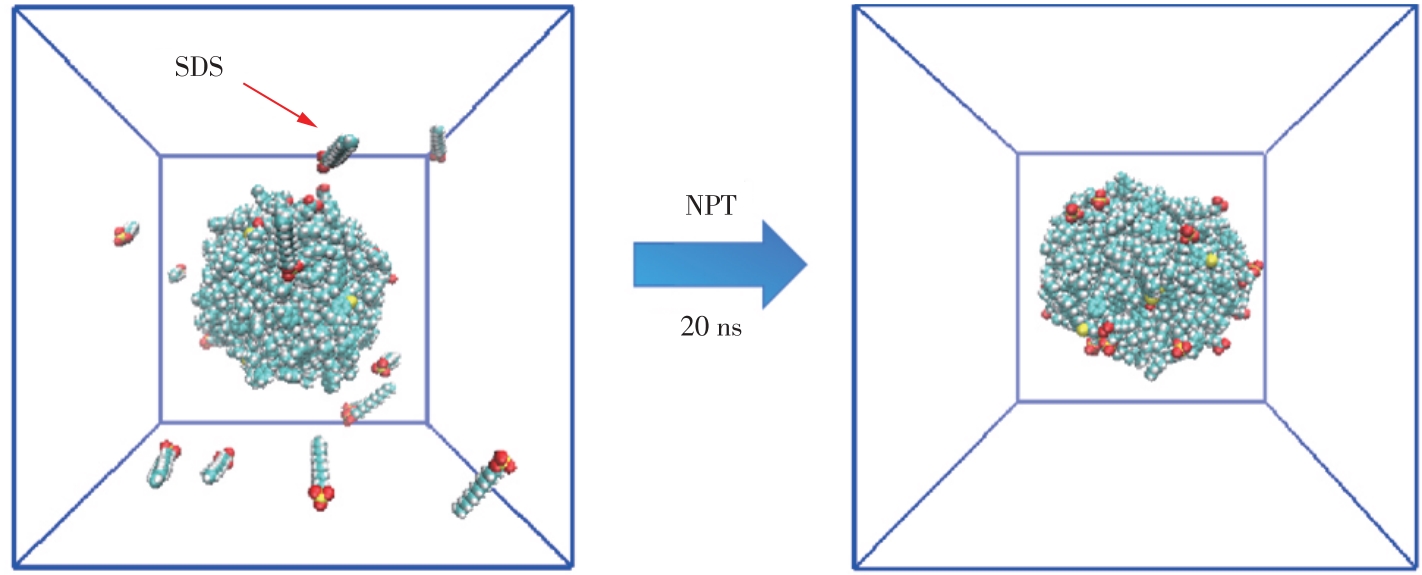
Fig.4
Construction of heavy oil system under synergistic CO2-thermal agent conditions"
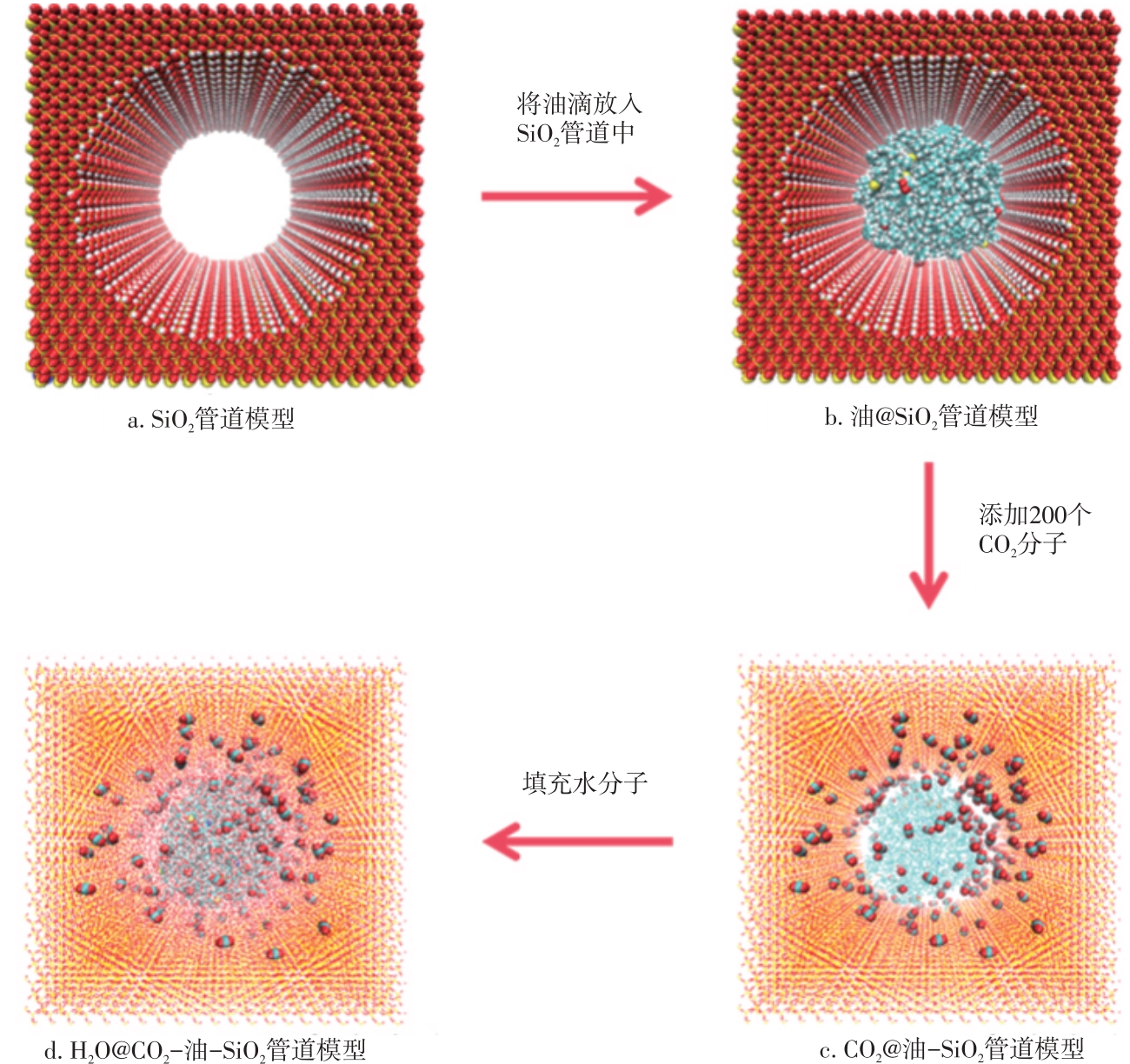
Fig.5
Multidimensional characteristic effects of surfactants on heavy oil emulsification behavior"

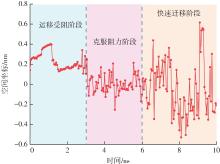
Fig.6
Variation of center-of-mass displacement of oil droplets during migration with simulation time"
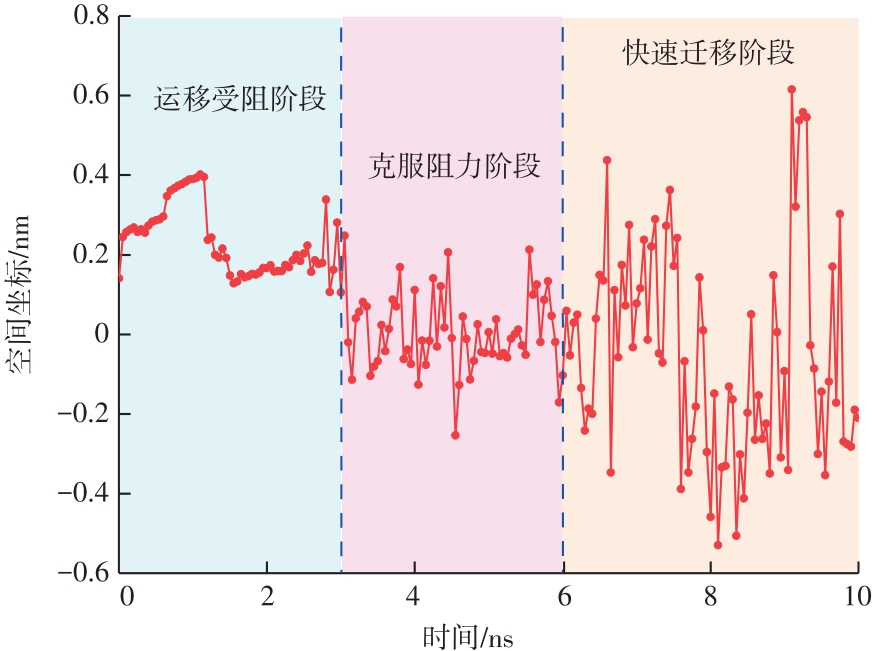
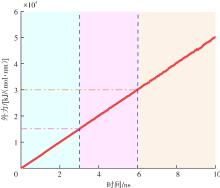
Fig.7
Variation of external force of oil droplets during migration with simulation time"
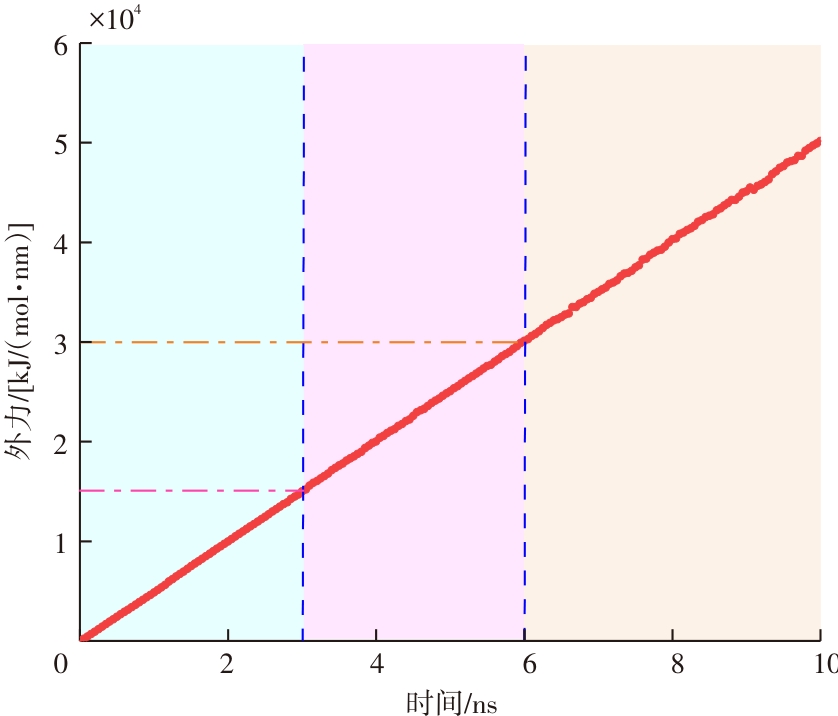
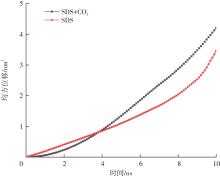
Fig.8
Variation of root mean square displacement with simulation time"
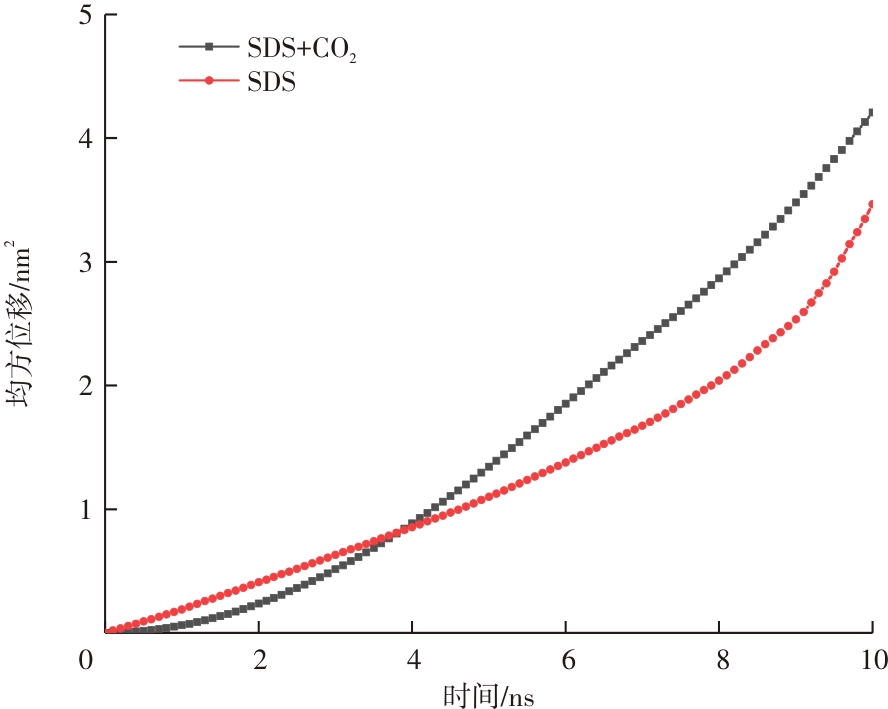
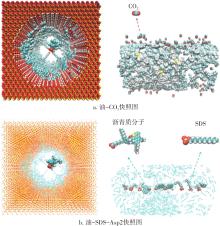
Fig.9
Snapshots of simulation results (water molecules omitted)"

| [1] | 刘晓瑜, 赵德喜, 李元庆, 等. 稠油开采技术及研究进展[J]. 精细石油化工进展, 2018, 19(1): 10-13. |
| LIU Xiaoyu, ZHAO Dexi, LI Yuanqing, et al. Progress of research on viscous crude production techniques[J]. Advances in Fine Petrochemicals, 2018, 19(1): 10-13. | |
| [2] | 黄琴, 桑丹, 张俊, 等. 渤海稠油多轮次蒸汽吞吐井开发后期接替技术研究[J]. 重庆科技大学学报(自然科学版), 2024, 26(5): 9-16. |
| HUANG Qin, SANG Dan, ZHANG Jun, et al. Replacement technology in the later stage of Bohai heavy oil multi-cycle steam stimulation well development[J]. Journal of Chongqing University of Science and Technology (Natural Science Edition), 2024, 26(5): 9-16. | |
| [3] | 石彦, 谢俊辉, 郭小婷, 等. 新疆油田中深层稠油CO2驱/吞吐实验研究[J]. 油气藏评价与开发, 2024, 14(1): 76-82. |
| SHI Yan, XIE Junhui, GUO Xiaoting, et al. Experimental study on CO2 flooding/huff and puff of medium-deep heavy oil in Xinjiang Oilfield[J]. Petroleum Reservoir Evaluation and Development, 2024, 14(1): 76-82. | |
| [4] | 李建山, 高浩, 鄢长灏, 等. 原油-CO2相互作用机理分子动力学模拟研究[J]. 油气藏评价与开发, 2024, 14(1): 26-34. |
| LI Jianshan, GAO Hao, YAN Changhao, et al. Molecular dynamics simulation on interaction mechanisms of crude oil and CO2 [J]. Petroleum Reservoir Evaluation and Development, 2024, 14(1): 26-34. | |
| [5] | 卢川. 稠油油藏气体-化学剂辅助注蒸汽改善开发效果研究[D]. 北京: 中国石油大学(北京), 2015. |
| LU Chuan. The improvement effects of gas and chemical agent during steam injection process for heavy oil[D]. Beijing: China University of Petroleum (Beijing), 2015. | |
| [6] | 柏明星, 张志超, 陈巧珍, 等. 二氧化碳置换法开采天然气水合物研究进展[J]. 石油与天然气地质, 2024, 45(2): 553-564. |
| BAI Mingxing, ZHANG Zhichao, CHEN Qiaozhen, et al. Advances in research on CO2 replacement for natural gas hydrate exploitation[J]. Oil & Gas Geology, 2024, 45(2): 553-564. | |
| [7] | 姚红生, 邱伟生, 周德华, 等. 苏北盆地复杂断块油藏CCUS-EOR关键技术与实践[J]. 天然气工业, 2025, 45(9): 212-222. |
| YAO Hongsheng, QIU Weisheng, ZHOU Dehua, et al. Key technologies and practices of CCUS-EOR in complex fault-block reservoirs in the Subei Basin[J]. Natural Gas Industry, 2025, 45(9): 212-222. | |
| [8] | 陈玉祥, 陈军, 潘成松, 等. 沥青质/胶质影响稠油乳状液稳定性的研究[J]. 应用化工, 2009, 38(2): 194-200. |
| CHEN Yuxiang, CHEN Jun, PAN Chengsong, et al. Influence of asphaltenes and resins on the stability of heavy crude emulsions[J]. Applied Chemical Industry, 2009, 38(2): 194-200. | |
| [9] | LI H, ZHENG S, YANG D. Enhanced swelling effect and viscosity reduction of solvent(s)/CO2/heavy-oil systems[J]. SPE Journal, 2013, 18(4): 695-707. |
| [10] | 张伟, 孙永涛, 林涛, 等. 海上稠油多元热流体吞吐增产机理室内实验研究[J]. 石油化工应用, 2013, 32(1): 34-36. |
| ZHANG Wei, SUN Yongtao, LIN Tao, et al. Experimental study on mechanisms of the multi-fluid thermal recovery on offshore heavy oil[J]. Petrochemical Industry Application, 2013, 32(1): 34-36. | |
| [11] | DONG X, LIU H, HOU J, et al. Multi-thermal fluid assisted gravity drainage process: A new improved-oil-recovery technique for thick heavy oil reservoir[J]. Journal of Petroleum Science and Engineering, 2015, 133: 1-11. |
| [12] | LI Z, LU T, TAO L, et al. CO2 and viscosity breaker assisted steam huff and puff technology for horizontal wells in a super-heavy oil reservoir[J]. Petroleum Exploration and Development, 2011, 38(5): 600-605. |
| [13] | 刘沙沙, 张恒, 王华, 等. 改性氧化石墨烯去除重金属离子的分子动力学模拟[J]. 高等学校化学学报, 2017, 38(1): 63-71. |
| LIU Shasha, ZHANG Heng, WANG Hua, et al. Molecular dynamics simulations of EDTA-modified graphene oxide for Pb(Ⅱ) and Na(Ⅰ) removal[J]. Chemical Journal of Chinese Universities, 2017, 38(1): 63-71. | |
| [14] | 刘沙沙, 王琳, 苑世领, 等. 不同构型聚α-烯烃分子润滑性的分子动力学模拟[J]. 高等学校化学学报, 2019, 40(7): 1472-1479. |
| LIU Shasha, WANG Lin, YUAN Shiling, et al. Molecular dynamics simulation of different configurations of PAO molecules in shear iron plates[J]. Chemical Journal of Chinese Universities, 2019, 40(7): 1472-1479. | |
| [15] | SONG S, ZHANG H, SUN L, et al. Molecular dynamics study on aggregating behavior of asphaltene and resin in emulsified heavy oil droplets with sodium dodecyl sulfate[J]. Energy & Fuels, 2018, 32(12): 12383-12393. |
| [16] | LIU B, SHI J, SUN B, et al. Molecular dynamics simulation on volume swelling of CO2-alkane system[J]. Fuel, 2015, 143: 194-201. |
| [17] | ZHANG J, PAN Z, LIU K, et al. Molecular simulation of CO2 solubility and its effect on octane swelling[J]. Energy & Fuels, 2013, 27(5): 2741-2747. |
| [18] | LIU B, SHI J, WANG M, et al. Reduction in interfacial tension of water-oil interface by supercritical CO2 in enhanced oil recovery processes studied with molecular dynamics simulation[J]. The Journal of Supercritical Fluids, 2016, 111: 171-178. |
| [19] | ZARGARTALEBI M, KHARRAT R, BARATI N. Enhancement of surfactant flooding performance by the use of silica nanoparticles[J]. Fuel, 2015, 143: 21-27. |
| [20] | LE T, OGBE S, STRIOLO A, et al. N-octane diffusivity enhancement via carbon dioxide in silica slit-shaped nanopores-a molecular dynamics simulation[J]. Molecular Simulation, 2016, 42(9): 745-752. |
| [21] | OLIVEIRA N F B, PIRES I D S, MACHUQUEIRO M. Improved GROMOS 54A7 charge sets for phosphorylated Tyr, Ser, and Thr to deal with pH-dependent binding phenomena[J]. Journal of Chemical Theory and Computation, 2020, 16(10): 6368-6376. |
| [22] | KOZIARA K B, STROET M, MALDE A K, et al. Testing and validation of the automated topology builder (ATB) version 2. 0: Prediction of hydration free enthalpies[J]. Journal of Computer-Aided Molecular Design, 2014, 28(3): 221-233. |
| [23] | MALDE A K, ZUO L, BREEZE M, et al. An automated force field topology builder (ATB) and repository: Version 1. 0[J]. Journal of Chemical Theory and Computation, 2011, 7(12): 4026-4037. |
| [24] | BERENDSEN H J C, GRIGERA J R, STRAATSMA T P. The missing term in effective pair potentials[J]. The Journal of Physical Chemistry, 1987, 91(24): 6269-6271. |
| [25] | APOSTOLAKIS J, FERRARA P, CAFLISCH A. Calculation of conformational transitions and barriers in solvated systems: Application to the alanine dipeptide in water[J]. The Journal of Chemical Physics, 1999, 110(4): 2099-2108. |
| [26] | BUSSI G, DONADIO D, PARRINELLO M. Canonical sampling through velocity rescaling[J]. The Journal of Chemical Physics, 2007, 126(1): 014101. |
| [27] | BERENDSEN H J C, POSTMA J P M, VAN GUNSTEREN W F, et al. Molecular dynamics with coupling to an external bath[J]. The Journal of Chemical Physics, 1984, 81(8): 3684-3690. |
| [28] | DARDEN T, YORK D, PEDERSEN L. Particle mesh Ewald: An N⋅log(N) method for Ewald sums in large systems[J]. The Journal of Chemical Physics, 1993, 98(12): 10089-10092. |
| [29] | SHELLEY J C, SPRIK M, KLEIN M L. Molecular dynamics simulation of an aqueous sodium octanoate micelle using polarizable surfactant molecules[J]. Langmuir, 1993, 9(4): 916-926. |
| [30] | BOEK E S, YAKOVLEV D S, HEADEN T F. Quantitative molecular representation of asphaltenes and molecular dynamics simulation of their aggregation[J]. Energy & Fuels, 2009, 23(3): 1209-1219. |
| [31] | CASTELLANO O, GIMON R, CANELON C, et al. Molecular interactions between Orinoco Belt resins[J]. Energy & Fuels, 2012, 26(5): 2711-2720. |
| [32] | 刘沙沙, 张恒, 苑世领, 等. 脉冲电场O/W乳状液破乳的分子动力学模拟[J]. 高等学校化学学报, 2021, 42(7): 2170-2177. |
| LIU Shasha, ZHANG Heng, YUAN Shiling, et al. Molecular dynamics simulation of pulsed electric field O/W emulsion demulsification[J]. Chemical Journal of Chinese Universities, 2021, 42(7): 2170-2177. | |
| [33] | ZHANG H, LIU S, WANG X, et al. Molecular dynamics study on emulsified oil droplets with nonionic surfactants[J]. Journal of Molecular Liquids, 2022, 346: 117102. |
| [34] | ELOLA M D, RODRIGUEZ J, LARIA D. Structure and dynamics of liquid methanol confined within functionalized silica nanopores[J]. The Journal of Chemical Physics, 2010, 133(15): 154707. |
| [35] | ELOLA M D, RODRIGUEZ J, LARIA D. Liquid methanol confined within functionalized silica nanopores. 2. Solvation dynamics of coumarin 153[J]. The Journal of Physical Chemistry B, 2011, 115(44): 12859-12867. |
| [36] | ZHURAVLEV L T. The surface chemistry of amorphous silica. Zhuravlev model[J]. Colloids and Surfaces A: Physicochemical and Engineering Aspects, 2000, 173(1-3): 1-38. |
| [37] | EMAMI F S, PUDDU V, BERRY R J, et al. Force field and a surface model database for silica to simulate interfacial properties in atomic resolution[J]. Chemistry of Materials, 2014, 26(8): 2647-2658. |
| [38] | EMAMI F S, PUDDU V, BERRY R J, et al. Prediction of specific biomolecule adsorption on silica surfaces as a function of pH and particle size[J]. Chemistry of Materials, 2014, 26(19): 5725-5734. |
| [39] | GHOUFI A, HUREAU I, MORINEAU D, et al. Confinement of tert-butanol nanoclusters in hydrophilic and hydrophobic silica nanopores[J]. The Journal of Physical Chemistry C, 2013, 117(29): 15203-15212. |
| [40] | 马莹. 预交联凝胶颗粒堵水调剖与表面活性剂驱油体系的分子动力学模拟[D]. 济南: 山东大学, 2017. |
| MA Ying. Molecular dynamic study on mechanism of preformed particle gel treatment for conformance control and surfactant flooding[D]. Jinan: Shandong University, 2017. | |
| [41] | CHENG Y, YUAN S. Emulsification of surfactant on oil droplets by molecular dynamics simulation[J]. Molecules, 2020, 25(13): 3008. |
| [42] | MA J, YAO M, YANG Y, et al. Comprehensive review on stability and demulsification of unconventional heavy oil-water emulsions[J]. Journal of Molecular Liquids, 2022, 350: 118510. |
| [43] | 陈汉钊, 吴正彬, 李轩, 等. 基于分子动力学模拟的致密储层CO2/N2换油机理研究[J]. 地质科技通报, 2025, 44(1): 36-47. |
| CHEN Hanzhao, WU Zhengbin, LI Xuan, et al. Mechanism of CO2/N2 oil exchange in tight reservoirs based on molecular dynamics simulation[J]. Bulletin of Geological Science and Technology, 2025, 44(1): 36-47. | |
| [44] | 姚远欣, 周雪冰, 李栋梁, 等. 水合物法模拟海底封存CO2气体的实验[J]. 化工进展, 2021, 40(6): 3489-3498. |
| YAO Yuanxin, ZHOU Xuebing, LI Dongliang, et al. Experiments of CO2 gas sequestration on the seabed by hydrate method[J]. Chemical Industry and Engineering Progress, 2021, 40(6): 3489-3498. | |
| [45] | 李延霞, 李杨, 沈龙, 等. N-甲基二乙醇胺溶液中CO2气体吸收与水合物生成特性实验研究[J]. 石油与天然气化工, 2024, 53(3): 79-85. |
| LI Yanxia, LI Yang, SHEN Long, et al. Experimental study on CO2 gas absorption and hydrate formation of N-methyldiethanolamine solution[J]. Chemical Engineering of Oil & Gas, 2024, 53(3): 79-85. | |
| [46] | 李保振, 康晓东, 张健, 等. 海上CO2驱研究进展及潜力评价[J]. 科技导报, 2018, 36(6): 83-89. |
| LI Baozhen, KANG Xiaodong, ZHANG Jian, et al. Offshore CO2 flooding projects and the potential evaluation in offshore oilfield[J]. Science & Technology Review, 2018, 36(6): 83-89. | |
| [47] | 王光付, 李阳, 王锐, 等. 二氧化碳地质封存与利用新进展[J]. 石油与天然气地质, 2024, 45(4): 1168-1179. |
| WANG Guangfu, LI Yang, WANG Rui, et al. Recent advances in geological carbon dioxide storage and utilization[J]. Oil & Gas Geology, 2024, 45(4): 1168-1179. |
| [1] | LI Jingwei, PENG Bo, WANG Zeteng, CHEN Xiaoqian, ZHANG Zhenghao, LIU Jindong, LIU Shuangxing, LI Xiaofeng. CO2 storage potential assessment models and their practical progress in oil and gas reservoirs [J]. Petroleum Reservoir Evaluation and Development, 2026, 16(1): 141-152. |
| [2] | WANG Nenghao, LIAN Wei, LI Jun, LI Jiaqi. Study on plume evolution and influencing factors of reservoir and caprock integrity in CO2 deep saline aquifer storage: A case study of Shenhua CCS project [J]. Petroleum Reservoir Evaluation and Development, 2026, 16(1): 128-140. |
| [3] | WANG Jiwei, LIU Jian, WANG Xuanru, SHI Luming, HAO Dong, SONG Peng, REN Jitian, XIAO Wenlian. Characterization of crude oil mobilization under advanced CO2 injection in tight oil of Chang 8 member, Ordos Basin [J]. Petroleum Reservoir Evaluation and Development, 2026, 16(1): 107-117. |
| [4] | ZHAO Yong, FENG Qin, SUN Xin, WANG Qing. Investigation on risk of induced earthquakes for CO2 geological storage in X block, Xihu Sag, East China Sea [J]. Petroleum Reservoir Evaluation and Development, 2026, 16(1): 23-33. |
| [5] | CHEN Qiuyu, ZHAO Zhongcong, LI Daming, ZHAO Xiaolong, ZHOU Pengcheng, XU Depei, SUN Xiaohui, HOU Yanxin, HUA Changjun. Study on effectiveness of supercritical CO2 on pore enlargement and permeability enhancement in deep ultra-low-permeability volcanic reservoirs [J]. Petroleum Reservoir Evaluation and Development, 2026, 16(1): 52-60. |
| [6] | BI Yongbin, MA Xiaoli, ZHONG Huiying, JIANG Mingjie, GU Xiao, CHEN Shaoyong. Research on migration characteristics of CO2 miscible fronts and microscopic mobilization mechanisms in deep low-permeability oil reservoirs [J]. Petroleum Reservoir Evaluation and Development, 2026, 16(1): 34-42. |
| [7] | YANG Long, XU Xun, GUO Liqiang, ZHANG Yizhong, WANG Kun, ZHENG Jingjing. Correction model for phase equilibrium parameters of CO2 geological storage in deep saline aquifers [J]. Petroleum Reservoir Evaluation and Development, 2026, 16(1): 61-73. |
| [8] | LIN Qianguo, WANG Jixing. Review and prospects of simulation studies on leakage, migration, and transformation of geological CO2 storage [J]. Petroleum Reservoir Evaluation and Development, 2026, 16(1): 11-22. |
| [9] | MAO Zhenqiang, FAN Chao, LIU Saijun, YANG Zhikai, GAO Tong, WANG Yuanyuan. Research and application of key technologies for development of CCUS demonstration project in medium-deep reservoirs [J]. Petroleum Reservoir Evaluation and Development, 2026, 16(1): 118-127. |
| [10] | LI Yang, WANG Rui, CHEN Zuhua, ZHANG Yao, JI Hongming, LIU Yunfeng, ZHAO Qingmin. Characteristics and development practices of CO2 flooding in deep low-permeability reservoirs [J]. Petroleum Reservoir Evaluation and Development, 2026, 16(1): 1-10. |
| [11] | ZHAO Zihan, PENG Xian, WANG Mengyu, ZHOU Yuan, LI Longxin, LUO Yu, XU Shihao, WANG Yongchao, REN Yunbo, XIONG Wei, ZHAO Yulong, CAO Cheng. Research on evaluation indicators for CO2-enhanced gas recovery and storage potential in carbonate gas reservoirs [J]. Petroleum Reservoir Evaluation and Development, 2026, 16(1): 74-83. |
| [12] | SONG Xuemei, ZHANG Kun, DONG Liang, MA Mengya, LIU Huihu, XU Hongjie, WANG Zhi. Evolution and fractal characteristics of pore structure in coals of different ranks under supercritical CO2-H2O [J]. Petroleum Reservoir Evaluation and Development, 2025, 15(6): 995-1006. |
| [13] | CHEN Jun, WANG Haimei, CHEN Xi, TANG Yong, TANG Liangrui, SI Rong, WANG Huijun, HUANG Xianzhu, LENG Bing. Study on main controlling factors of CO2 huff-n-puff for enhanced oil recovery and storage in shale oil reservoirs [J]. Petroleum Reservoir Evaluation and Development, 2025, 15(4): 537-544. |
| [14] | ZHANG Chao, ZHU Pengyu, HUANG Tianjing, YAN Changhao, LIU Jie, WANG Bo, ZHANG Bin, ZHANG Yi. Study on the influence of CO2-water-rock reactions under reservoir conditions on geochemical properties of sandstone reservoirs [J]. Petroleum Reservoir Evaluation and Development, 2025, 15(4): 545-553. |
| [15] | TANG Yong, YUAN Chengang, HE Youwei, HUANG Liang, YU Fuji, LIANG Xiuli. Experimental study on injection media and methods for enhanced oil recovery in tight oil reservoirs: A case study of Fuyu reservoir in Daqing [J]. Petroleum Reservoir Evaluation and Development, 2025, 15(4): 554-563. |
|
||
